- Semiconductor BusinessHOME
- Products and Services of Macnica,Inc.
-
technical information

-
Events and Seminars
- Handling Manufacturer
- Support
- Inquiry
- Click here to purchase products
- Semiconductor business e-mail magazine registration


 Narrow down by specifying conditions
現在2240件がヒットしています。check


Hello, this is Taro. This time, I will write about the voltage controlled oscillator (VCO), which is one of the components of the PLL.
See here for the relationship between PLL and VCO.
Overview of VCOs
A VCO is an oscillator that outputs a frequency corresponding to the input voltage. A rough diagram of the relationship between input voltage and output frequency is shown below.
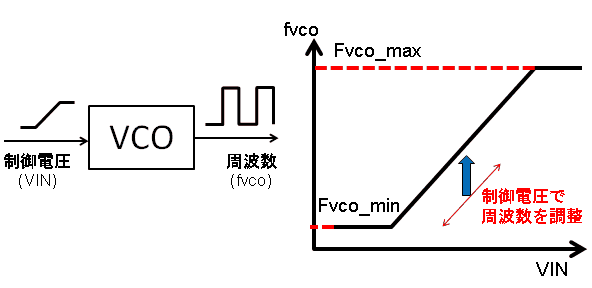
The PLL component VCO controls the output frequency by means of an error signal coming from the PFD/CP through the LPF. The feedback signal is then adjusted to be synchronous with the reference signal. See here for the components of the PLL.
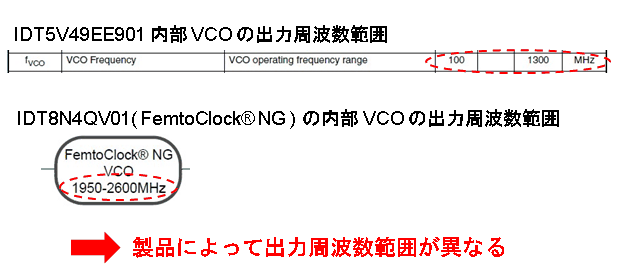
The frequency range that the VCO can output varies. The following shows the output frequency range of the VCO installed in IDT's products.
Type of VCO
VCOs are broadly classified into the following three categories.
・Ring-VCO
・LC-VCO
・VCXO
These VCOs are used differently depending on the application.
Ring-VCO
A Ring-VCO is an oscillation circuit in which an odd number of inverters are connected in a ring shape. Oscillation frequency is controlled using the number of inverter stages and gate delay.
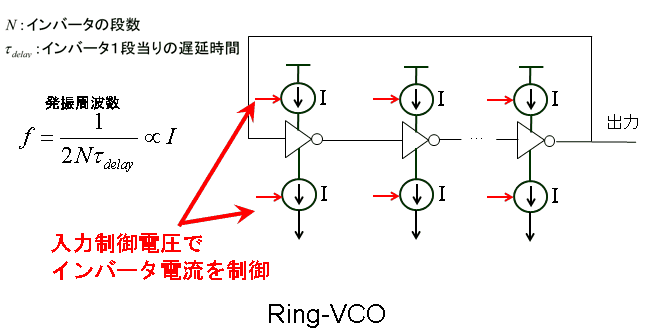
The VCO commonly used in PLLs is the Ring-VCO because of its wide output frequency range.
However, frequency stability is inferior to LC-VCO and VCXO.
As shown in the figure above, the frequency is controlled by the current, but this is because it is affected by power supply noise.
However, low-noise clock generators are used in general PLLs because noise can be suppressed by technology that suppresses the effects of power supply noise and the design of the LPF, and integration is possible.
LC-VCO
An LC oscillator can be oscillated by connecting a coil and a capacitor and satisfying the oscillation conditions. The oscillation conditions are shown below.
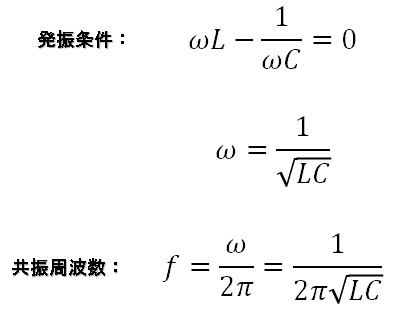
By connecting a varactor to this capacitor, it can be used as a VCO. A varactor is a variable capacitance diode whose capacitance can be varied by voltage.
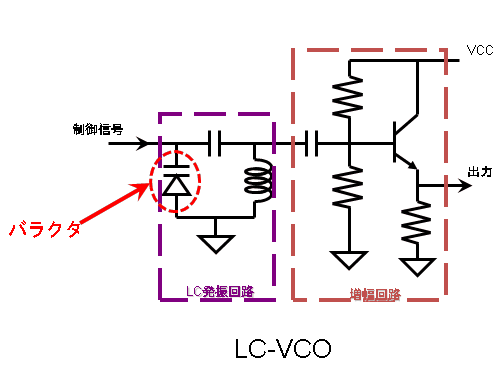
LC-VCOs have lower output phase noise characteristics than Ring-VCOs, so they are used in product PLLs for applications that are sensitive to phase noise.
For example, the Zero Delay Buffer for audio has a PLL with an LC-VCO.
In addition, LC-VCOs are also used in PLLs that require high frequencies because they are capable of high frequency output.
VCXO
The VCXO has a configuration in which the LC-VCO coil is replaced with an XTAL (crystal oscillator).
High frequency stability compared to Ring-VCO / LC-VCO. When used as the VCO of the PLL, even if the REF clock is interrupted, it is possible to output almost constant output.
Although there are such advantages, the disadvantages are that the output frequency range is narrow and the circuit scale is larger than that of the Ring-VCO / LC-VCO.
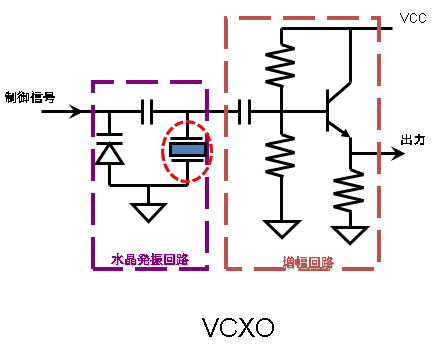
A VCXO-based PLL is used as a Jitter Attenuator.
The jitter attenuator reduces jitter by re-outputting the clock signal with the PLL. However, since the circuit scale of XTAL is large as mentioned above, it may be necessary to attach XTAL externally.
Summary
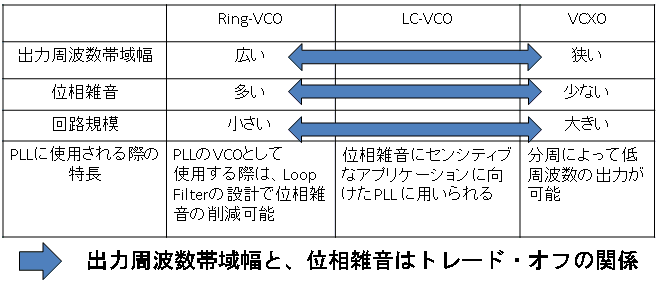
Application reference example
・Ring-VCO: All consumer electronic devices such as media players, digital cameras, and POS terminals
・LC-VCO: Applications that require low phase noise such as audio
・VCXO: Applications with strict Jitter accuracy requirements such as multi-access communication systems
IDT has a wide range of timing products, so different VCOs are used for different applications.
When selecting a timing product that uses a PLL, please refer to this article and pay attention to the VCO as well.