- Semiconductor BusinessHOME
- Products and Services of Macnica,Inc.
-
technical information

-
Events and Seminars
- Handling Manufacturer
- Support
- Inquiry
- Click here to purchase products
- Semiconductor business e-mail magazine registration


 Narrow down by specifying conditions
現在2201件がヒットしています。check

introduction
High-speed optical transceivers also contribute to generative AI technology. However, as optical transceivers become faster, the power consumption of AI training and GPU cloud networks increases. This leads to issues such as power shortages, heat generation, and larger equipment due to cooling mechanisms.
One solution to these issues is Linear Pluggable Optics (LPO), which is currently attracting attention as an energy-saving, high-speed optical transceiver.
This article will introduce you to LPO.
What are Linear Pluggable Optics (LPO)?
Before introducing LPOs, let us first explain how a traditional high-speed optical transceiver works, as shown in Figure 1.
(1) Conventional high-speed optical transceivers process electrical signals sent from the host using a signal processing IC called a DSP inside the optical transceiver. Specifically, the DSP processes electrical signals that have become distorted before they are received, correcting their waveform.
(2) After the signal is processed by the DSP, it undergoes photoelectric conversion and an optical signal is transmitted.
(3) Similarly, after the optical transceiver performs optical-to-electrical conversion on the optical signal it receives, the signal undergoes signal processing in the DSP.
(4) After signal processing, it sends an electrical signal to the host.
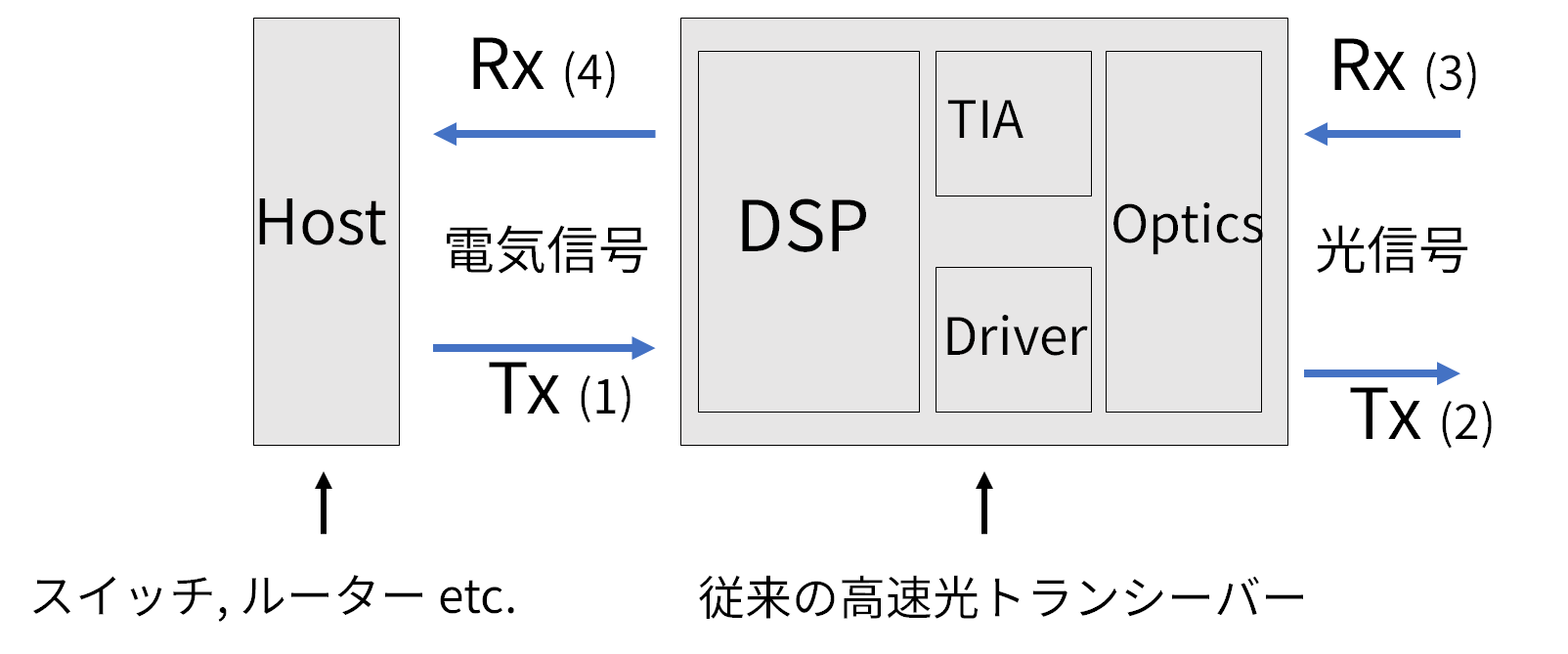
Figure 1
Next, we will explain LPO with reference to Figure 2 below.
First, an LPO does not have a DSP, so it receives an electrical signal from the host, converts it into an optical signal, and then transmits it.
Similarly, the optical signal received by the LPO is converted to an electrical signal and then sent to the host.
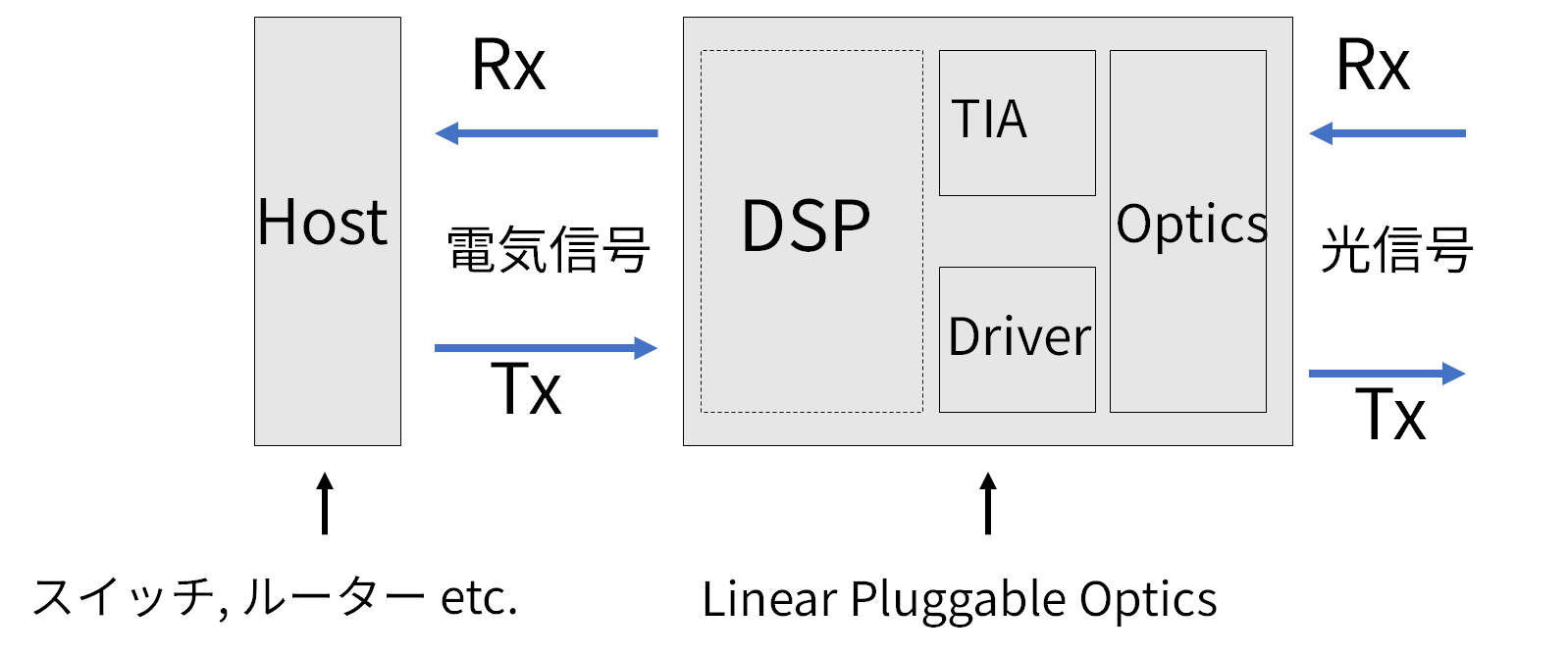
Figure 2
In other words, LPO is an optical transceiver that does not process signals during the optical-electrical conversion. However, without signal processing, it may affect the communication of high-speed signals. Therefore, all signal processing is performed by the host.
That's the introduction to LPO. Next, I'll explain the advantages and disadvantages of LPO.
Advantages of Linear Pluggable Optics
- Low power consumption: Since no signal processing is performed, the power consumption of the signal processing IC is reduced.
- Low heat: Low power consumption means less heat generated by the optical transceiver.
- Low latency: No signal processing required, so there is little latency.
Disadvantages of Linear Pluggable Optics
- Host Dependency and Problem Isolation: If the host's signal processing performance is insufficient, the link quality may be degraded. Also, when a problem occurs, it is difficult to determine whether the cause is the host or the LPO.
- Transmission distance: Since no signal processing is performed, the maximum transmission distance is shorter than that of conventional optical transceivers.
Linear Pluggable Optics Operation Demonstration
We conducted a demonstration of measuring BER using Coherent's 2x400G DR4 LPO (under development) at JANOG55. This article introduces the demonstration.
Used equipment
・2x400G DR4 OSFP LPO
・Dedicated evaluation board (EVB)
- Optical fiber (SMF, MPO12 connector, length 1m)
- PC with dedicated GUI installed
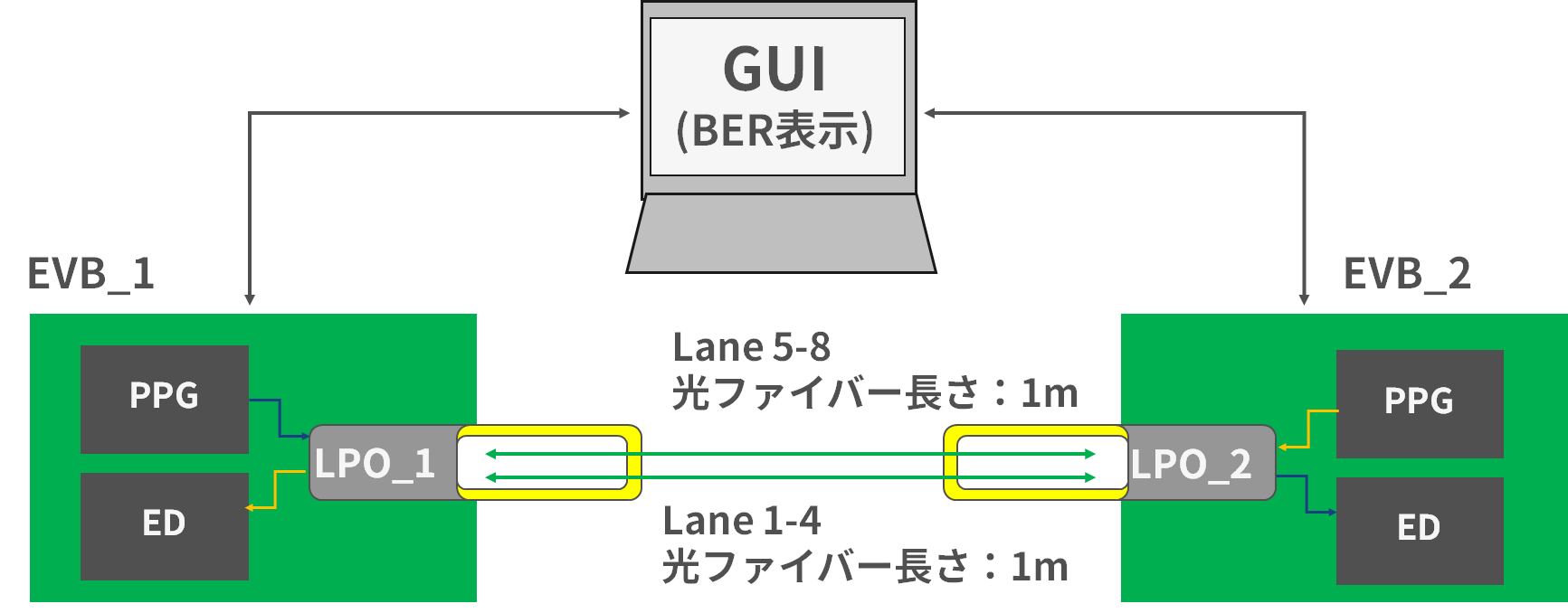
Figure 3
As shown in the diagram above, one LPO is connected to one dedicated evaluation board, and each LPO is connected by optical fiber.
The dedicated evaluation board is equipped with a 100Gbps/lane signal generator (PPG: Pulse Pattern Generator) and a receiver (ED: Error Detector).The Bit Error Rate (BER) was measured using this evaluation board and a dedicated GUI.
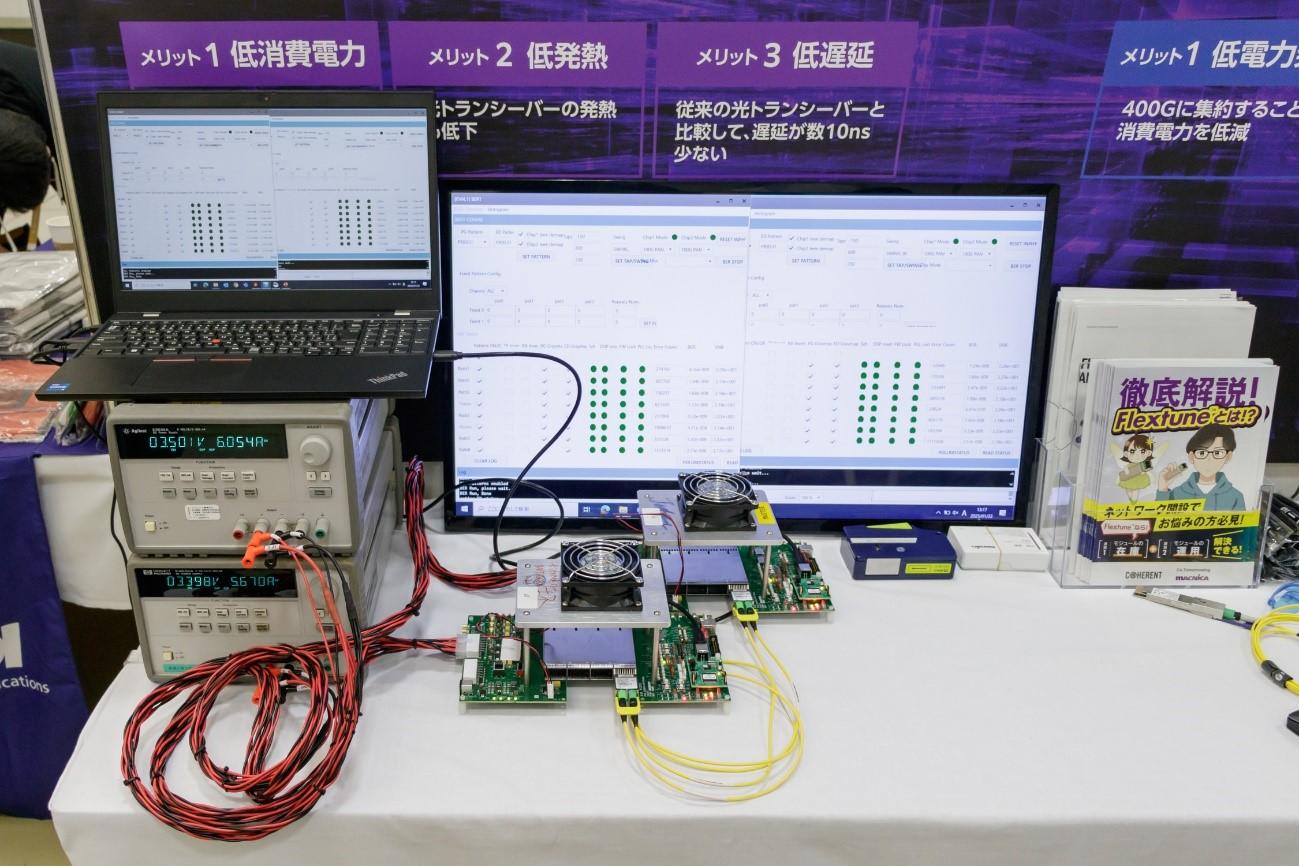
(Actual machine)
The following table shows the BER measurement results. Considering that the FEC limit for FEC applied to high-speed signals of 100 Gbps/lane is 2.4E-4, this BER is considered to have no effect on communications.
|
Ch |
LPO_1 |
LPO_2 |
|
1 |
6.16E-9 |
1.24E-9 |
|
2 |
1.34E-8 |
1.66E-9 |
|
3 |
1.68E-8 |
5.47E-9 |
|
4 |
1.37E-8 |
1.88E-8 |
|
5 |
5.23E-9 |
6.91E-10 |
|
6 |
4.21E-8 |
1.92E-8 |
|
7 |
7.32E-9 |
3.33E-9 |
|
8 |
2.75E-8 |
2.57E-8 |
*PRBS31 test pattern is used
Summary
Linear Pluggable Optics (LPO) is an optical transceiver that features low power consumption, low latency, and low heat generation. Therefore, it is attracting attention as an energy-saving, high-speed optical transceiver in data centers for AI training and GPU cloud.