- Semiconductor BusinessHOME
- Products and Services of Macnica,Inc.
-
technical information

-
Events and Seminars
- Handling Manufacturer
- Support
- Inquiry
- Click here to purchase products
- Semiconductor business e-mail magazine registration


 Narrow down by specifying conditions
現在2158件がヒットしています。check
![Event report in 5 minutes! [Explanation without using formulas] Why digital coherent technology is suitable for long-distance, high-capacity communication](/business/semiconductor/articles/145938_head.png)
I tried to explain it without using formulas as much as possible.
With the rapid increase in network traffic in recent years, the "digital coherent method" is increasingly being adopted for optical communications. However, few people are implementing and operating it with a solid understanding of the principles and the differences between it and conventional methods such as NRZ and PAM4.
With this in mind, this seminar focused on the content of a presentation given by the Company engineers at the JANOG54 BoF and explained in an easy-to-understand manner, using as few mathematical expressions as possible, what kind of technology digital coherent is and why it is suitable for long-distance, large-capacity transmission. This article will provide an overview using materials.
You can watch the video from the day by simply registering, so please check the end of the article.
agenda of the day
|
time |
content |
|
Thursday, August 8, 2024 |
・ JANOG54 @Looking back on Nara ・Why digital coherent technology is suitable for long-distance, high-capacity communications ・ JANOG50@Hakodate presentation - Data rates on the electrical side (host) and optical side (media) Modulation method (transmitter) - Detection method (receiving side) ・Where do I apply FEC? -Video demonstration of 100G DCO operation |
First, understand the technical explanation of 400G-ZR/ZR+
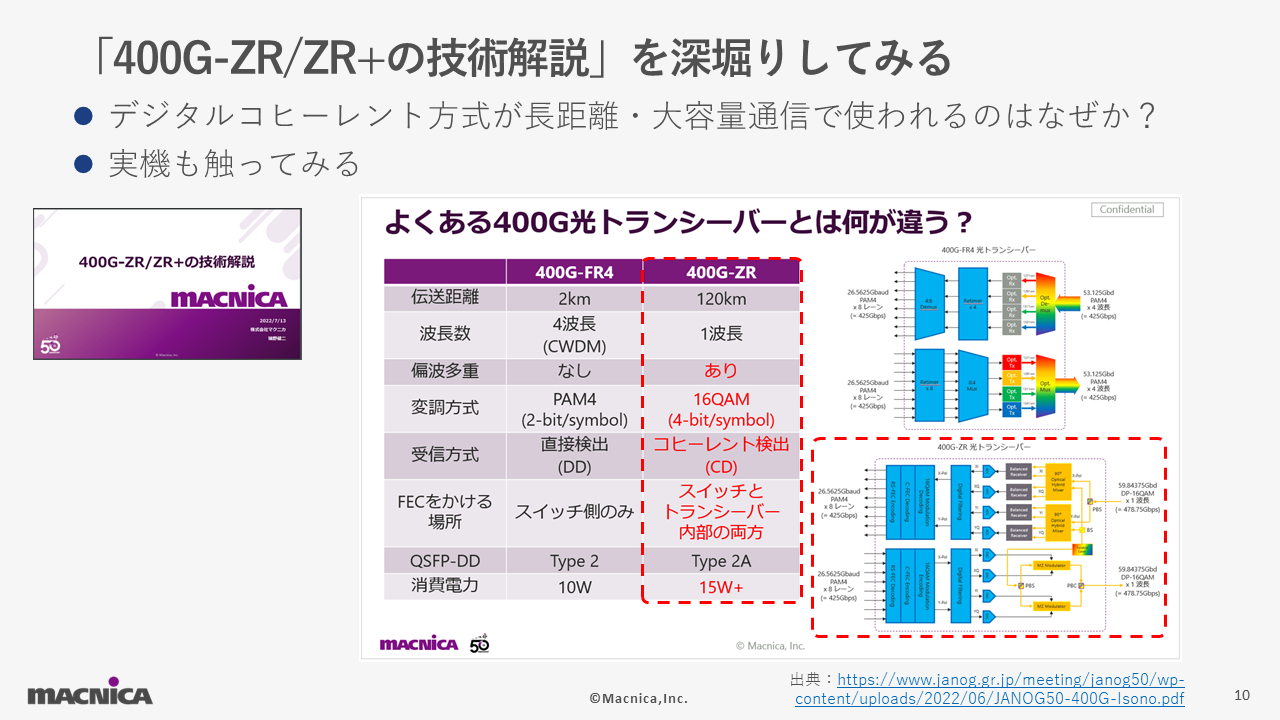
When 400G-ZR/ZR+ first came out, several the Company jointly announced the results of their verification of how to achieve 400G transmission at "JANOG50" held in Hakodate. We provided a technical explanation of the specifications and block diagrams of 400G-ZR/ZR+. The goal of this seminar was to provide a deeper understanding of the content announced in Hakodate.
Electrical and optical data rates
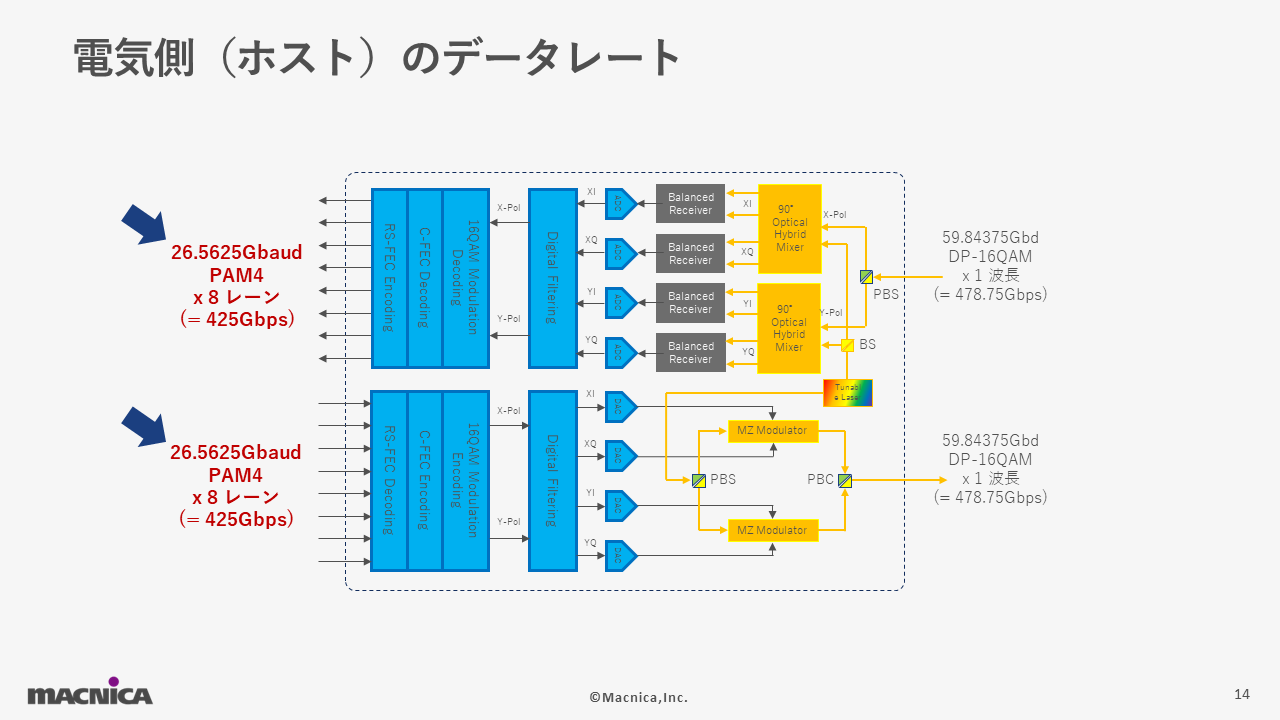
Before introducing digital coherent optics, we have used the block diagram of 400G-ZR/ZR+ to explain why the data rate of electrical signals has increased to 425Gbps while still using 400Gbps communication, and why the data rate of optical signals has increased to 478.75Gbps.
Modulation method (transmitter)
The most basic modulation method for transmitting digital data on an optical signal is called NRZ (Non Return to Zero), which puts the digital signal directly on the optical amplitude. This method is used in a variety of products. The more complex PAM4 (Pulse Amplitude Modulation, 4-level) also puts the digital signal on the optical amplitude, but in a format where two bits are mapped to one signal level. This means that twice the data capacity can be sent even with the same signal repetition period.
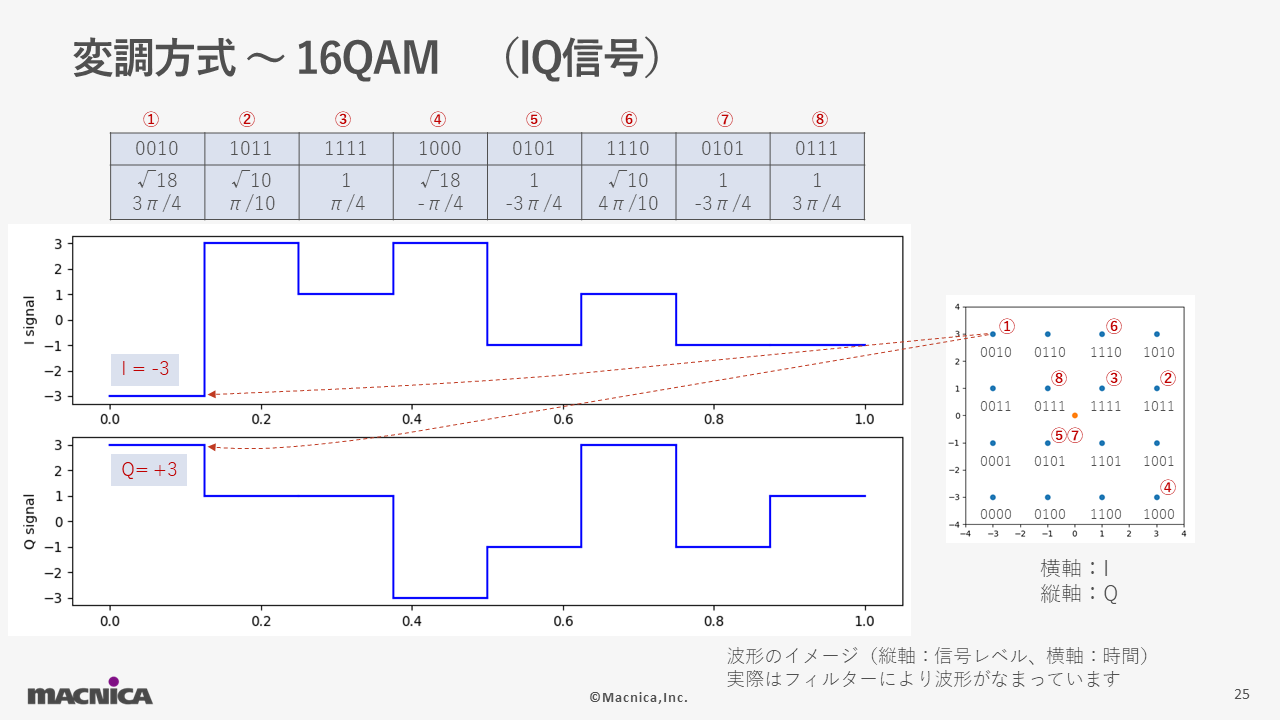
The modulation method used in 400G-ZR/ZR+ is called 16QAM (16 Quadrature Amplitude Modulation), which superimposes the digital signal not only on the amplitude of the light but also on the phase. This modulation method is suitable for large-volume communications that send large amounts of data, as it can increase the bit rate while keeping the baud rate low.
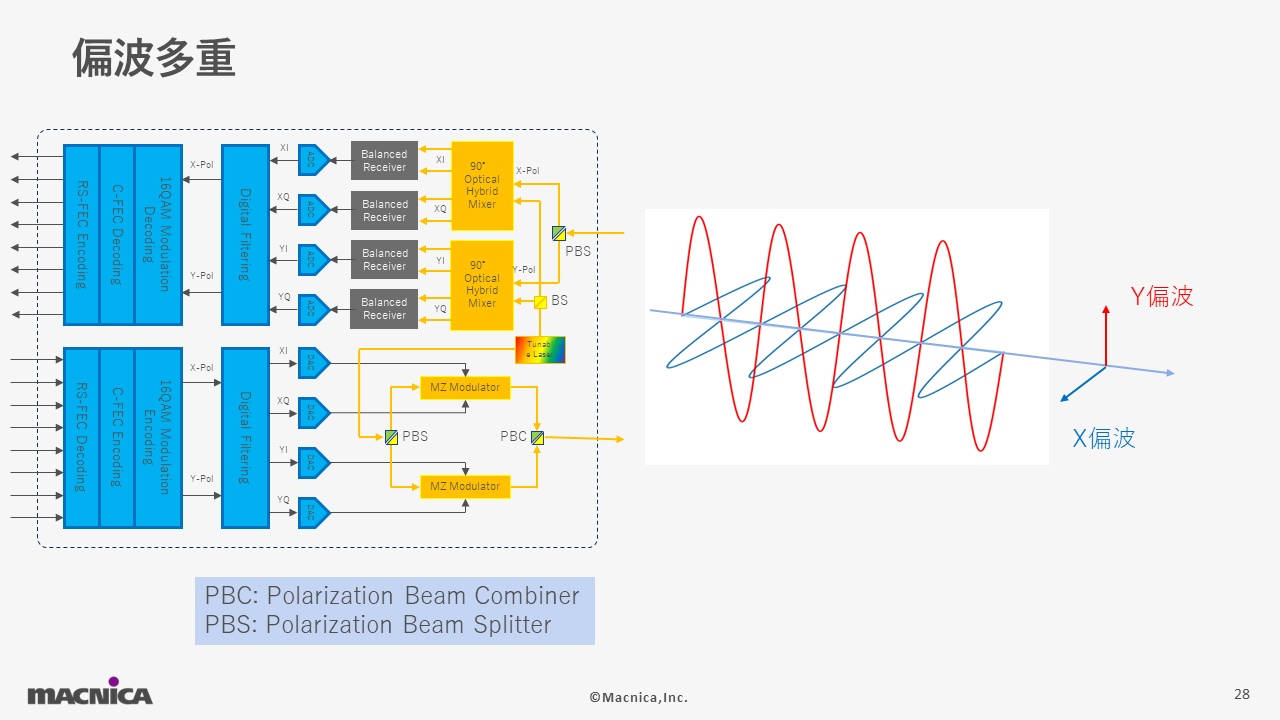
Using multiple diagrams, we explained how modulated signals are created and what I and Q signals are. We also explained "polarized multiplexing technology," a mechanism that allows communication at twice the capacity at one time.
Modulation method (receiving side)
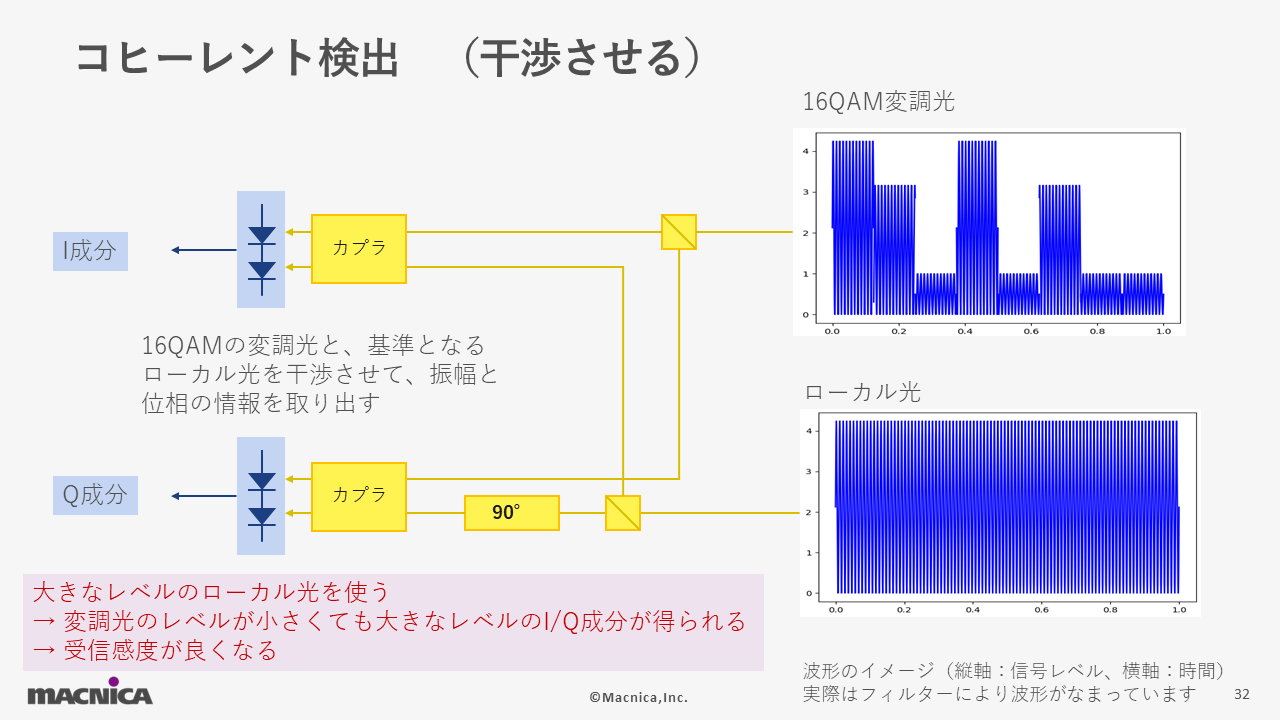
In the explanation on the receiving side, we provided a detailed explanation of how the received optical signal is processed and converted into an electrical signal, as well as how the receiving sensitivity is improved by interfering with local light (coherent detection).
Where do I place the FEC?
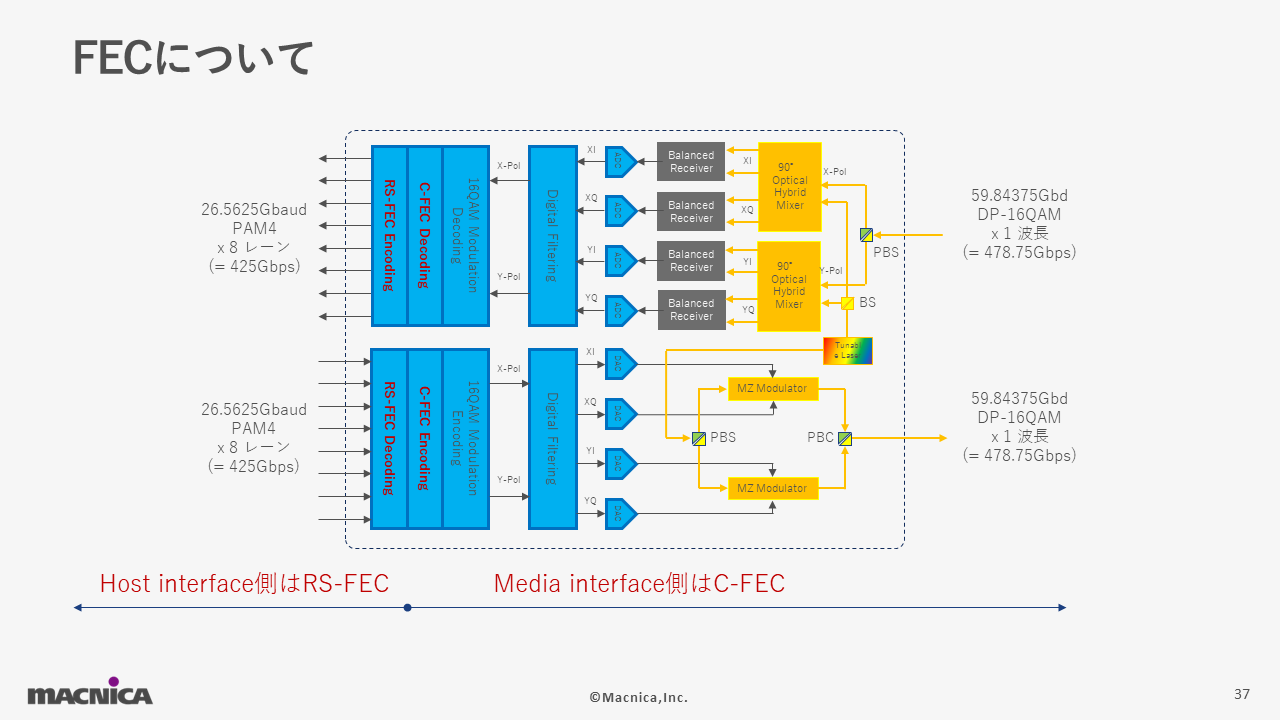
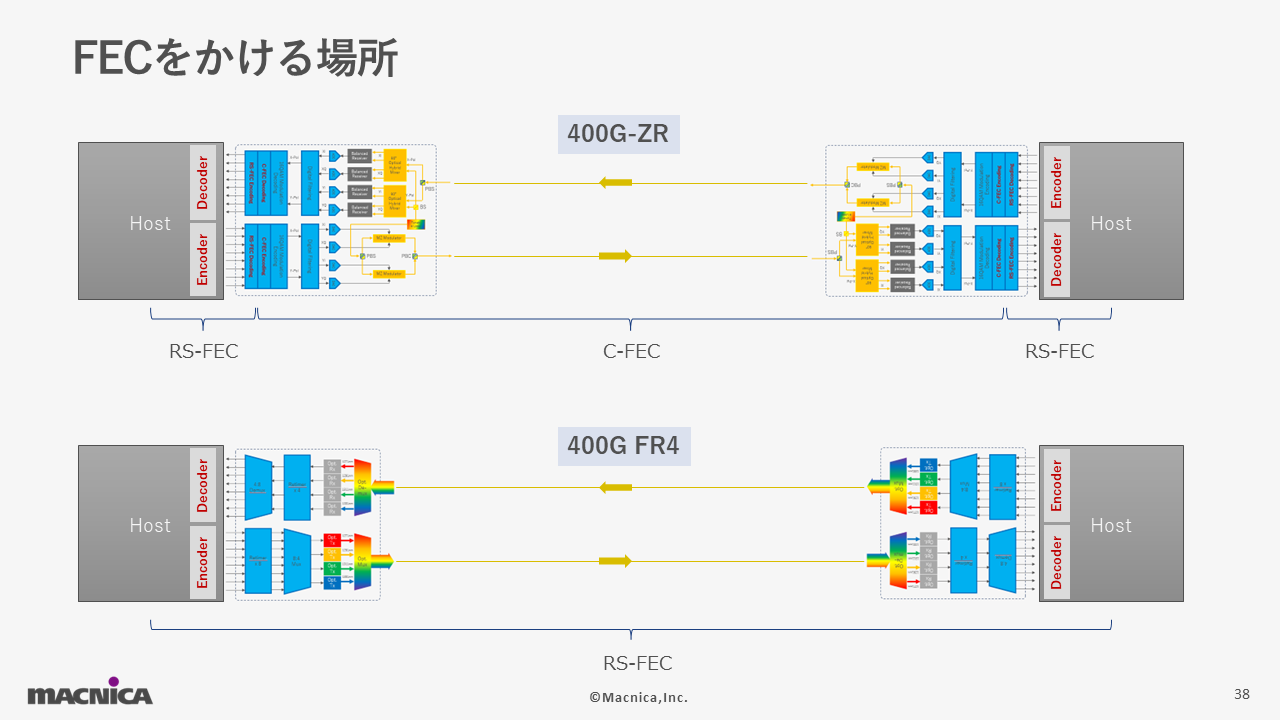
In communications over 400G, RS-FEC is always applied on the host side. Therefore, the electrical signal transmitted by the optical transceiver from the host side is also subjected to RS-FEC. However, in the case of digital coherent optics such as 400G-ZR/ZR+, the host's RS-FEC is temporarily terminated and a separate optical-specific FEC (C-FEC for 400G ZR, O-FEC for 400G ZR+) is applied to apply a stronger FEC. This is thought to contribute to longer distance transmission.
You can view on-demand videos and materials with a simple registration.
So far, we have briefly explained why digital coherent technology is suitable for large-capacity, long-distance transmission.
If you missed this seminar or would like to watch it again, or if you would like to watch a video of the actual machine in operation, please take this opportunity to register using the form below.
Please also check this
Click here for quotes and inquiries