- Semiconductor BusinessHOME
- Products and Services of Macnica,Inc.
-
technical information

-
Events and Seminars
- Handling Manufacturer
- Support
- Inquiry
- Click here to purchase products
- Semiconductor business e-mail magazine registration


 Narrow down by specifying conditions
現在2247件がヒットしています。check

Explaining basic knowledge of 400G/800G standards that will be useful when considering implementation
Among the various components that make up optical transmission networks, optical transceiver modules and optical connectors have evolved significantly and a wide variety of standards have been created. In order to make the appropriate selection from the numerous standards, it is essential to gain a deeper understanding of optical transceiver modules and optical connectors and acquire the knowledge to make the right selection.
At the seminar held on November 8, 2023, we explained the standards and latest trends of 400/800G optical transceiver modules and optical connectors, which are expected to become more widespread in the future.
This article will be a report of the event, and will introduce some of the content introduced at the seminar. At the end of the article, we have provided an on-demand video of the seminar and the materials presented on the day, so please take a look.

agenda of the day
|
time |
content |
|
2023/11/8(Wed) |
・The latest trends in optical transceiver standards and the optical connectors used (Senko Advance Co., Ltd.) |
Changes in the optical communications industry

The first half of the session was explained by Mr. Takahashi of Senko Advance Co., Ltd.
With the rapid increase in data traffic, hyperscale data center operators have been replacing traditional metal wiring with optical wiring since the mid-2010s, supporting the growth of the industry. Meeting wireless demand is also important. For example, 5G, which began in the late 2010s, requires a large amount of optical fiber to connect cell sites. Furthermore, in 2020, the pandemic caused a major change in lifestyle, and the emergence of generative AI such as ChatGPT caused an explosion in data volume, dramatically changing the face of the optical communications industry.
The emergence of new optical connector interfaces
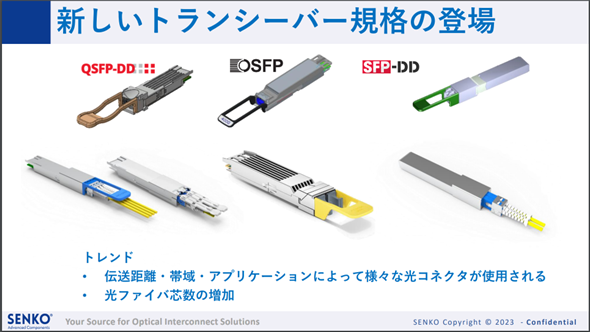
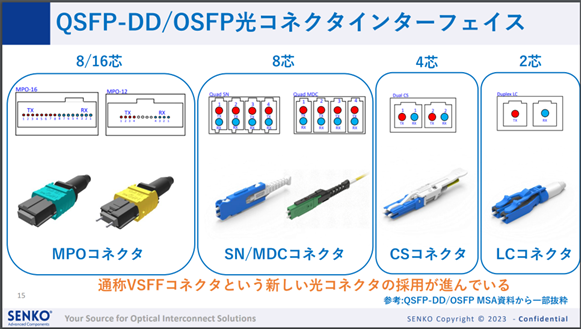
As new standards for optical transceiver modules are released to accommodate the need for wider bandwidth and larger capacity, new optical connector interfaces are emerging. In addition to MPO and LC connectors, the latest VSFF (Very Small Form Factor) connectors have been increasingly adopted as their successors in recent years for QSFP-DD/OSFP optical connector interfaces.
Size and operability of VSFF connectors
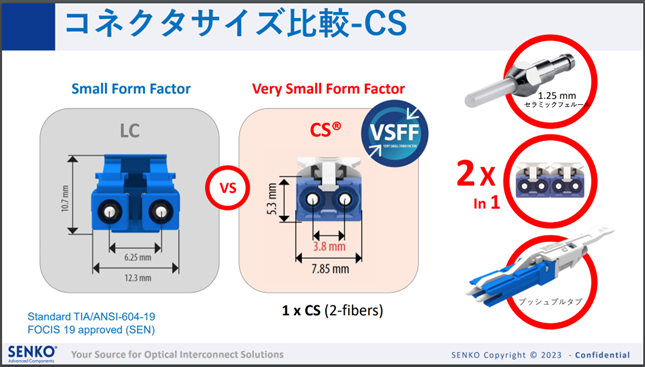
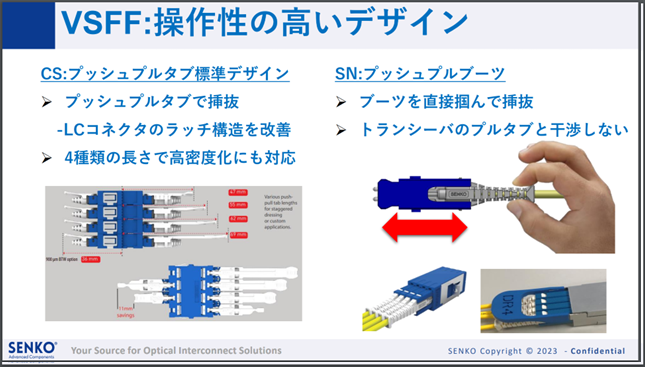
As an example, the CS connector, which is 40% smaller than the LC connector, has almost the same mechanical and optical characteristics, and the push-pull tab allows for easy insertion and removal. Other connectors such as SN and SN-MT are also explained in detail while showing the actual devices on camera.
Optical Transceiver Module Standards

The second half of the presentation was given by Mitamura from Macnica
There are two types of optical transceiver modules: form factor standards and optical transmission standards. The mechanical elements and electrical interfaces differ depending on the form factor standard, while the transmission distance and optical interfaces such as optical fibers and connectors differ depending on the optical transmission standard.
Form factor standards (QSFP-DD/OSFP and QSFP112)
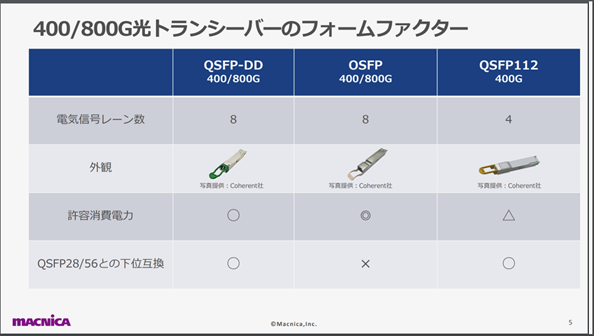
We introduced the features and electrical characteristics of each form factor, QSFP-DD/OSFP (compatible with 400G/800G) and QSFP112 (compatible with 400G), and also touched on points to note when selecting one.
- OSFP is not backward compatible with QSFP28/56 (supports 100/200G), so a conversion adapter is required.
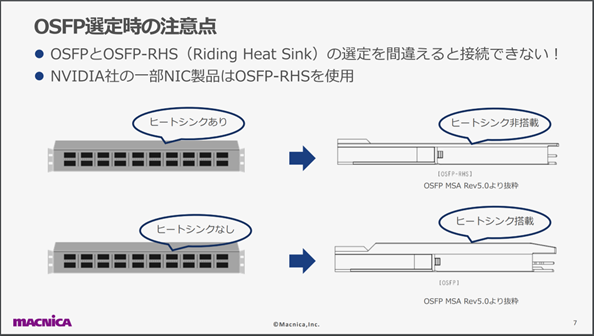
・There are two types of OSFP: OSFP (optical transceiver with heat sink) and OSFP-RHS (optical transceiver without heat sink). Therefore, it is necessary to select OSFP or OSFP-RHS according to the port of the host device.
Optical transmission standards (400G/800G)
We have carefully selected and explained key points to help you understand the basics of the representative 400G/800G optical transmission standards, such as transmission distance, number of transmitting and receiving lanes, number of data rates, and compatible connectors.
・400GBASE-SR8
・400GBASE-DR4/DR4+/4x100-LR
・400G-FR4/LR4
・400G-ZR/ZR+
・800G-DR8
・800G-2x400G SR4/DR4
・800G-2x400G FR4
The following two articles provide more information about each standard. Please click on the images to check them out.


You can view on-demand videos and materials with a simple registration.
This article provides an overview of the standards and latest trends of 400/800G optical transceiver modules and optical connectors.
The on-demand videos and materials can be kept as a keepsake and used as reference for future selections, so if you missed them or were a participant and would like to review them, please take this opportunity to register using the form below and refer to them.
Click here for quotes and inquiries