- Semiconductor BusinessHOME
- Products and Services of Macnica,Inc.
-
technical information

-
Events and Seminars
- Handling Manufacturer
- Support
- Inquiry
- Click here to purchase products
- Semiconductor business e-mail magazine registration


 Narrow down by specifying conditions
現在2240件がヒットしています。check
Introduction
As electronic systems and applications become more interdependent, overcurrent faults must be quickly isolated to prevent damage to adjacent circuits and systems. At the same time, nuisance trips due to ambient temperature, inrush current or other events that do not pose a risk to the system must be minimized to ensure integrated systems remain online. Connected, next-generation applications such as IoT and smart sensor-based designs are particularly vulnerable to overcurrent events that lead to the failure of one or more devices, potentially reducing network reliability.
Many of these highly integrated and interdependent applications are systems that operate in harsh environments, making circuit protection a critical part of these designs to maintain reliability. A prime example is the integrated electronics in automotive designs, which are exposed to wide temperature variations, shock and vibration, humidity, and other adverse conditions. Stringent automotive reliability standards for new automotive applications such as engine control, battery management systems (BMS), comfort / convenience features, and infotainment require overcurrent protection to meet these specifications.
New surface mount (SMD) fuse technology advancements are helping to address the growing need for effective overcurrent protection in a wide range of applications that must operate in harsh environmental conditions. In particular, new AEC-200 equivalent compliant fuses offer designers robust performance and features that provide next-level performance and operation in high-stress applications.
Where Automotive Grade Fuses Come Into Efficiency
Automotive designs incorporate more electronic components than ever before. With the rapid growth predicted in the electric vehicle (EV) market, circuit protection solutions must evolve to meet the increasing dynamic design requirements. According to research firm Research and Markets, the global hybrid and electric vehicle fuse market is projected to grow at a CAGR of over 23% between 2018 and 2022. One of the major factors influencing this market growth is the increasing number of electronic components used in hybrid and electric vehicles and a corresponding increase in the number of potential failure conditions. As electrification of the automotive sector increases, so too will the need for reliable automotive-grade fuses.
The increase in possible fault conditions in today's electrified vehicle applications is driving designers of high energy storage systems to look for circuit protection components that can protect multiple elements of their design. Within a BMS, overcurrent protection is required for the master control power input, slave control monitor lines, cell balancing lines, and battery modules and connection boards.
Many designs rely on resettable devices to protect against overcurrent threats caused by momentary fault conditions. To protect against fault currents that could cause significant circuit or system damage, non-resettable fuses are a good choice. With the trend towards making all embedded electronics smaller while adding more functionality, there is an increasing demand for space-saving SMD fuses that can be easily mounted on PCBs.
Protected by Design
Fuses, such as Bourns® SingleFuse™ SMD fuses, protect loads based on the current flowing through the fuse. The fuse trips when it exceeds its rated parameters. As a single blow fuse, Bourns® SingleFuse™ SMD fuses result in a true open circuit when the device trips, preventing current from flowing to downstream components on the other side of the surge.
The SingleFuse™ SF-0603SA-M, SF-0603HIA-M, SF-1206SA-M and SF-1206HIA-M families are developed using Bourns' advanced multi-layer ceramic designs to provide enhanced voltage and current handling capabilities. Offered in small 0603 and 1206 package sizes, these models feature high inrush current withstand and slow-blow fusing speeds.
SMD fuse construction is critical to ensure the device will withstand surges within its rated specifications. Using Bourns' innovative PCB wire core, metal foil and ceramic multi-layer designs, the latest AEC-200 equivalent compliant model family provides increased voltage and current handling capabilities and more precise hot spot control along the fuse element. They also offer better arcing suppression and inrush current tolerance compared to traditional ceramic tube fuse designs, as well as better structural integrity when blown. Additionally, precise fuse characteristics facilitate customization, allowing designers to meet application-specific fuse requirements.
Selecting the Right Fuse
Since start-up pulses are common in automotive applications, designers typically specify fuses for automotive designs based on inrush current withstand requirements. Most designs require fuses with enhanced inrush current withstand capability, which enables the fuse to withstand inrush conditions without nuisance tripping and protect against unwanted overcurrent conditions. It is also important to consider the expected duration of the condition when specifying the fuse type.
Current and voltage ratings, as well as blow speed, are also important considerations when selecting an automotive grade fuse. Bourns' automotive grade SMD fuse portfolio currently offers a wide range of current ratings from 0.5A to 20A and voltage ratings from 24V to 250V. Available package sizes currently range from EIA2410 to 0603 with four different blow speed options including fast acting, fast acting precision, slow blow and high inrush withstand.
It is important not to use slow-blow fuses as a replacement where a fast-acting fuse is specified, as slow-blow fuses may not open quickly enough to protect sensitive electronics from an overcurrent condition.
Product safety standards such as UL require overcurrent protection for battery-powered equipment and associated chargers and power sources. By providing secondary overcurrent protection, SinglFuse™ SMD fuses offer many benefits to many consumer electronics products.
Bourns® SinglFuse™ is AEC-200 equivalent compliant, making it the ideal protection solution for certain harsh environment applications. The new seven model families are fully compliant with Bourns in-house AEC-Q200 equivalent test procedures, ensuring robust performance in a variety of high stress applications.
What is Automotive Grade?
Designed and developed to meet specific standards, Bourns Automotive Grade Standard Components are manufactured in fully IATF16949 certified facilities and must be tested and qualified using AEC-Q product validation criteria for passive components and presented to customers for selection and approval using the PPAP.
Conforms to the most current applicable AEC-Q200, AEC-Q101 or AEC-Q102 product validation standards, or equivalent standards as determined by Bourns
Note: AEC-Q200 compliant testing of one-time SMD fuses is still in development. However, Bourns has developed a number of standardized test procedures to meet stringent automotive design specifications.
Bourns has developed what it believes to be a comparable testing procedure for its fuse products.
New product and process developments meet or exceed the requirements established in the latest revised AIAG Advanced Product Quality Planning (APQP) process.
Bourns' design review process ensures that Bourns® standard components meet or exceed the requirements of the APQP process.
Available when reviewed by Bourns quality and design engineering teams
Manufacturing facility VDA6.3 process audit score above 80% with no downgrades
・ The manufacturing site must be IATF16949 certified.
Application example
The following application examples show how designers can use Bourns® SingleFuse™ SMD fuses with various voltage ratings, current ratings and fusing speeds to meet specific protection requirements.
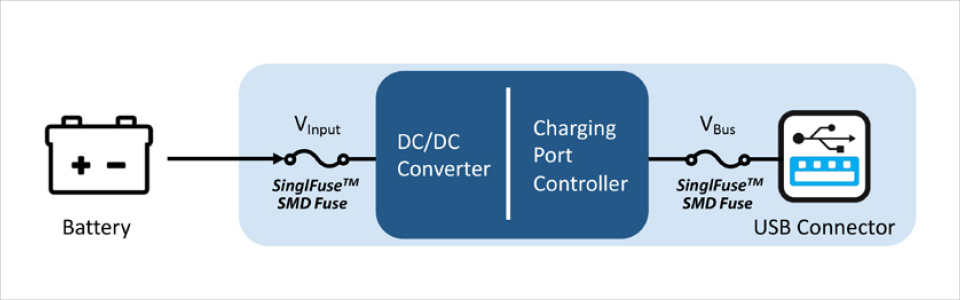
USB I/O port
Designed to provide the optimum voltage and current ratings for automotive systems using DC/DC converters such as 48V -12V, Bourns® SingleFuse™ provides the fusing speed required for USB I/O port protection.
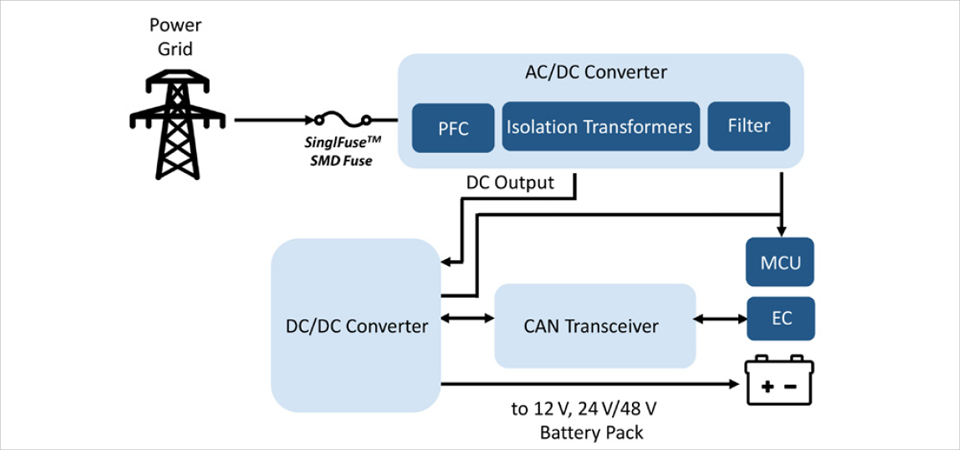
On-board charger
In On-Board Charger (OBC) applications, SinglFuse™ SMD fuses can be used as primary overcurrent protection between the power grid and the DC-DC converter.
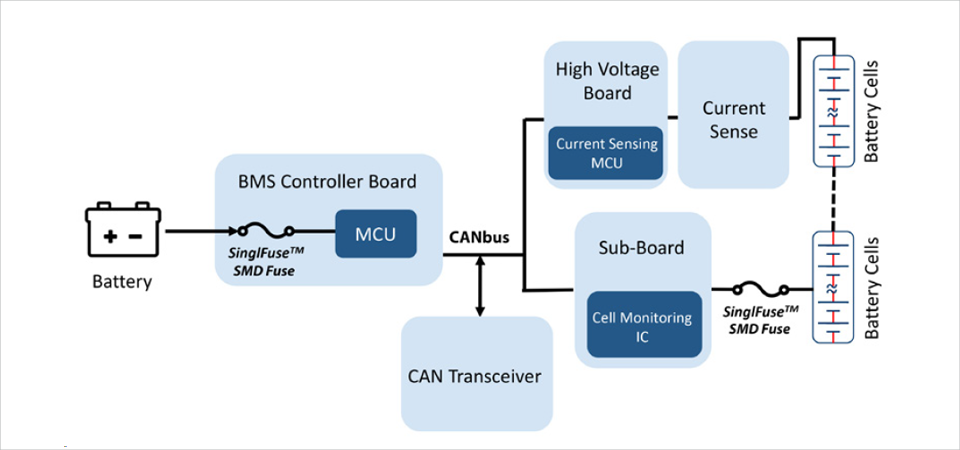
Battery Management System (BMS)
In battery management systems, SinglFuse™ SMD fuses can be used for both the BMS controller board primary overcurrent protection and the battery cell overcurrent protection.
Designers are encouraged to test all components, including SinglFuse™ SMD fuses and other overcurrent protection devices, to ensure proper performance in their particular application.
More than just a battery system
With these new automotive-grade fuses, Bourns continues to expand its SinglFuse™ SMD fuse portfolio to address the growing need for effective circuit protection in a variety of battery system applications. With their robust design and wide temperature range operation, Bourns' latest automotive-grade fuses are also suitable for a wide variety of applications including communications and networking equipment, PCs and monitors, server farms, portable memory, portable electronics, gaming systems, robotics, smart appliances and industrial controllers.
In addition to the automotive grade fuses featured in this article, Bourns continues to expand its portfolio of fuse technologies allowing designers to select the right fuse for their application.
Recommended related articles
- Bourns® SF-0603HIA-M Series *Redirects to manufacturer's website.
- Bourns® SF-1206SA-M Series *Redirects to manufacturer's website.
- Bourns® SF-1206HIA-M Series *Redirects to manufacturer's website.
- Bourns@ SF-1206SA-R Series *Redirects to manufacturer's website.
- Bourns® SF-1206SA-W Series *Redirects to manufacturer's website.
- Bourns® SF-2410FPA-W Series *Redirects to manufacturer's website.
- Bourns® SF-2410FA-W Series *Redirects to manufacturer's website.
Inquiry
If you have any questions regarding this article, please contact us below.
Bourns Manufacturer Information Top
If you would like to return to the Bourns Manufacturer Information top page, please click below.