- Semiconductor BusinessHOME
- Products and Services of Macnica,Inc.
-
technical information

-
Events and Seminars
- Handling Manufacturer
- Support
- Inquiry
- Click here to purchase products
- Semiconductor business e-mail magazine registration


 Narrow down by specifying conditions
現在2189件がヒットしています。check

When sampling an analog signal, we need to reject frequencies higher than half the sampling frequency.
Bessel filters are used for this purpose.
I will explain the Bessel filter in two parts, comparing it with other filter types.
The figures are numbered 1 and 2 consecutively.
See below.
Folding noise (alias) in FFT
For this purpose, a Bessel low-pass filter (LPF: Low-Pass Filter) is used.
A low-pass filter allows frequencies below a set frequency to pass and blocks frequencies above it. The set frequency is called the cutoff frequency, the frequency range to be passed is called the passband, and the frequency range to be cut off is called the cutoff frequency.
Ideally, the passband has zero attenuation and the cutoff band has infinite attenuation, but in reality, frequencies above the boundary are attenuated with a slope of, for example, 12dB (decibel) or 24dB when the frequency is doubled. increase. This attenuation characteristic is called roll-off characteristic.
The value of this roll-off characteristic is -6 dB per stage of the filter. [Footnote 1]
Doubling the frequency is called an octave (or octave), so it is written like -6dB/oct. If it is 6 stages, it will be -36dB/oct. Octaves are also often used as musical eighth intervals (e.g. lower "do" to upper "do"). oct comes from the Latin octo(8).
-6dB/oct is -20dB/dec if you consider 10 times the frequency instead of 2 times the frequency.
dec represents 10 in decade.
In addition to the low-pass type, filters can be classified into high-pass type (HPF: High-Pass Filter), band-pass type (BPF: Band-Pass Filter), and band-stop type (BEF: Band-Elimination Filter). increase.
In addition, there is also an all-pass filter (APF: All-Pass Filter) that controls the group delay characteristics [footnote 2].
If we classify filters according to their characteristics, there are Bessel filters, Butterworth filters, Chebyshev filters, and so on.
The differences in their characteristics are flatness of the passband, attenuation characteristics, and group delay, and there are applications according to their characteristics.
Bessel has the flattest passband, while Chebyshev has a ripple in the passband.
The damping characteristic is steepest for Chebyshev and slowest for Bessel.
The group delay is flattest for Bessel and most disordered for Chebyshev.
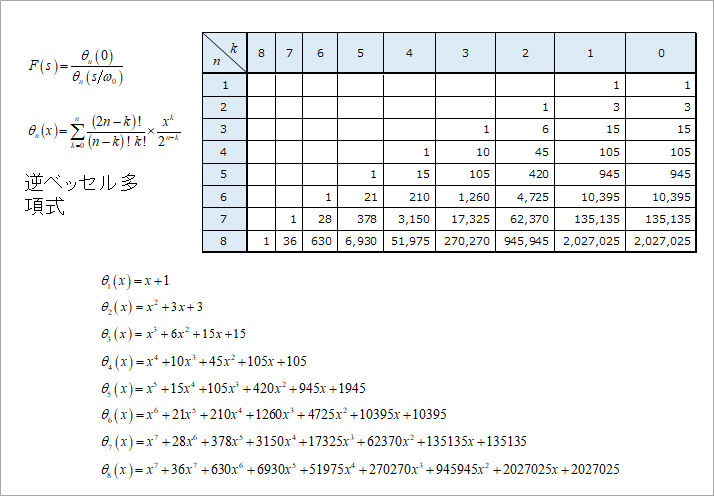
The Bessel filter transfer function is shown at F(s) in Figure 1. θn is the inverse Bessel polynomial, shown in Figure 1 for n=1 to 8. The table in the figure organizes the coefficients of each polynomial.
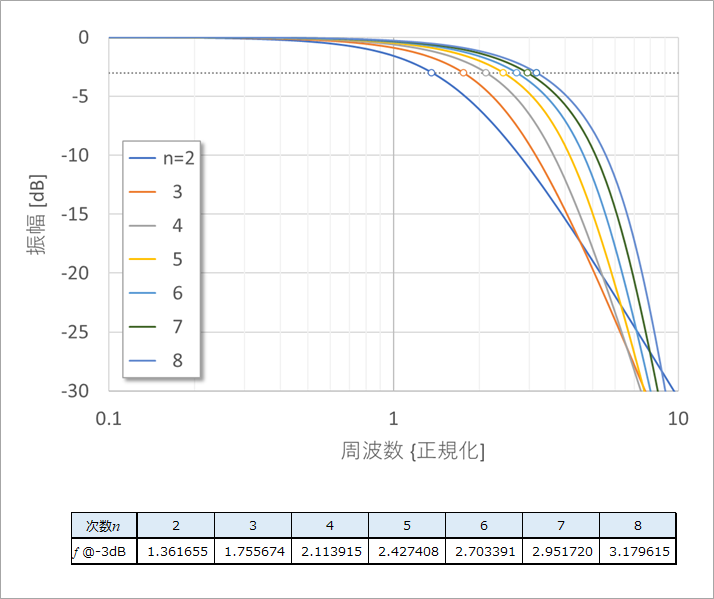
If the frequency characteristic is obtained with F(s) in Fig. 1, the -3 dB point will not be the normalized frequency as shown in the table in Fig. 2. For example, in the orange characteristic with n=3, the -3dB point (normalized frequency) is 1.76.
Therefore, the frequency should be divided by the values in this table.
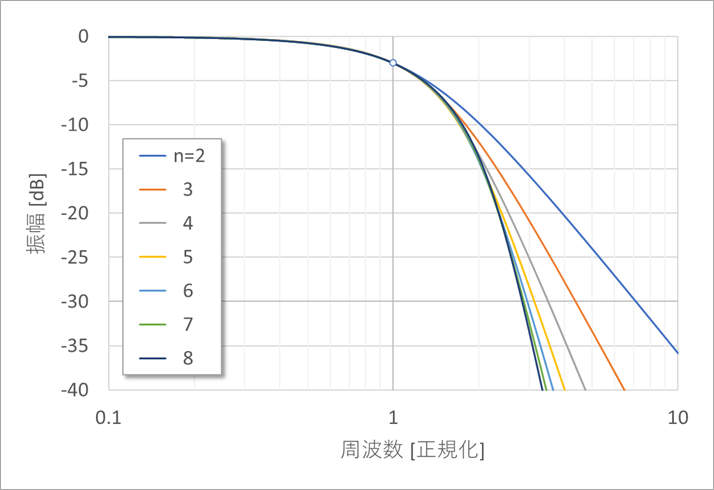
Figure 3 shows the frequency characteristics when the frequency is divided by the values in the table of Figure 2.
Below, the characteristics of the Bessel filter are based on this figure.
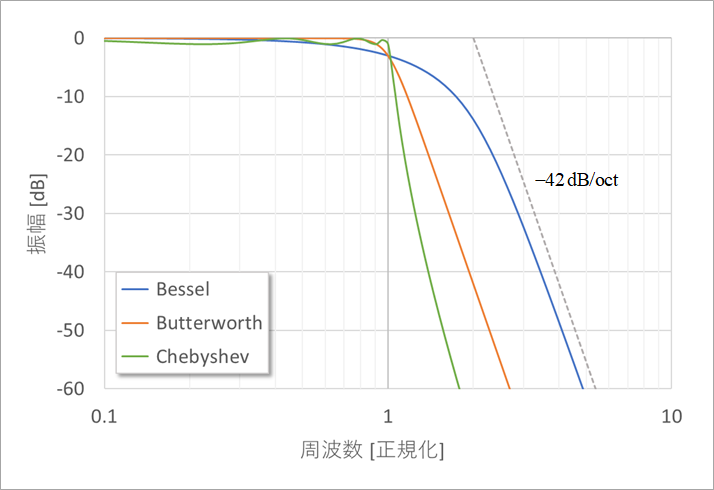
Figure 4 compares the attenuation characteristics of the three filters. The order of the filter is 7 and the roll-off characteristic is -42dB/oct. The cutoff frequency is normalized to 1. The Chebyshev ripple in this case is assumed to be 1 dB.
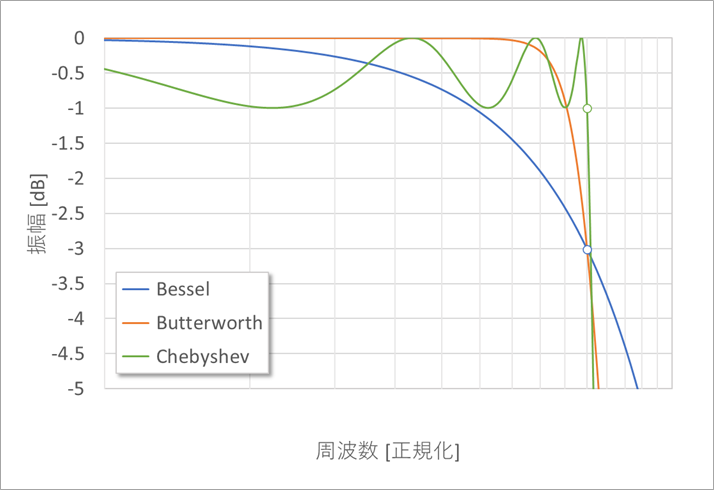
Figure 5 is an enlarged view of Figure 4 from the passband to near the cutoff frequency.
The characteristics of each filter described above are well represented.
The attenuation of the Bessel and Butterworth cutoff frequencies is -3dB [footnote 3].
Chebyshev is the negative value of the ripple, which in this case is -1dB. [Footnote 4]
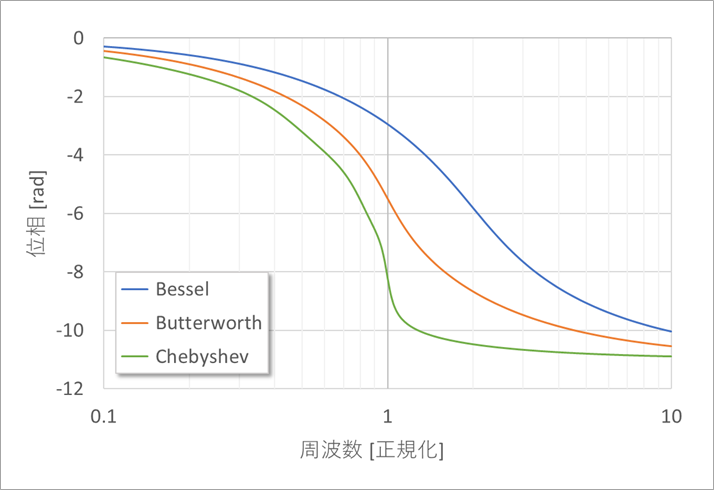
Figure 6 shows the phase characteristics of each filter. Bessel changes slowly, Chebyshev changes steeply.
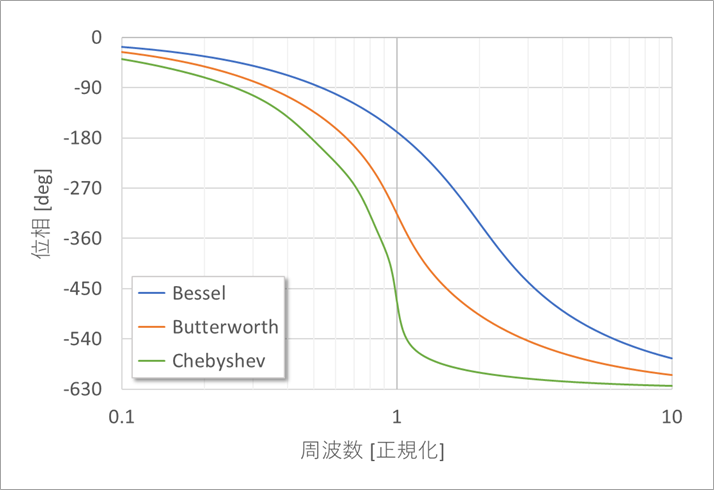
Figure 7 shows the phase in degrees.
The maximum change is -90 degrees for each order of 1, so for the 7th order, it changes to -630 degrees.
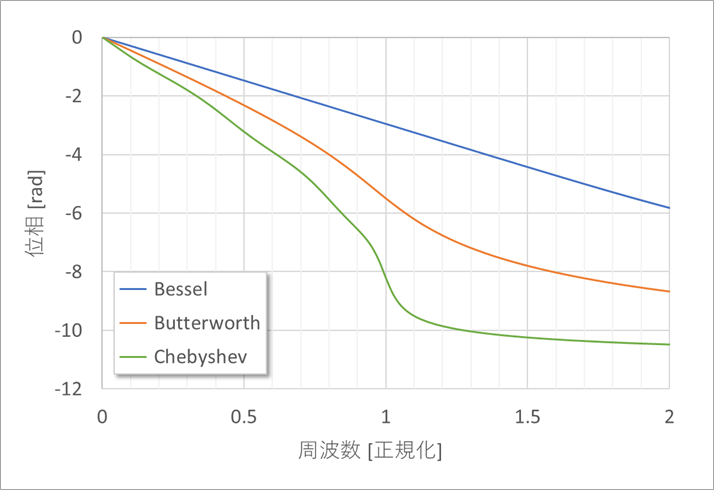
The frequency characteristic is usually expressed logarithmically on the horizontal axis.
Here, to see the linearity of the phase, if we linearly represent the frequency axis as shown in Fig. 8, we can see that Bessel varies linearly with frequency.
This column focuses on signal integrity.
The signals to be handled are mainly pulse waveforms.
To faithfully transmit a pulse waveform, the amplitude characteristic should be as flat as possible, extending to higher frequencies, and the phase should be as linear as possible with frequency.
A measure called group delay is used to evaluate this waveform distortion.
As mentioned in footnote 2, it is expressed as the derivative of phase with respect to angular frequency.
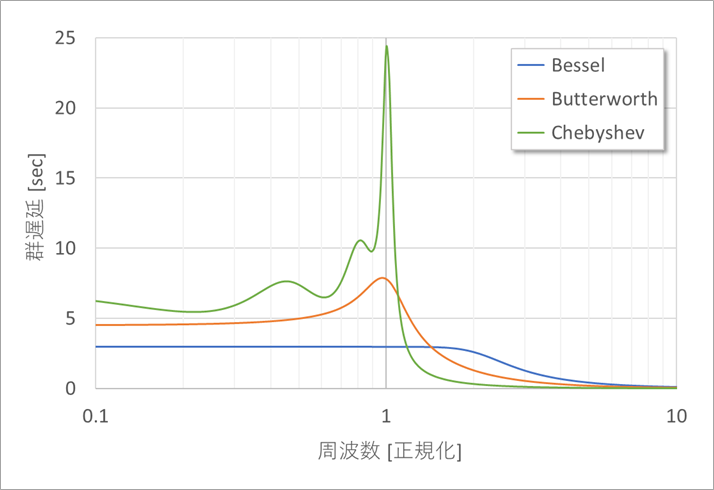
Figure 9 shows the group delay characteristics.
Non-Bessel filters vary greatly in group delay, but Bessel is nearly constant in the passband.
In this article, we have focused on the principle of the Bessel filter.
Next time, I will explain how the signal waveform changes when passing through this filter.
Footnote 1
-6dB is exactly 20log(1/2)=-6.0206.
Usually when we express something like -6dB/oct, we don't usually use decimal places because we want to know it's a multiple of 6.
Footnote 2
Group delay (GD) is the delay characteristic of a waveform. It is an index that expresses the linearity of the phase φ. It is obtained by differentiating the phase difference between the input and output with respect to the angular frequency ω. i.e.
GD=-dφ/dω.
Footnote 3
-3dB is exactly 20log(√1/2)=-3.0103.
Since this is also used as 3 dB down, it is not usually used after the decimal point.
Footnote 4
There seems to be various definitions of Chebyshev's cutoff frequency gain. As with other filters, if the order of the filter is -3dB, or if the order of the filter is even, if the Chebyshev cutoff frequency is -1dB, the DC gain will be -1dB. For example, set the cutoff frequency gain to 0 dB. Since this article focuses on Bessel, I will limit myself to this.
What is Yuzo Usui's Specialist Column?
It is a series of columns that start from the basics, include themes that you can't hear anymore, themes for beginners, and also a slightly advanced level, all will be described in as easy-to-understand terms as possible.
Maybe there are other themes that interest you!