- Semiconductor BusinessHOME
- Products and Services of Macnica,Inc.
-
technical information

-
Events and Seminars
- Handling Manufacturer
- Support
- Inquiry
- Click here to purchase products
- Semiconductor business e-mail magazine registration


 Narrow down by specifying conditions
現在2213件がヒットしています。check
A sensor-over-Ethernet platform that enables high-precision sensor synchronization and high-speed data transfer.
Holoscan is a platform that enables low-latency AI inference while accurately synchronizing streaming data from multiple sensors in edge environments.
This significantly streamlines the development and deployment of edge AI pipelines that require ultra-low latency in milliseconds, such as those used in medical devices, industrial testing, robotics, and broadcasting.
And the HSB (Holoscan Sensor Bridge) plays a crucial role as the sensor connection base for Holoscan.
HSB is a sensor-over-Ethernet platform that synchronizes data acquired from various sensors with high precision and transfers it to the GPU with low latency via high-speed Ethernet.
In Holoscan, which supports Physical AI, HSB plays a crucial role in connecting sensors and GPUs.
The Importance of Sensor Synchronization in Physical AI
In fields such as robotics, autonomous mobile robots (AMRs), medical devices, and industrial inspection equipment, efforts are accelerating toward realizing Physical AI, where AI perceives the real world and makes autonomous decisions and takes action.
Physical AI systems need to process data acquired from various sensors, such as cameras, LiDAR, radar, and IMUs, in real time to accurately perceive their surroundings.
What becomes important at this stage is "sensor synchronization," which precisely synchronizes the time of multiple sensors.
For example, when an autonomous mobile robot recognizes obstacles in its surroundings, if the camera images and LiDAR data are from different time points, it can lead to recognition errors or misjudgments. By ensuring that all sensors capture the same moment, high-precision sensor fusion, improved safety, and more accurate environmental recognition become possible.
Furthermore, in Physical AI, multimodal processing, which integrates and analyzes data from multiple types of sensors, is crucial. AI learns the correlations between different types of data, enabling it to identify signs and factors that are difficult for humans to detect. By simultaneously analyzing different types of data such as electric current, vibration, temperature, images, and sound, it can go beyond simple anomaly detection and even estimate the causes and root causes of anomalies.
This is creating new value in many areas, such as predictive maintenance, quality improvement, and increased equipment utilization.
Holoscan configuration
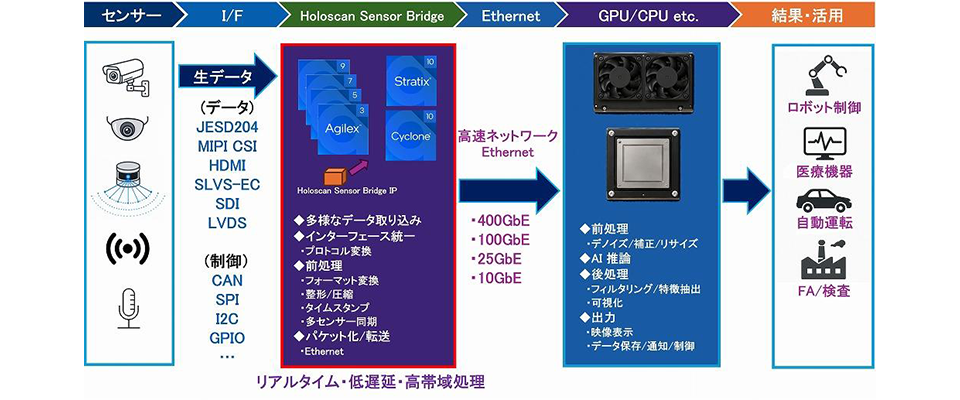
Holoscan is a platform for real-time sensor fusion and AI inference by ingesting streaming data generated from sensors such as cameras and LiDAR onto GPUs with low latency.
This can significantly streamline the development of physical AI systems for medical devices, robotics, industrial inspection, and more.
• Sensor group
・HSB (Holoscan Sensor Bridge)
・Holoscan SDK
Sensor group
Holoscan is not limited to a specific sensor and can support sensors from various vendors.
We acquire data in real time from various sensors with different specifications.
◆ Examples of main sensors
• Camera (RGB, IR, Thermal)
LiDAR
・Radar
IMU
·encoder
- Acoustic sensor
• Temperature, pressure, and vibration sensors, etc.
◆ Main Interface
(Data Interface)
・JESD204
MIPI CSI
HDMI
SLVS-EC
SDI
(Control interface)
CAN
SPI
GPIO
HSB (Holoscan Sensor Bridge)
The main roles of HSB are as follows:
◆ Various sensor connections
- Acquire data from cameras, LiDAR, radar, IMU, etc.
◆ Interface unification
Protocol conversion
◆ Data preprocessing
Format conversion
Data formatting/compression
- Adding a timestamp
• Multi-sensor synchronization
◆ Packetization and high-speed transfer
• Ethernet transfer (10G/25G/100G/400G)
Holoscan SDK
The main features of the Holoscan SDK are as follows:
Sensor Fusion
・AI inference
Image recognition and object detection
・3D recognition/spatial recognition
Robot control
• Digital twin integration
Real-time visualization
Application development framework
At the end
Inquiry
If you are considering building a physical AI system using Holoscan Sensor Bridge or Altera® FPGA, please feel free to contact us.