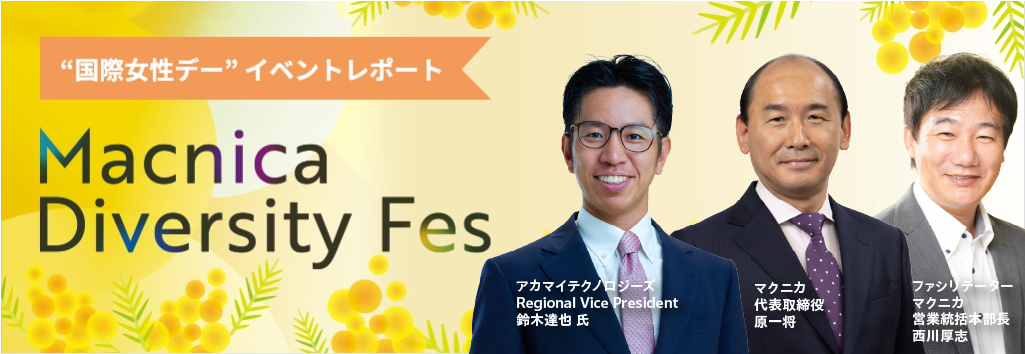
March 8 is International Women's Day established by the United Nations every year to promote the advancement of women and their advancement in society worldwide.
Macnica, which actively promotes DE&I activities, held the second employee-only event, "Macnica Diversity Fes 2025", following last year. The event was held in a hybrid format of physical venue and online streaming using the showroom "MET Valley" on the first floor of the Macnica Headquarters Building, and up to approximately 500 employees participated. We will tell you about the state of the event that was a great success in a report.
Report Contents
Part 1: What is a truly diverse company? ~A conversation between Akamai Technologies' Suzuki and President Hara~
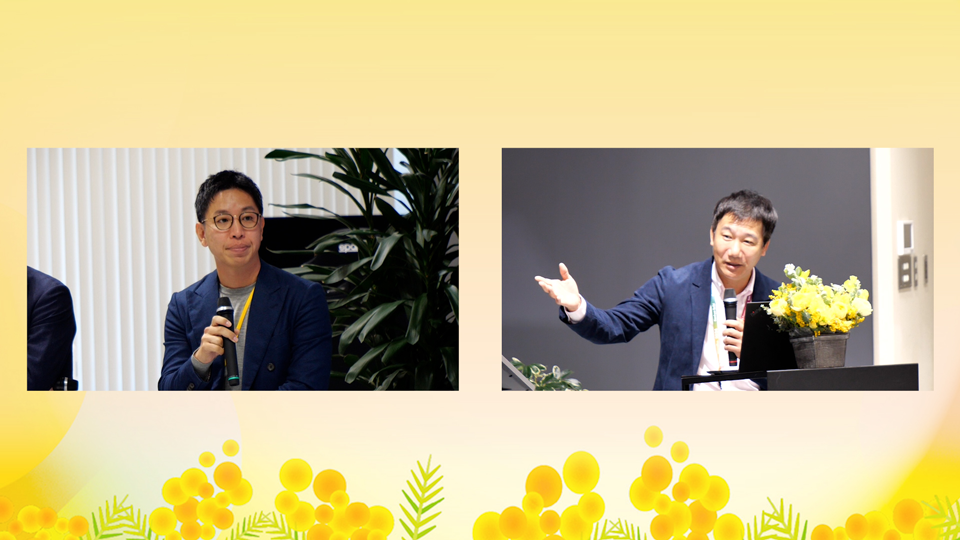
In the first part of the event, Akamai's Tatsuya Suzuki, who is promoting DE&I using a global perspective, was invited as a guest and discussed "essential diversity promotion" with Macnica 's President Hara and Executive Officer Nishikawa.
Speakers
- Tatsuya Suzuki (Regional Vice President, Akamai Technologies, Inc.)
- Kazumasa Hara (Representative Director and President Macnica)
- Atsushi Nishikawa (Executive Officer /General Manager of Sales Division, Macnica, Inc.)
From the interview
Macnica is working to promote DE&I
President Hara began by explaining Macnica 's approach to promoting DE&I. "To grow as a service solutions company, Macnica aims to create an environment that embraces diversity and become a strong company where each individual can maximize their capabilities," he said, emphasizing the need to further accelerate DE&I through practical initiatives in addition to the company's existing culture.
■ Regarding "diversity ≠ preferential treatment for women"
Tatsuya Suzuki, who works at Akamai, has been in charge of Asia Pacific for the past five years. While leading a highly diverse team, he has used his own research methods to gain in-depth knowledge about diversity and has applied this knowledge to improvements on the ground.
She said that through this experience, she realized that many women don't want to be treated specially. She questioned the idea that diversity equals preferential treatment for women, emphasizing that "improving the core behind achieving numerical targets is more important."
Member of the Board agreed with this opinion, saying, "Numbers are important, but the essence is to create an environment where everyone can work comfortably, and that is the true essence of diversity."
President Hara also stated, "Numbers are merely results; what's important is the quality of the content. Rather than focusing only on women, Macnica wants to aim for a corporate culture where individual minorities are respected."
Everyone deeply agreed that promoting diversity is not just about preferential treatment, but that the key is to build a corporate culture that respects the diversity of all people.
■Data collection and the three-tier model
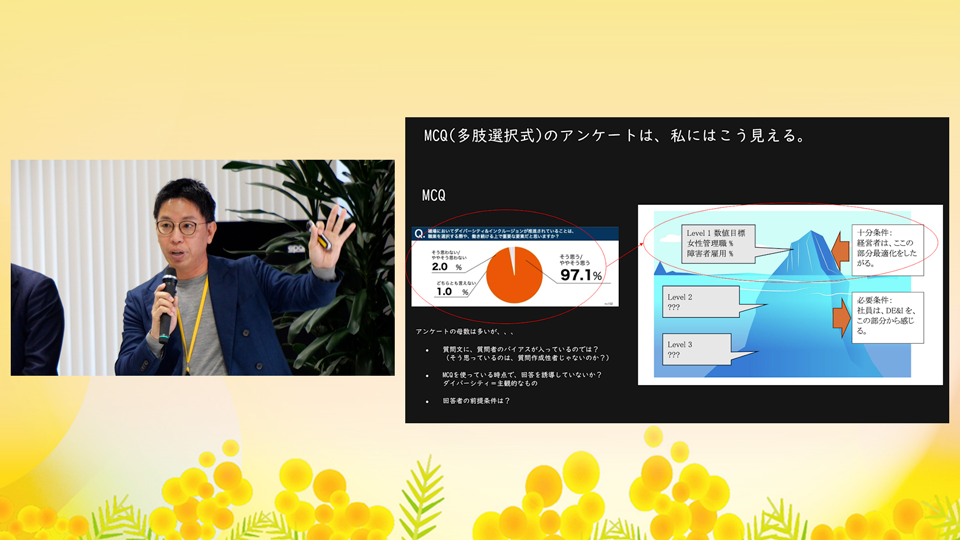
Next, Mr. Suzuki explained the methods used in conducting diversity surveys.
Suzuki: "Diversity is a subjective concept that relates to perceptions. This is why it's important to use a method called 'Perception Based Research,' which focuses on the respondent's perceptions, rather than a multiple choice question (MCQ) that simply asks 'yes or no.'"
Suzuki also likened the perception of diversity to an iceberg, explaining, "The numbers that are visible on the surface, such as the 'ratio of female managers,' are merely the tip of the iceberg. Beneath that is an invisible layer, such as the organizational awareness and culture, and only when these change will the visible numbers change."
Based on this idea, a survey was conducted in advance among Macnica employees, asking the following questions:
-Please tell us the names of up to four companies that have a positive impression of their Diversity, Equity, and Inclusion (DE&I) initiatives.
-On the other hand, please tell us the names of companies that give you a negative impression.
-What do you think the companies that answered positively have in common?
-What do you think the companies that answered negatively have in common?
After reviewing the survey results, President Hara commented, "I felt that there were areas where Macnica was doing well and areas where there is still room for improvement. However, one thing that was common among the survey responses was that we were highly rated as a company that values people, and this reminded me once again that this is a value that Macnica should continue to cherish."
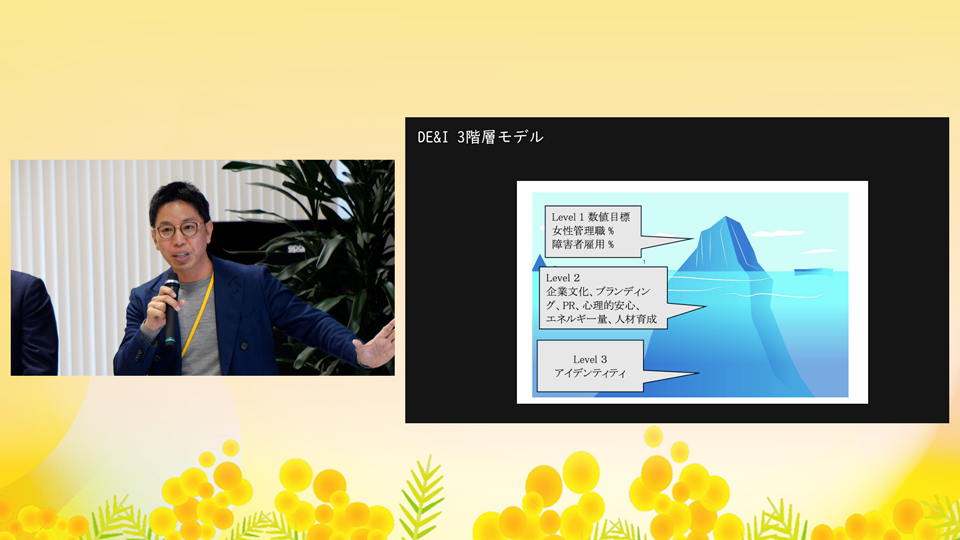
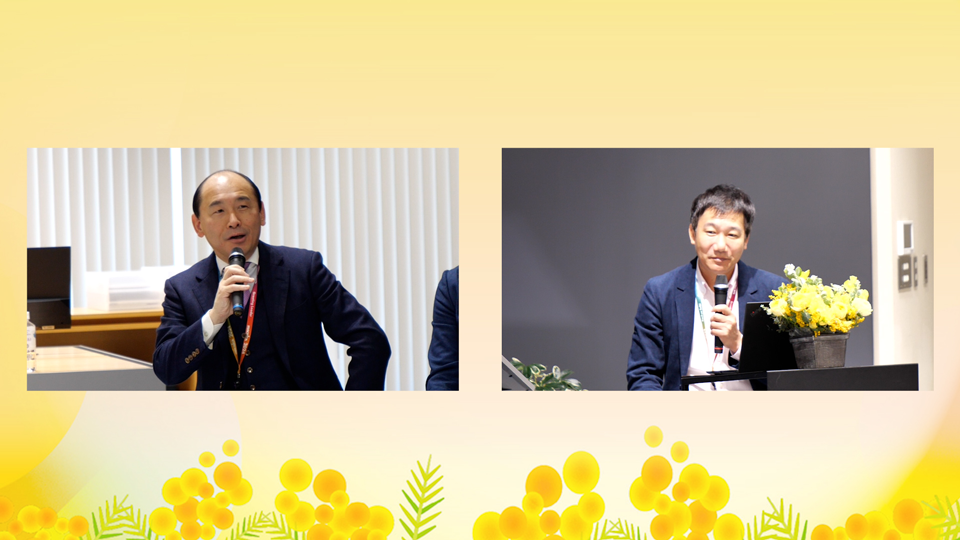
Suzuki then pointed out the importance of "Identity," the deepest level 3 of the three-tier model of diversity.
Suzuki: "Humans tend to try to exclude minorities when they join in order to protect their identity. This problem cannot be solved financially; it requires a rethinking of the very structure of the organization."
Regarding this point, Nishikawa Member of the Board, "Individual thinking and occupational roles are closely linked. For example, women may find it difficult to enter aggressive workplaces such as sales. Even if the ratio on the surface is increasing, there may be cases where women feel uncomfortable inside."
President Hara empathized with this, saying, "A uniform organizational environment creates these kinds of problems. If everyone is the same, the fun and diversity of ideas is lost, so we need to hire a variety of talent and be conscious of balancing the vitality of the team." He went on to say, "Similar issues arise if the organization is biased towards minorities only, so it's important to create a diverse organization." Member of the Board Nishikawa responded, "So you're saying you want to value individuality."
Suzuki also said, "It is important for leaders to consciously lower barriers and create an environment where diverse people can work comfortably."
Member of the Board then touched on the importance of non-monetary incentives.
Member of the Board "I think it's very important to have an atmosphere where people feel like 'it's fun,' 'it's flexible,' and 'it's easy to speak up.' It's important to be fair, of course, but ultimately, if the environment is such that only those who raise their hand are recognized, many people will end up being overlooked. I feel that the key to diversity is how to maintain and develop a bright, low-stress environment."
■Summary
To conclude the event, President Hara summarized the event as follows:
"Macnica is an open and fair company with many energetic employees, offering ample opportunities for both new graduates and mid-career hires. I was reminded of the importance of utilizing each employee's identity and carving out their own career path, while keeping in mind the Level 2 corporate culture that Suzuki mentioned. This allows individuals to thrive as minorities, break down uniformed organizations, and lead to innovation."
Responding to these words, Suzuki said, "Macnica has a solid corporate culture," and added, "Diversity is the key to shaping the organization five years from now. The company is already producing excellent results, but I hope it will aim to become even more super excellent."
Member of the Board Nishikawa also agreed with this idea, and spoke of his vision for the future, saying, "While cherishing Macnica 's current colors, I would like to paint a new organizational color five years from now."
Part 2: DE&I ch. Let's all try it together ~Employee opinion exchange meeting~
In the second part, three active Macnica employees took to the stage to share their thoughts and experiences on three DE&I-related themes. Macnica employees other than the speakers also discussed the same themes at their tables (or breakout rooms at the online venue), and heated debates were seen here and there. Including memorable keywords from the first part of the discussion, the discussion provided an opportunity for each employee to see DE&I as something that "applies to them."
■Theme 1: Please tell us your impressions of the first part.
Kanda: "The talk about Occupational Identity and Personal Identity left a strong impression on me. I was particularly frightened by the fact that unconscious identity can sometimes be used to unintentionally impose certain beliefs on others, and it reminded me of the importance of having a perspective that questions what is taken for granted."
Miyamoto: "When I first graduated, I felt a strong sense of discomfort with the perception that sales jobs should be a certain way, and there was a time when I struggled with my occupational identity and my own identity. I think the entire company needs to be aware of letting go of this kind of bias."
Ms. Sugawara: "I empathized with what she said: 'Women don't want to be treated differently.' I was relieved when President Hara said, 'The numbers are only as good as the true essence.'"
Through comments from different positions and perspectives, the session broadened awareness of how to confront unconscious bias.
■Topic 2: Do you think there are any barriers to diversity at Macnica? If there are any barriers, what do you think should be done?
The second theme focused on the "walls" at Macnica.
Miyamoto: "There are few female managers and salespeople, and without role models nearby, it's hard to imagine what you'll be like in five or ten years. I think it's important to have senior colleagues in the same position nearby."
Sugawara says, "I feel that the assumption that 'childcare is a woman's role' is still deeply rooted. I am able to work full-time thanks to my husband taking six months of parental leave. This experience made me realize that there is no childcare role that only I can do."
Kanda: "I think the value of 'hardworking people are valued' is limiting career diversity. I also think the structure that requires you to move into a management position that doesn't suit you in order to increase your salary is a barrier."
The session highlighted issues that lie not only in the institutional aspects, but also in the very nature of evaluation and awareness.
■Theme 3: What do you think Macnica should do to become an "Excellent DE&I Company"? (*An excellent DE&I company is a company that excels in diversity, equity, and inclusion initiatives.)
The final topic was specific proposals for striving to create a "better Macnica."
Sugawara: "It's important to have a system that makes it easy for people with a variety of backgrounds to work. I think that using that system properly and giving back to the company properly will also lead to trust."
Miyamoto: "I feel that we need to be more proactive in our PR activities to spread awareness of Macnica 's appeal. Also, by creating opportunities to reconcile the differences in attitudes toward diversity between upper management and frontline staff, we can incorporate diverse opinions and increase the flexibility of our organization."
Kanda: "I think there needs to be more flexibility in terms of working hours and places. People have different times and circumstances when they can concentrate, so meeting each individual's needs will improve productivity. However, it's important that employees clearly demonstrate their results so that the system isn't abused."
The comments from each of the three speakers revealed the challenge of how to utilize the system to build a trusting and flexible workplace.
■Summary
This exchange of opinions highlighted awareness and challenges surrounding diverse working styles and values.
It was important not only to have a formal system, but also to actually use it and demonstrate results, and to confront unconscious bias. This was an opportunity for each employee to take DE&I personally and reaffirm the significance of working to create a better workplace.
Event Survey Results
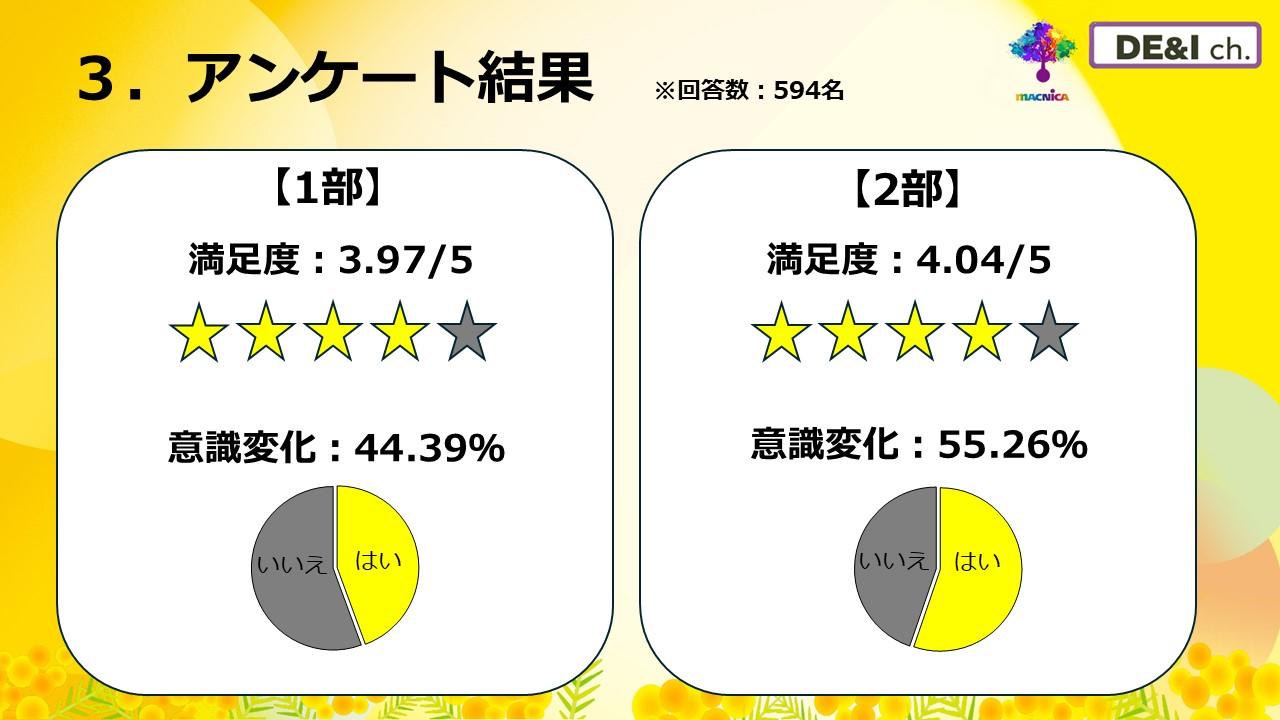
After the event, a survey was conducted among all employees, and a total of 594 responses were received.
For both Part 1 and Part 2, participants were asked about their level of satisfaction with the event (out of 5) and whether their attitudes had changed before and after participating. The results were as follows:
- Part 1: Satisfaction score: 3.97 points, 44.39 % responded that there was a change in their attitude
- Part 2: Satisfaction score was 4.04 points, 55.26 % responded that there was a change in their attitude
The following comments were received in the free-form comments:
- "The topic of diversity felt familiar to me, and it made me realize that it was something that affected me."
- "I want to try more things in the future, things that I had given up on because I'm a woman."
- "There's a possibility that my perspective was biased, so I'll be more careful in the future."
- "Each of the three speakers was very different, and there were a variety of opinions and perspectives within the group, which made me realize once again the importance of having opportunities to be exposed to a variety of opinions."
For many employees, this was a valuable opportunity to reexamine DE&I from their own perspective.
Macnica will continue to promote DE&I going forward.