Transfer assistance is extremely important care in supporting the daily lives of users, but it also places a great strain on the caregiver's body and carries the risk of accidents.
Many people have concerns such as, "The user's body is too big and I can't move them properly," or "I'm worried that they might get injured."
However, by utilizing the correct knowledge, techniques, and appropriate tools, transfer assistance can be provided in a way that is safe for both the user and the caregiver.
In this article, we will introduce in detail the basics of transfer assistance, specific procedures for full and partial assistance, precautions to take if the patient is paralyzed, and how to make use of convenient welfare equipment.
Basic principles that form the foundation for safe and secure transfer assistance
The most important thing when providing transfer assistance is to ensure the safety of both the user and the caregiver. To do this, it is necessary to understand a few basics.
● Calling out and consenting
Before you begin providing assistance, be sure to speak to the user, explain what you are planning to do, and get their consent. By explaining specific actions, such as "I'm going to do this" or "I'm going to stand up slowly," the user will feel at ease and accept your assistance. It is also important to carefully check the user's condition (is there any pain, how much they can move on their own, etc.) before providing assistance. What you can do will change depending on the user's physical condition and mood on that day. This will help reduce the user's anxiety and make it easier to obtain their cooperation.
Body alignment
To stabilize the user's body, it is important to firmly secure their feet and keep their center of gravity low. Caregivers should also bend their knees and lower their hips to reduce strain on their own bodies.
● Utilizing the principle of leverage
Rather than relying on force, by shifting the body's center of gravity and using the principle of leverage, assistance can be provided smoothly and with minimal effort.
● Environmental improvement
Adjust the position and height of the bed and wheelchair to be used for transfer in advance to ensure a smooth flow of movement. Consider the presence or absence of bed rails and their shape when planning a layout that will allow for a safe transfer.
Making care easier! Using convenient welfare equipment
In order to reduce the burden of transfer assistance and increase safety, it is essential to utilize welfare equipment such as sliding sheets and sliding boards.
These devices are excellent because they allow the user's body to "slide," eliminating the need for caregivers to lift them.
● Sliding seat
It is used to move the body while sitting or lying down, such as from a bed to a wheelchair or when changing positions on the bed.It has low friction resistance, allowing for smooth movement with little force.
● Sliding board
It bridges the gap between a bed and a wheelchair, allowing the user to sit and slide across the board, allowing them to transfer without having to lift their body.
It is especially effective when the user is large or when you want to reduce the physical burden on the caregiver. When used correctly, the user can be transferred with peace of mind.
Specific transfer procedures for full assistance and partial assistance
Transfer assistance can be "full assistance" or "partial assistance" depending on the user's condition. The appropriate assistance method should be selected based on the user's physical condition and remaining abilities.
In the case of full assistance
This is assistance when the user has difficulty moving on their own. In order to reduce the burden on the caregiver's body, the key is to "slide" or "move" the user rather than lifting them.
■ Preparation before assisting
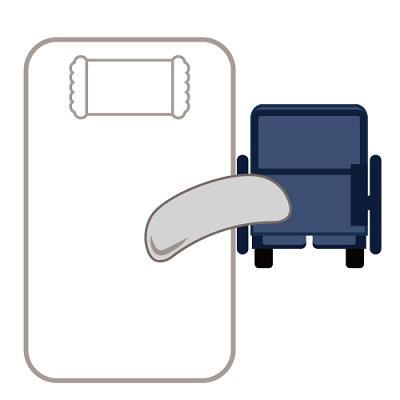
1. Place the wheelchair parallel to the direction of travel of the user's bed (head or foot side) and apply the brakes.
The position is adjusted to make transfer easier, taking into consideration the user's paralyzed side.
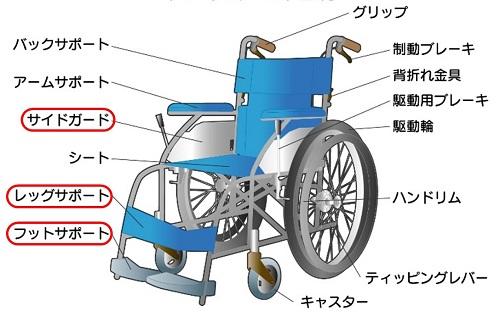
Wheelchair parts names
② Raise the foot support and remove the leg support if it is removable.
③If the side guard can be moved, flip it up.
④ Adjust the bed height to be the same as the wheelchair seat or slightly higher.
⑤ Prepare a sliding sheet or sliding board if necessary.
■ Specific transfer procedures
1. Calling out to the patient and adjusting their position (assisting them in getting up)
Call the user and let them know they will be transferred.
First, have the patient move to the edge of the bed. Next, have the patient cross their arms and bend their knees.
This allows you to assist the person in getting up with minimal effort.
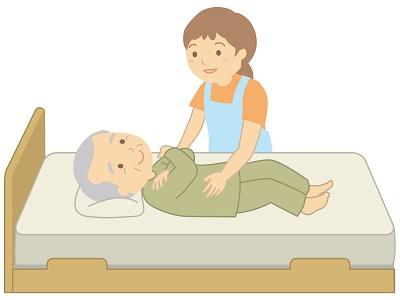
The caregiver places their arms under the user's shoulders and knees and slowly raises them gradually, using the principle of leverage, from a supine position to a side-lying position and then to a sitting position.
*If the patient has paralysis, they should be placed in a lateral position with the paralyzed side facing downwards, and guided so that the healthy side is easy to use. Having the patient hold onto the bed rail or the caregiver's shoulder with the non-paralyzed hand will make it easier for them to stabilize themselves.
2. How to lower your legs
Place the client's feet over the edge of the bed.
At this time, the weight of the user's body is used to guide the upper body to easily rise.
3. Stability in sitting position
The caregiver checks whether the user's balance is stable while sitting on the edge of the bed. The caregiver places their hands under the user's armpits to support their stability.
4. Use of sliding sheets/boards
- For sliding seats: Place the sliding seat under the user's buttocks. The caregiver supports the user's body while sliding them over the seat to transfer them into a wheelchair.
- For a sliding board: Place a sliding board between the bed and wheelchair, and have the user slide onto the board. The caregiver should support the user's torso as needed to facilitate a smooth transfer.
5. Sit back down
Once the user has transferred to the wheelchair, we will assist them in adjusting their position so that they can sit deeply and stably.
In the case of partial assistance
This is assistance for users who still have some remaining ability. It is important for the caregiver to focus on supporting the user, making the most of what the user can do.
■ Preparation before assisting
1. Place the wheelchair parallel to the direction of travel of the user's bed (head or foot side) and apply the brakes.
If the patient is paralyzed, they will be positioned so that they can be transferred to the wheelchair from their healthy side (the side without paralysis).
Wheelchair parts names
② Raise the foot support and remove the leg support if it is removable.
③If the side guard can be moved, flip it up.
④ Adjust the bed height to be the same as the wheelchair seat or slightly higher.
⑤ If necessary, use bed rails (especially L-shaped or U-shaped rails) to enable the user to stand up by holding on to them.
■ Specific transfer procedures
1. Calling out and warm-up exercises
Inform the user that they will be transferred and ask them to sit shallowly on the bed.
Give specific instructions such as, "You're going to stand up now," or "Try moving over here on your own."
2. Standing up from a sitting position
The patient should place both feet over the edge of the bed and assume a sitting position.
- Utilizing bed rails: If there are L-shaped or U-shaped rails, have the user hold on to them firmly and use their own strength to help them stand up. The caregiver will help shift the user's center of gravity and support their lower back and core if they are unstable.
- In the case of paralysis: The caregiver will lock the paralyzed knee with their own knee to support the user so that the knee does not bend. They will guide the user to stand up on the healthy side, and the caregiver will encourage the user to move using the paralyzed leg.
3. Change of direction
Once the user stands up, they are asked to take small steps to change direction and move until their bottom touches the seat of the wheelchair.
The caregiver monitors the user's balance and provides assistance as needed.
4. Seating
Once the user feels the seat of the wheelchair, encourage them to slowly sit down.
The caregiver supports the user's knees and hips and helps them sit safely.
5. posture adjustment
Once seated in the wheelchair, check that the user is sitting deeply and in a stable position, making any necessary adjustments.
Be prepared for "what if" situations when assisting a patient with a transfer! What to do if something goes wrong
There is always the possibility of unexpected situations occurring during transfer assistance.
In the unlikely event that a user loses balance or an unexpected situation occurs, calmly follow the steps below.
1. Do not lift with force
If you try to lift a user who has lost their balance, both the caregiver and the user are at increased risk of secondary injury.
2. Slowly guide the baby to the floor
Whenever possible, use your own body as support to slowly guide the person to the floor and help them come out of the position safely.
3. Call for help
Call out for help loudly or use the nurse call button to immediately request assistance from other staff.
It is important to deal with the issue as a team, rather than handling it alone.
4. Safety confirmation and reporting
Once the situation has calmed down, your first priority should be to check on the safety of the users and promptly report this to your supervisor and other relevant parties.
Confident and safe care
Transfer assistance is something that you gradually become accustomed to with experience. Take your time and try to perform each step carefully. When you run into a problem, don't keep it to yourself, but consult with your seniors or colleagues, and make active use of convenient welfare equipment.
If you have any concerns about safety during your daily work, such as unexpected movements by users or the risk of them falling at night, a monitoring system can be a reliable ally.
Macnica 's "Attentive Connect™" detects when a user gets out of bed and monitors the user's movements in real time, helping caregivers to stay aware of the user's condition at all times. Furthermore, a seating sensor installed in the wheelchair quickly alerts the user with an audible signal when the user tries to stand up, helping to prevent risks such as falls. This allows for quick response, reduces the risk of falls, and leads to safer transfer assistance.
Related information
Inquiry
If you have any questions about this service, please contact us below.
Introduction of monitoring system
trial package
Trial Package
In addition to the sensor equipment, it also comes with an operating terminal and a Buddycom (intercom) app.
The free trial is available for a limited time and in limited quantities.
Interested? Here Please check.