- Healthcare Business HOME
- wellness
- nursing care
- medical care
- DX Support
-
column·
example
- Inquiry

Adult diapers can be broadly divided into "rehabilitation pants" and "tape-on diapers."
This time, we will explain in detail how to change tape-fastened diapers in bed, which are suitable for people who are bedridden, spend their time in bed, or want to sleep peacefully at night.
"I don't know which diapers to choose." "I'm worried about whether the ones I'm using are right for me."
For those of you who are in this situation, please take a look at this article which explains how to choose diapers!
What you need to prepare for a diaper change
To ensure a smooth diaper change and a comfortable experience for the user, it is important to prepare in advance. Before starting the diaper change, please have the following items ready:
① Gloves
Be sure to wear one to prevent infection. Disposable masks are hygienic.
② Garbage bags
This is necessary for hygienically disposing of used diapers. It is a good idea to choose a bag with deodorizing properties or one that can be tightly tied.
③ Spare diapers and urine pads
Prepare diapers and pads that are the right size and absorbency for the person receiving care and their excretion volume.
④ A bottle of genital cleanser and warm water
This is essential to keep the water clean and prevent skin problems. In addition to using a dedicated bottle, you can also use a clean plastic bottle cap by poking a few holes in it. Prepare lukewarm water (35-40°C) that is warm enough for body temperature.
⑤ Towel or wet wipes
Use it to wipe away moisture after washing or to clean specific areas. Choose a material that is gentle on the skin.
⑥ Ointments and moisturizers
If necessary, prepare ointments and moisturizers prescribed by your doctor or nurse to prevent dry skin. These will help prevent skin problems such as diaper rash.
⑦ Newspapers and disposable sheets
It is a good idea to have something to put on the bed to prevent it from becoming contaminated.
Procedures from advance preparation to replacement completion
1. Preparing the environment and communicating with the customer before the replacement
Before starting the exchange, speak to the user and explain what you will be doing. This will make it easier for them to cooperate with you at ease. At the same time, create an environment that makes it easy for them to exchange.
① Check that the room temperature is appropriate and adjust if necessary
② Gently say things like, "I'm going to change your diaper now," or "I'm going to move around a bit," and get your child's consent.
3) To protect your privacy, close the curtains or take other measures to block outside views.
④ Make sure you have all the necessary supplies (gloves, diapers, cleaning supplies, etc.) on hand and keep them within easy reach to ensure smooth operation.
2. New diapers and pads
Having new diapers and urine pads ready in advance will make the changing process go more smoothly.
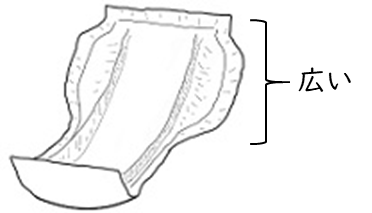
1. Unfold the new diaper and make sure the three-dimensional gathers are properly raised.
② Place the urine absorption pad in the center of the diaper.
Pads come in a variety of shapes, but did you know that there is an optimal orientation depending on gender?
For men: Since urine comes out from the front, the most absorbent part of the pad (the wide part) forward Setting it to this position will help prevent leaks.
For women: Since urine tends to flow towards the buttocks, backward It is recommended to set it to .
This simple innovation allows absorption to match the flow of urine, preventing leakage more effectively.
3. Changing the position and disposing of used diapers
This is where you actually remove the used diaper and prepare to put in a new one.
① Place the user on their side
Assist the person slowly, saying things like, "Turn onto your side now." The caregiver should focus on supporting the person's body and make use of the person's remaining abilities as much as possible.
*If landscape orientation is difficult
By having the caregiver raise the knee opposite the person being assisted, it is easy to turn to the side with little effort (for example, raise the left knee when turning to the right).This reduces the burden on both the person and the caregiver.
② Roll up the used diaper lengthwise so that the contaminated side is facing inwards.
③ Place the rolled up diaper lightly between your legs and place a new diaper in front of it.
At this time, adjust the new diaper so that its center is aligned with the person's spine, which will make it easier to put on later.
④If necessary, you can lay down a waterproof sheet or newspaper at this time to prevent contamination of the bed.
4. Key points for washing and wiping the genital area
This is an important step to keep your skin clean and prevent skin problems.
1. While lying on your side or on your back, wash your genitals with lukewarm water from a cleaning bottle.
If there is excrement, rinse from top to bottom (from the urethra to the anus), being careful not to spread the excrement.
When washing the bottom, you can turn the baby on its side again and wash it with a bottle, or you can gently wipe it with a towel dampened with lukewarm water.
After washing, gently wipe off any moisture with a clean towel or wet tissue.
The key to this is to not scrub your skin but to press it down to absorb the moisture. Be sure to wipe carefully around areas where skin overlaps and wrinkles so that no area is left unwiped.
③If necessary, apply ointments or moisturizers as directed by a doctor or nurse to protect the skin.
5. Putting on a new diaper
Once clean, put on a new diaper.
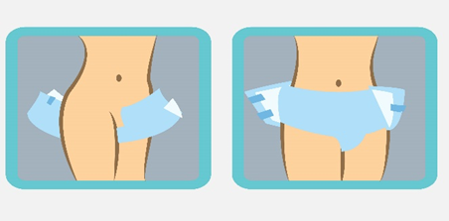
1. Place the care recipient on their back and pull the new diaper up between their legs to their crotch area.
② Once you have brought the diaper to your baby's abdomen, gently pull out the creases at the base of the legs to prevent any gaps between the diaper and the baby's body.
This will ensure a snug fit and help prevent leaks.
③Tie the tape that you wrapped around your back on your stomach.
If you apply the upper tape downwards and the lower tape upwards, crossing them slightly, the diaper will not slip off and will fit better to the body.
④ Make a final check to make sure the gathers on the diaper are not standing up and digging into the legs, and that they are not too tight or too loose.
6. Checking and cleaning up after replacement
Once the change is complete, check the condition of the person being cared for and put away the used items.
① After changing the diaper, check to see if the person you are caring for is experiencing any discomfort or pain.
② Roll up used diapers to prevent waste from spreading, tie the top tightly, and place in a garbage bag.
3. Put away any towels or cleaning products you have used and wash your hands thoroughly.
Specific measures to prevent skin problems (diaper rash)
Changing diapers is not just about replacing soiled diapers; it is also an important form of care to protect the skin from skin problems. People who are bedridden or who wear diapers constantly tend to have particularly sensitive skin. Here we will introduce specific preventative measures that form the basis of diaper care.
Making skin observation a habit and early detection
Make it a habit to consciously observe your baby's skin every time you change their diaper. Not missing any signs of trouble is the first step to preventing the condition from worsening.
Redness, rash, eczema
Pay attention to areas that come into contact with the diaper, the hip joints which tend to sweat, and the folds of the stomach.
Sores, blisters, peeling skin
This is a sign of severe inflammation. In particular, if the skin is oozing or blisters are present, it is important to take extra care, as there may be an infection at the same time.
- Signs of bedsores
In particular, check for redness or discoloration of the skin around protruding bones, such as the sacrum (the center of the buttocks), gluteal region, greater trochanter (the side of the groin), and heels. These are likely to occur due to pressure or misalignment.
If you discover an abnormality
Do not continue to use over-the-counter medications on your own judgment, but consult a doctor or nurse immediately. Early, professional treatment will prevent the condition from becoming serious.
Proper wiping and thorough drying
Keeping the skin clean and removing excess moisture is very important for protecting the skin's barrier function.
- Appropriate cleaning methods
Be sure to rinse in one direction, from the urethral opening to the anus. This is a golden rule to prevent bacterial infection.
If you use soap, choose one that is mildly acidic and hypoallergenic, and lather well. Wash gently without scrubbing.
- Thorough and reliable drying
After washing, dry with a clean towel. Friction can be stressful on the skin, so it's a good idea to pat the area gently to absorb the moisture.
Humid environments are a breeding ground for bacteria, which can cause skin problems. It is important to wipe away any moisture carefully and dry quickly.
Skin protection and moisturizing care
Care to protect the skin from dryness and irritation from excrement is also essential.
・Use moisturizer
After wiping, apply a moisturizer (lotion, cream, etc.) before your skin dries. Since moisture evaporates easily from the skin after bathing and wiping, it is effective to apply it immediately. Gently spread it along the skin's texture, and be careful not to apply too much. It is recommended to choose a product that is hypoallergenic and gentle on the skin, such as a petrolatum-based product.
・The effectiveness of water-repellent cream
If you are particularly concerned about skin irritation caused by stool, you can protect your skin from the irritating substances in the stool by applying a thin layer of water-repellent cream. You may need to use this cream in conjunction with an ointment or moisturizer.
・Complying with doctor and pharmacist instructions
Be sure to use prescribed ointments and creams in the amount and manner instructed. Do not use or discontinue use at your own discretion.
Appropriate selection of diapers and pads and frequency of changing them
The diapers and pads used can also be a major cause of skin problems.
Breathability and material
Choosing a diaper that is breathable will help reduce moisture buildup and help maintain healthy skin.
Choose a material that is comfortable and non-irritating to the skin.
Size and fit
Choose a size that fits your body perfectly, not too big or too small. If it's too big, it will leak through the gaps and become stuffy, and if it's too small, it will cause tightness and chafing.
・Frequent replacement
If your baby has excreted urine or feces, change the pad as soon as possible. Reducing the amount of time your baby's skin is in contact with urine or feces is the most basic way to prevent skin problems.
Even if there is no excretion, it is important to check the condition of the skin regularly and change it if necessary.
By taking these measures in combination, the risk of skin problems can be significantly reduced, allowing those receiving care to live more comfortably.
Using technology to improve care
Changing diapers is not just a routine care task, but an important aspect of care that protects the dignity of those receiving care and helps them live a secure life. With the right knowledge and careful practice, daily care can go more smoothly.
Utilizing technology is also effective in supporting this kind of daily care. For example, Macnica 's monitoring system, "Attentive Connect™," is useful for changing diapers at night. This system detects the heart rate, breathing, and turning over of the care recipient, and can check in real time whether they are awake. This allows caregivers to change diapers at the right time, without having to wake them up. As a result, care can be provided that protects the care recipient's sound sleep and does not disrupt their sleep rhythm.
By utilizing Attentive Connect™, the burden on both caregivers and those receiving care can be further reduced, enabling more comfortable care.
Related information


Inquiry
If you have any questions about this service, please contact us below.
Introduction of monitoring system

Next-generation monitoring system AttentiveConnect
Data such as sensor alerts, sleep and vital information can be collectively managed on this system.