- Connectivity Business HOME
- service·
solution -
event·
Seminar
-
Case studies, columns,
Blog
- Inquiry
product
- Transportation/storage status monitoring and tracking service - Macnica Tracks® -
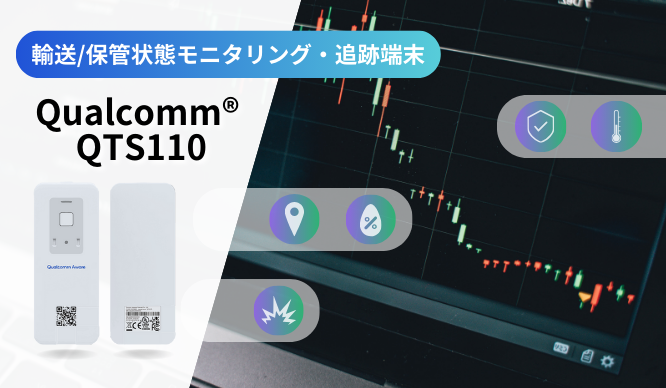
- Transportation/storage status monitoring and tracking terminal - Qualcomm® QTS110 -
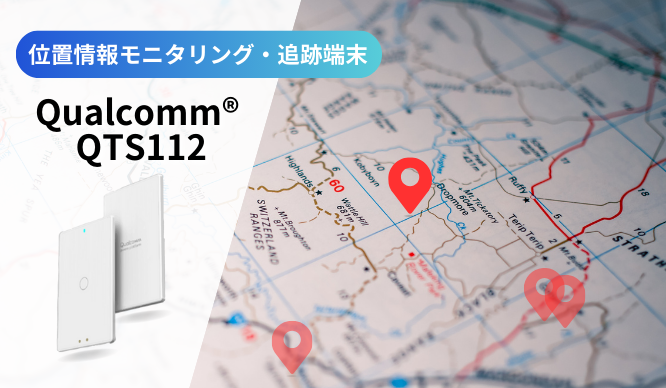
- Location monitoring and tracking device - Qualcomm® QTS112 -
- [FAQ] Transportation/storage condition monitoring and tracking service - Macnica Tracks® -
- List of documents
Visualizing "What happened?" during transportation ~ QTS110 Impact Detection Demonstration Experiment Report ~
Introduction
The "QTS110" appears frequently on this site.
Even though it can detect impact, it's hard to imagine how much impact (G) it will actually react to.
To answer questions such as "How strong is 10G?" and "What happens if you drop the box?", we conducted internal testing using two scenarios.
What is Qualcomm® Aware Tracker "QTS110"?
The Qualcomm® Aware TrackerQTS110 is a device that can monitor and track the status of goods and assets in real time during transportation and storage.
It is equipped with multiple sensors for location information, temperature and humidity, detecting impacts when dropped, and detecting obstructions, loss, and theft, allowing for remote status monitoring.
Click here for details on each product/service solution
QTS110 Shock Detection Overview
The QTS110 uses an internal 3-axis acceleration sensor to determine impact in three levels: 5G, 10G, and 30G.
There are various factors involved in determining impact values, such as acceleration, vibration frequency, and amplitude.
The judgment will vary depending on the circumstances in which the impact occurred, such as how firmly the device was fixed, whether there was a cushion, the material of the object that was hit, and the speed.
We recommend that you test the level of shock that will occur in your actual operating environment before using the product.
| element | explanation |
| Acceleration (G) | The instantaneous acceleration detected by the sensor. If the peak value exceeds the threshold, it is determined to be an "impact." |
| Vibration frequency | Indicates whether the impact occurs quickly or lasts for a long time. High frequency impacts are sharp, while low frequency impacts are gentle. |
| Amplitude (displacement) | The amount of physical movement at the time of impact. |
| Device Fixation | If the fixing is loose, the acceleration detected may be greater than the actual impact. |
| Presence or absence of cushioning material | Rubber or sponge absorbs the impact and reduces acceleration. |
| Collision object material | The way shock waves are transmitted varies depending on the hardness of the material, such as metal vs. wood. |
| collision speed | High-speed collisions tend to produce high G-forces. |
Internal Verification ① (Shocking)
We assumed an actual logistics site and verified "from what height would it be caught on what threshold?"
Impact detection verification (packaged state)
Luggage weight: approx. 4kg
Packaging: Cardboard (38 x 39 x 27)
① Pack the device in a bubble wrap bag
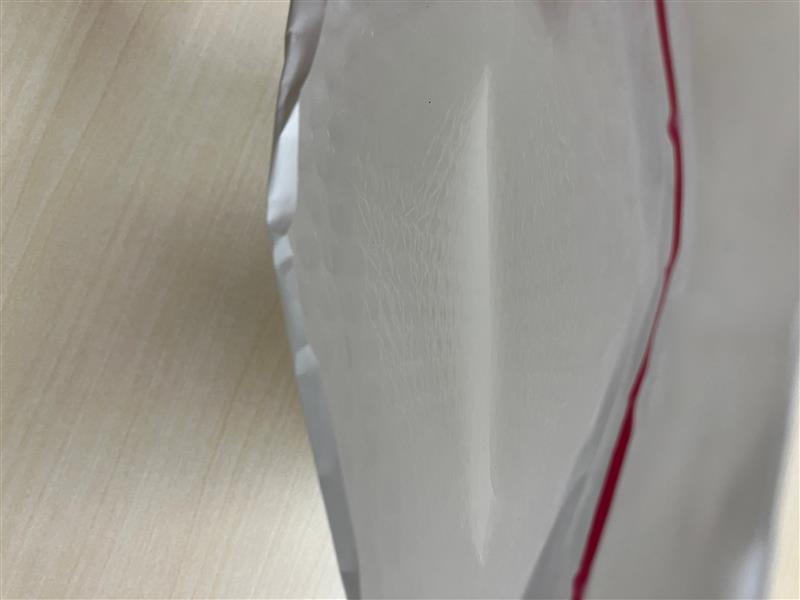
Bubble wrap bags
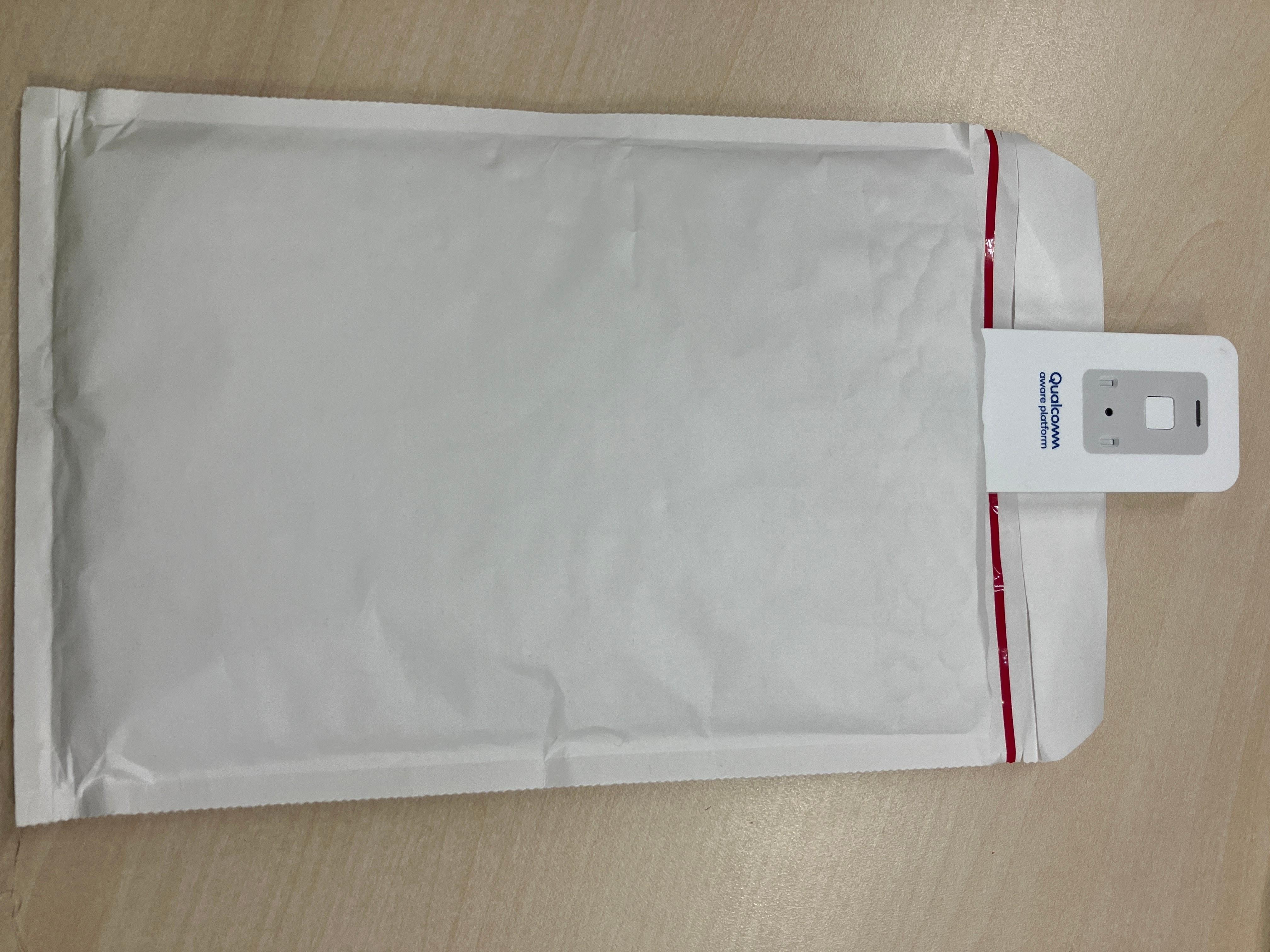
Device in bubble wrap bag
② Place it on top of the luggage and seal the cardboard box.
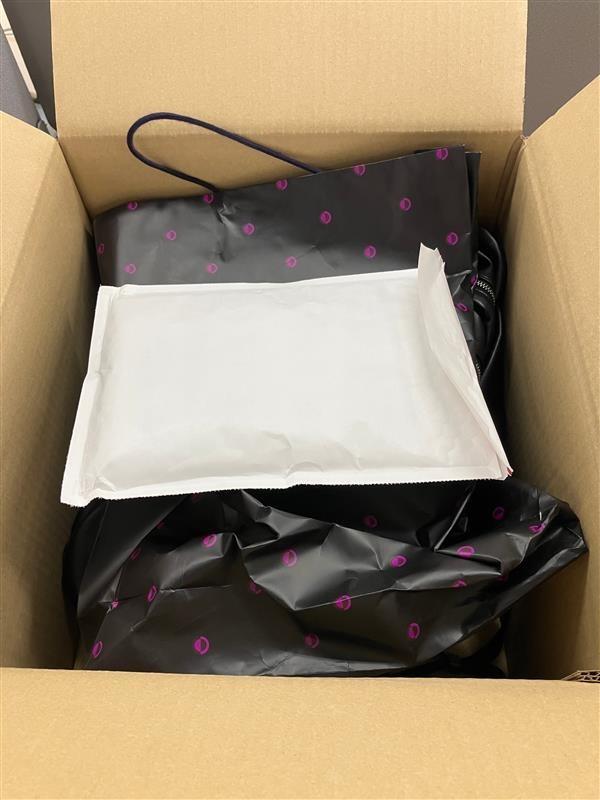
Place the bubble wrap bag containing the device on top of the cardboard box.
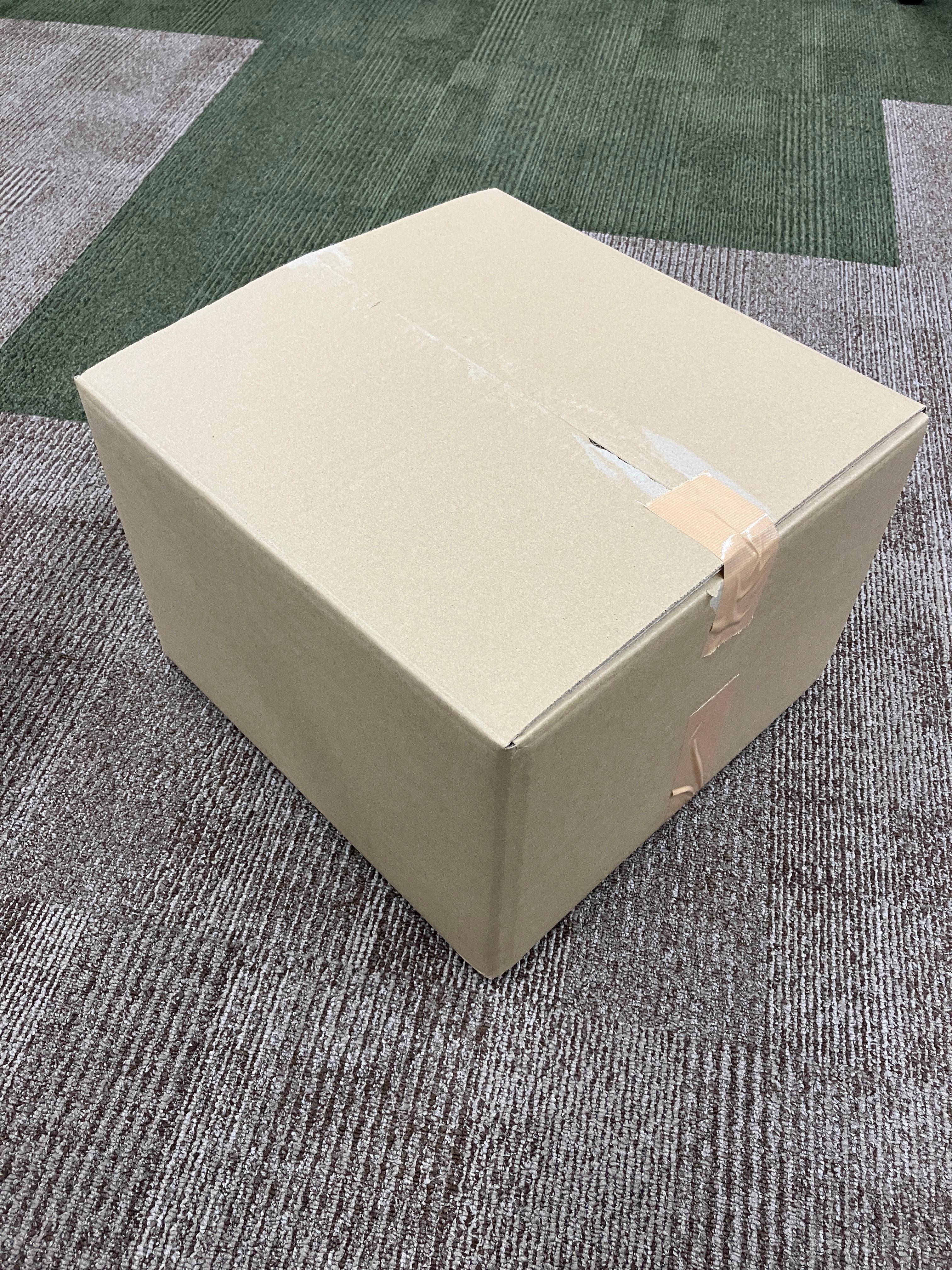
Picture of packed cardboard boxes
Impact detection verification (contents)
Set 5G, 10G, or 30G for each test in the device settings
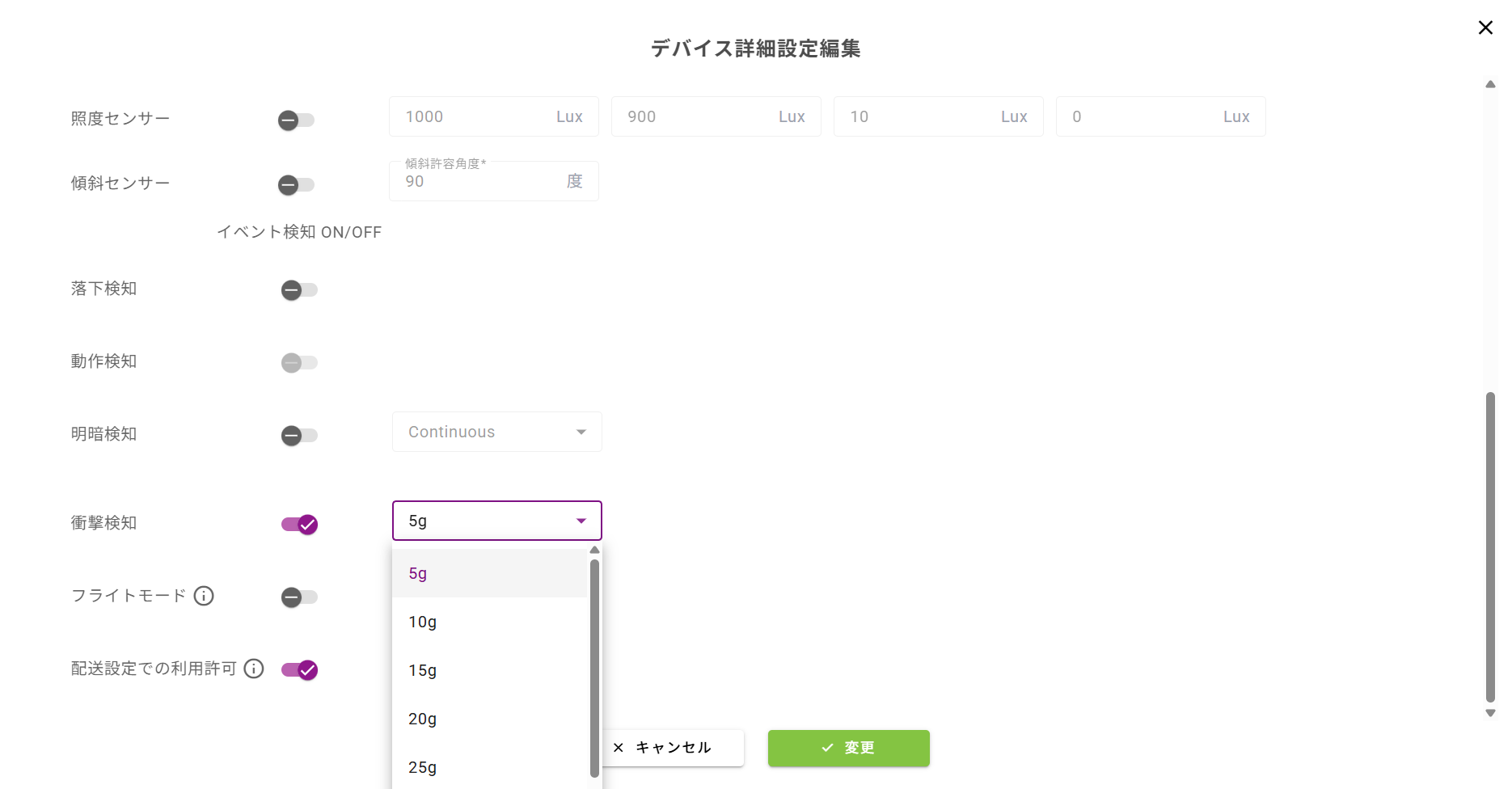
Image of device detailed settings on the dashboard
Cardboard dropped from heights of 10cm, 30cm, 50cm, and 1m
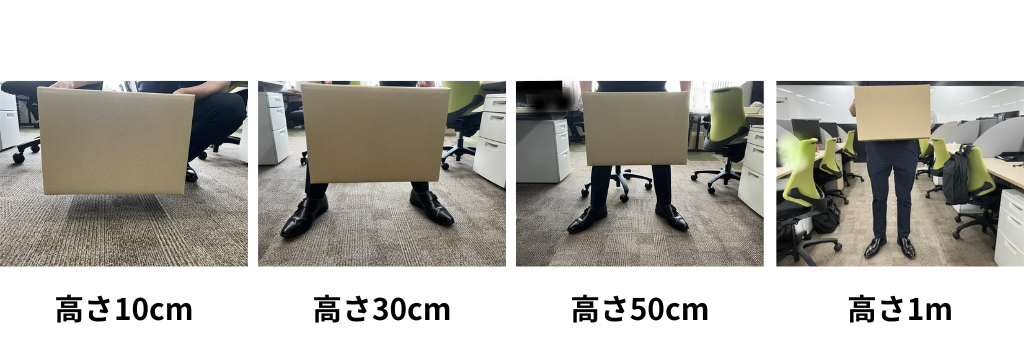
Impact detection verification (results)
5G and 10G detected impact when dropped from a height of 10cm.
Impacts of 30G only are detected from 1m.
Details of the verification results are as follows:
| Impact detection: 5 G | Impact detection: 10 G | Impact detection: 30 G | |
| Height 10cm | ○Detection | ○Detection | × Undetected |
| Height 30cm | ○Detection | ○Detection | × Undetected |
| Height: 50cm | ○Detection | ○Detection | × Undetected |
| Height: 1m | ○Detection | ○Detection | ○Detection |
Internal Verification ②
Our company is 2026 year 2 month 11 Sun (Wed) ~ 13 The event was held on Friday, JANOG57"
When shipping the exhibit equipment from Shin-Yokohama to the venue in Osaka, we used the transportation route to install and test the operation of the QTS110.
Impact detection verification (packaged state)
Luggage weight: approx. 10kg
Packaging: Cardboard (27x 57 x 50)
Target period: February 5th 9:00 to February 19th 9:00
Transportation method: Truck (transportation industry)
Shock setting: 10G
① Attach the device to the target product (white Box switch)
② Place the items in a cardboard box containing cushioning material.
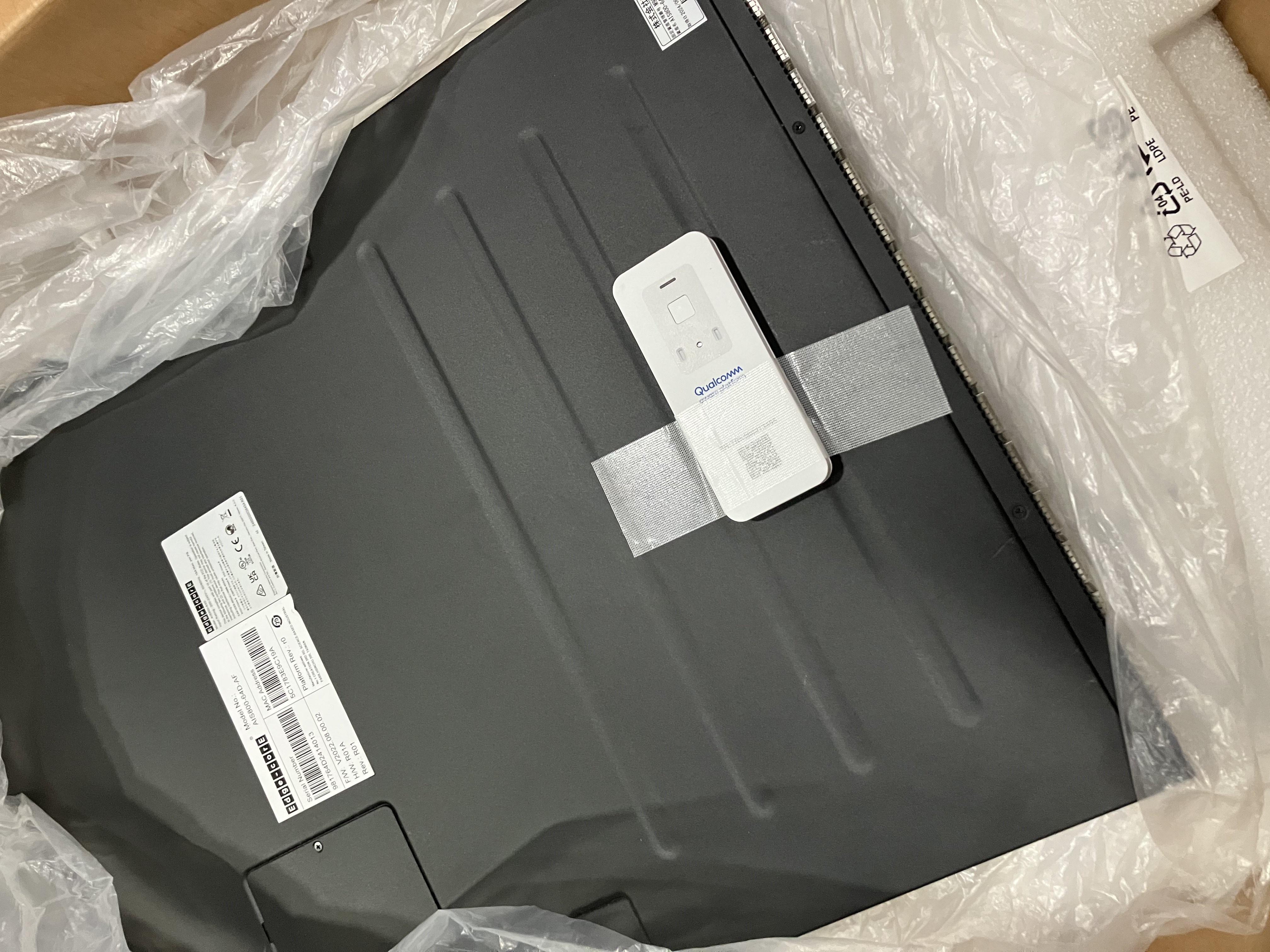
Image of the device attached to the target item
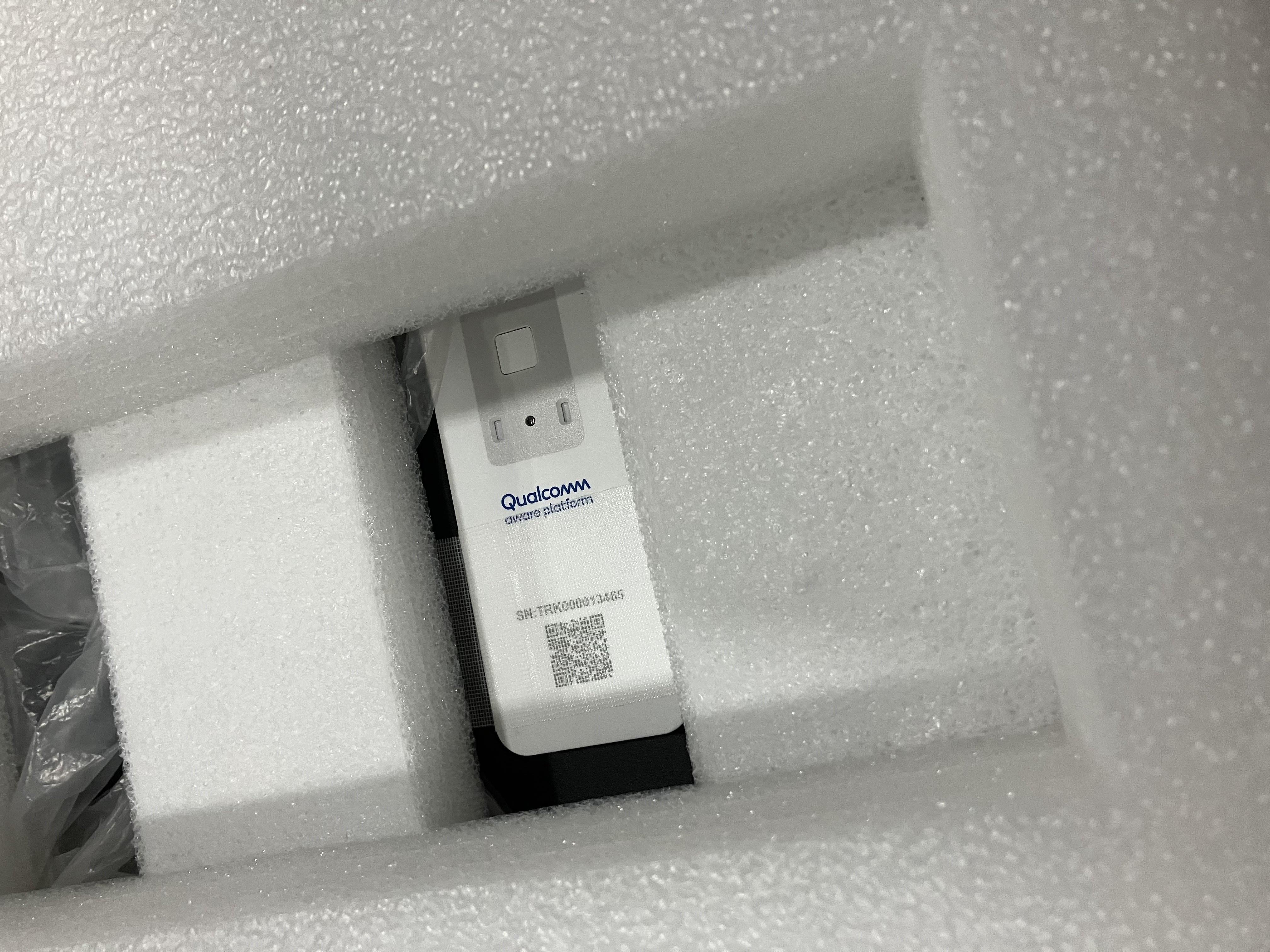
Image of the product packed in a cardboard box containing cushioning material
Impact detection verification (results)
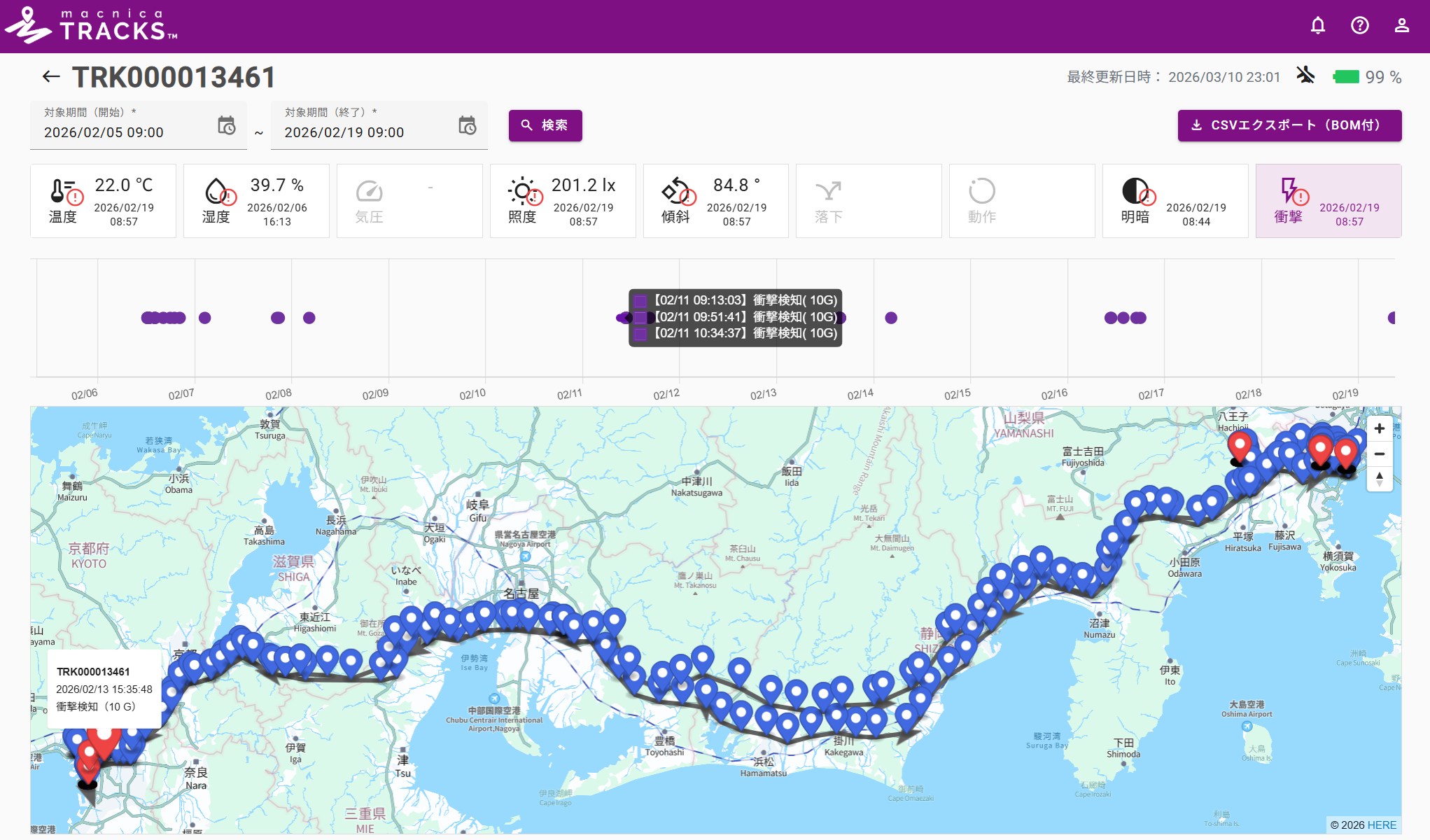
An image showing only impact detection on the dashboard
Monitoring the vehicle's movements during transportation revealed that a total of 42 impacts (10G) were detected on the Macnica Tracks® dashboard.
Between 9:00 and 11:00 on February 11th, three impacts were detected in succession.
No damage was observed during this transport, but in the unlikely event that damage occurs, the exact date, time and location of the impact can be identified.
All accumulated data can be exported in bulk as a CSV file (with BOM), allowing you to instantly cite it in internal reports or conduct more detailed original analysis.
In this way, it is now possible to grasp the load during transportation, which was previously difficult to grasp, using accurate numerical values and time-series data.
lastly
In this verification, the QTS110 was installed to visualize the dynamics during transportation, and the data proved that no shocks beyond the acceptable limits occurred during the transportation process.
This means that even if damage to a package is discovered after delivery, it can be quickly determined that the cause is not during transportation but in a "other process."
Clarifying where responsibility lies will help maintain the trust of both shippers and transport companies.
Our goal is not just to check things after the fact.
By understanding impacts and other issues in real time and "visualizing" logistics quality, we can take "reliable measures to protect your valuable cargo."
Why not try "visualizing peace of mind" with QTS110?
Related article

Inquiry
If you have any questions about the QTS110 or would like us to try out some experiments, please contact us using the form below.