product
Application for evaluation machine
SONiC Practical Hands-on Seminar Lecture Report Part 1 - Learning the Basics of Open Network OS with White Box Switches -

Introduction
This article is based on a lecture given at the SONiC Practical Hands-on Seminar held on August 26, 2025.
We provide an easy-to-understand introduction to SONiC, from its basic architecture to its command system, even for beginners.
If you would like to download the presentation materials, please refer to the link below.
About Broadcom SONiC
SONiC overview
SONiC is an abbreviation for Software for Open Networking in the Cloud, and is a Linux-based open source network operating system that runs on switches and ASICs from multiple vendors.
It was developed by Microsoft and released to the community as open source in 2016.
SONiC's unique feature is its switch abstraction layer (SAI) that separates hardware and software, enabling it to flexibly support cutting-edge 800G switches. Furthermore, by dividing the software into multiple containerized components, it allows for rapid feature additions and updates.
SONiC is released every May and November, with new features and bug fixes added each time.
Furthermore, SONiC continues to evolve within a vibrant ecosystem that includes ASIC vendors such as Broadcom, Intel, and NVIDIA, switch vendors such as Celestica, Edgecore, and Micas, and cloud vendors such as Google and Microsoft.
Accelerated development to address modern use cases has led to a surge in adoption in recent years, and it is quickly becoming the dominant OS for data center networks.
This is due to the fact that it can provide a full set of network functions such as BGP and RDMA, and has a long track record of operation in the data centers of several major cloud service providers.
Also, because it is open source, there is no need to worry about it being acquired or monopolized by a specific company, and it also has the advantage of being highly compatible with third-party products such as monitoring tools.
SONiC basic architecture
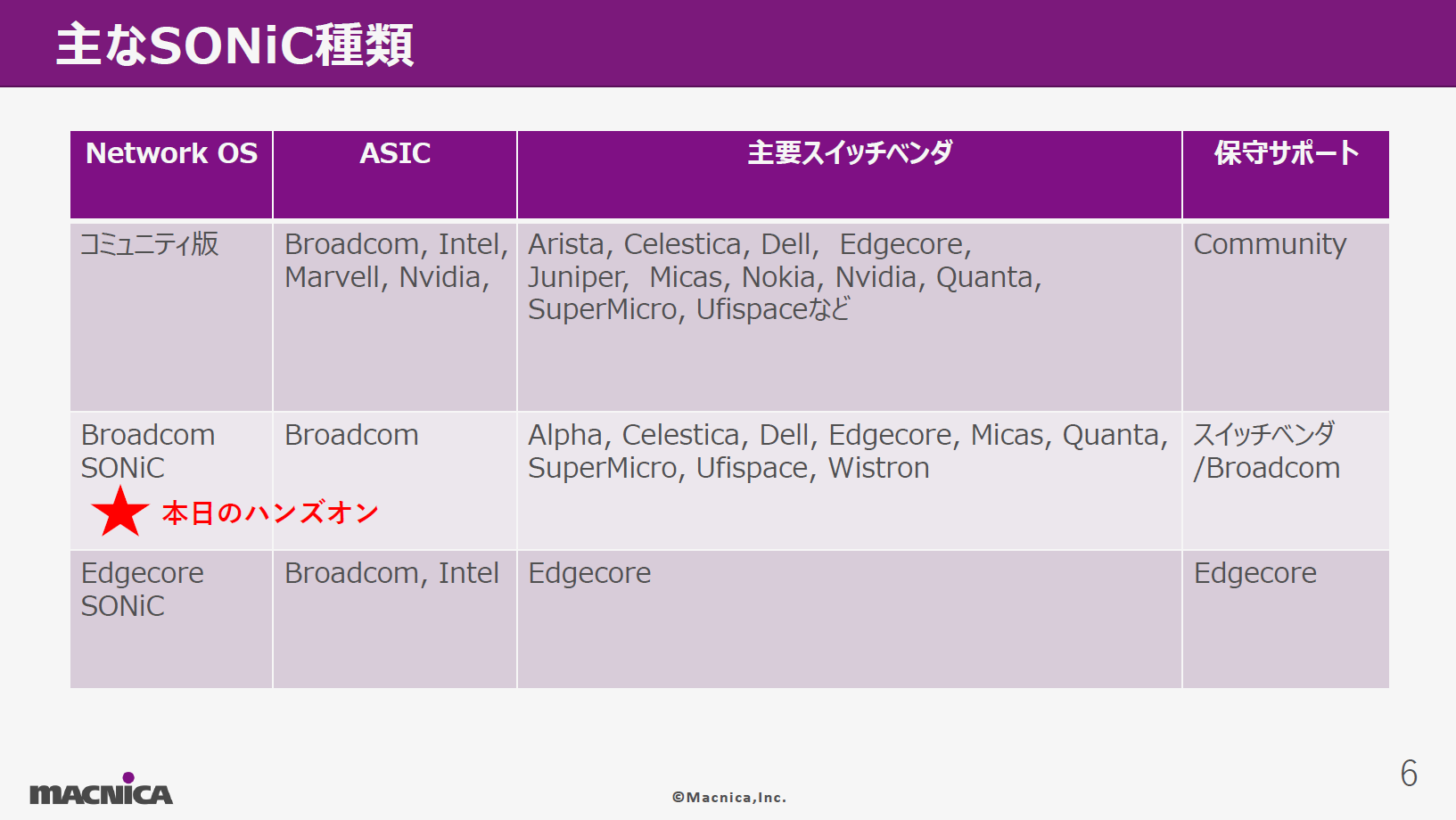
The three main versions of SONiC
Community version: Compatible with the widest range of ASIC and switch vendors. However, since support is community-based, some companies provide support for the Community version of SONiC for customers who are concerned about maintenance support. AvizNetworks, which we handle, is one of them.
Broadcom version: Compatible with many switch vendors that use Broadcom ASICs. Support is provided by each switch vendor.
Edgecore version: Compatible with Edgecore switches equipped with Broadcom and Intel ASICs, and is supported by Edgecore itself.
The other three major network operating systems
OcNOS: Supports switches equipped with Broadcom ASICs from Celestica, Edgecore, and Ufispace. Support is provided by the developer, IP Infusion.
Beluganos: Supports Edgecore and Ufispace switches equipped with Broadcom ASIC. Support is provided by NTT.
Cumulus: Previously, we supported Broadcom ASICs, but after being acquired by NVIDIA, we now only support NVIDIA ASICs and NVIDIA switches, and support is provided by NVIDIA.
*The hands-on seminar held this time focused on Broadcom SONiC.
Differences between the community and commercial versions
Next, we will explain the differences between the free community version of OSS SONiC and the Edgecore version of SONiC.
After being released by Microsoft, the Community version of SONiC has been continuously developed by community participants around the world.
The Edgecore version of SONiC is also based on this Community version of SONiC, and Edgecore is developing it based on Version 202211 of the Community version of SONiC, adding unique functions for its own switches to ensure stable operation.
Both are common releases, and there are no dedicated packages for specific use cases, such as for data centers or service providers.
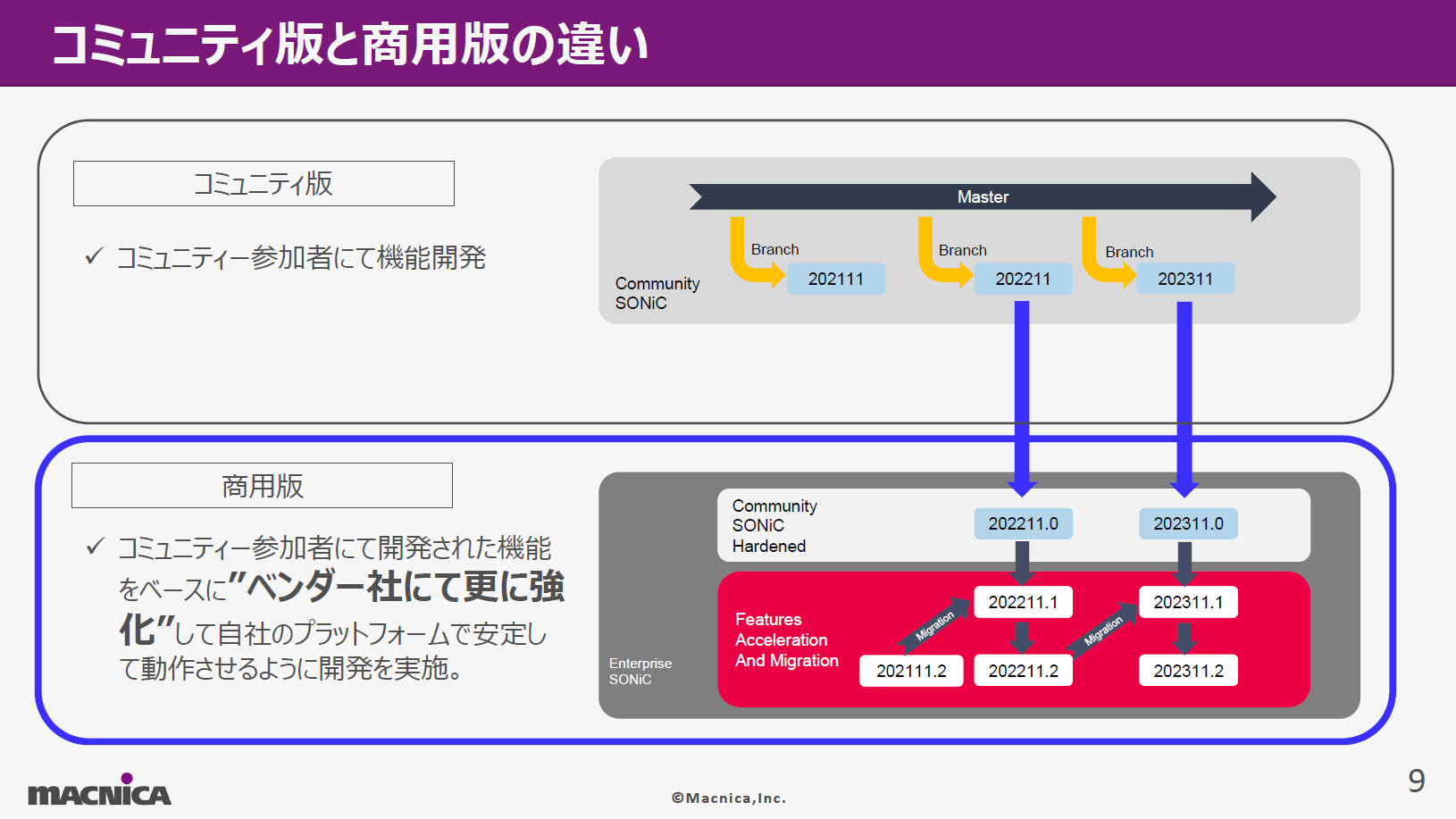
In terms of functionality, there are some key differences between the Community version of Sonic and the Edgecore version of Sonic. The difference in platform is a particularly important factor.
SONiC Community Edition: Compatible with white Box switches from multiple vendors, including those equipped with ASICs from Broadcom and Intel.
Edgecore SONiC: Designed exclusively for Edgecore switches, not compatible with switches from other manufacturers
As a benefit from the customer's perspective, the Edgecore version of SONiC is officially supported by the manufacturer, and compatibility with peripheral devices such as transceivers and cables has been verified, allowing for safe implementation and operation. Furthermore, maintenance is handled directly by Edgecore, so it is highly reliable in commercial environments and has a well-established support system.
SONiC Use Cases
Next, we will introduce a table that summarizes examples of switch port speeds to show what specific functions can be utilized with SONiC.
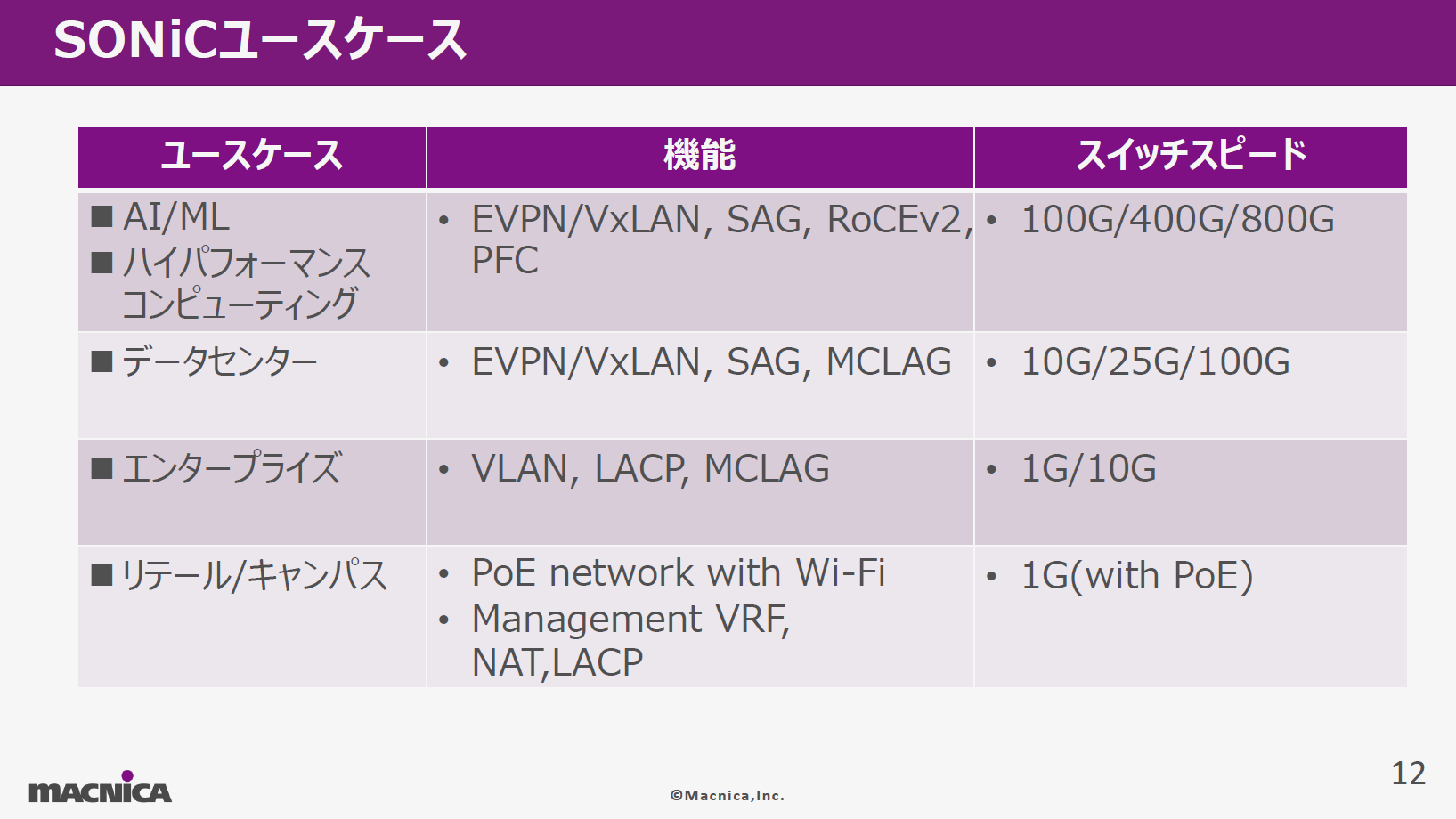
The network functions and switch configurations required for each application are introduced below.
For AI/ML and high-performance computing (HPC): High-speed 400G/800G switches leverage low-latency, high-bandwidth features such as EVPN/VxLAN and RoCEv2.
For data centers: 25G/100G switches are the main focus, and features with excellent redundancy and scalability, such as EVPN/VxLAN and MCLAG, are used.
For enterprises: 1G/10G switches with basic network isolation and bandwidth expansion features such as VLAN and LACP.
For retail / campus networks: PoE (Power over Ethernet) compatible switches allow you to connect and power devices such as IP phones and surveillance cameras.
Overseas, Microsoft, Alibaba, eBay, and others have been among the first to introduce SONiC, but in recent years, adoption cases have also been rapidly increasing in Japan. Many specific examples have been introduced at technical events such as JANOG and SONiC workshops.
SONiC domestic adoption example
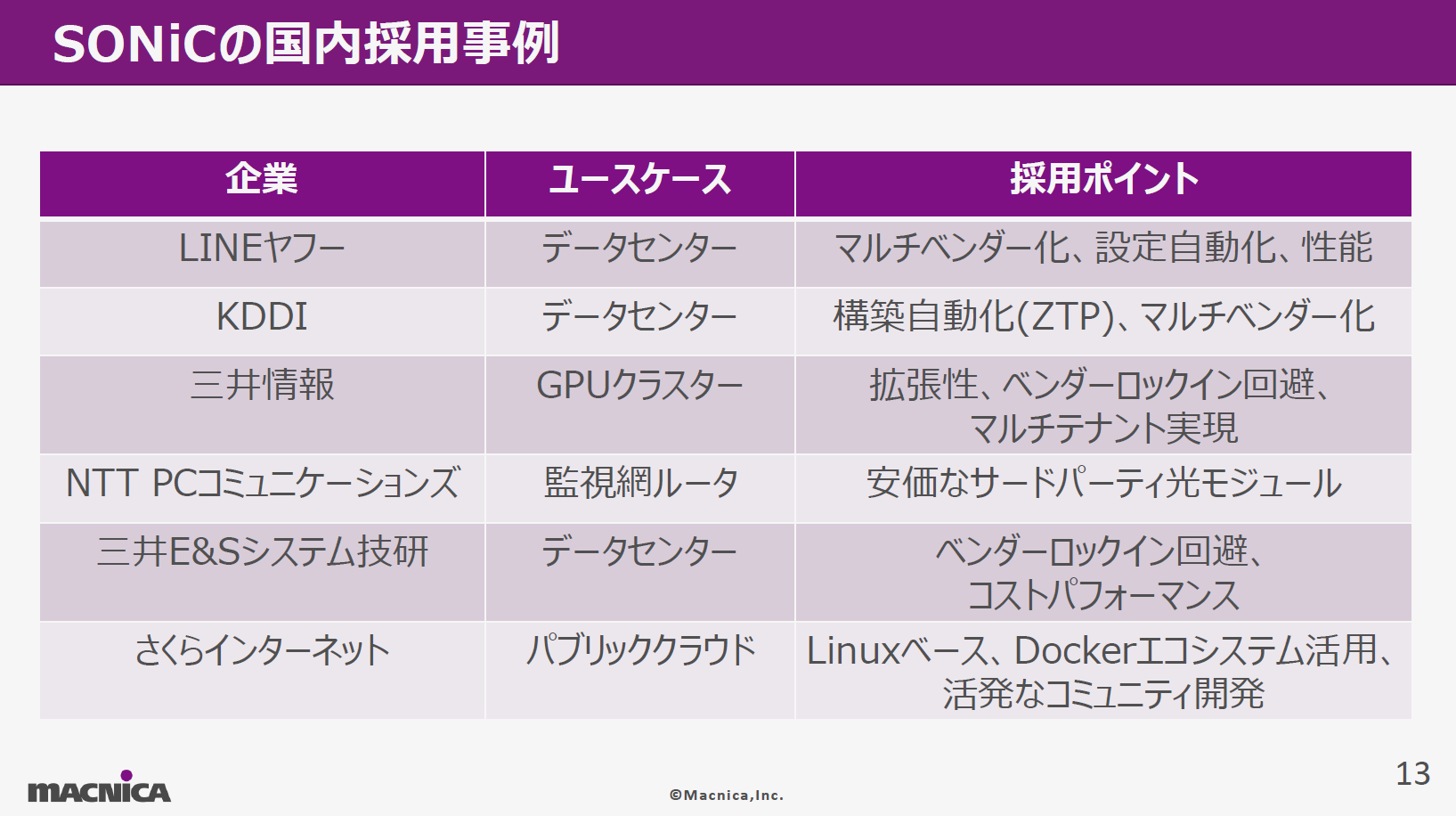
LINE Yahoo!: Implemented SONiC in the CLOS data center. Key points for implementation were multi-vendor compatibility, automated configuration, and high performance.
KDDI: SONiC is used in data centers. The key points for adoption are the automated construction using ZTP and multi-vendor support.
Mitsui Knowledge Industry (MKI): SONiC is being introduced to a GPU cluster for drug discovery. The key points for the introduction are scalability, avoidance of vendor lock-in, and multi-tenant support.
NTT PC Communications: Adopts SONiC for its monitoring network routers. Compatibility with inexpensive third-party optical modules is the key to its adoption.
Mitsui E&S Systems Research Institute: Deployed approximately 100 Edgecore SONiC and Edgecore switches in a large-scale data center network. Used to collect and transfer autonomous driving data, SONiC has been used from the PoC phase to the actual commercial phase.
*For details on Mitsui E&S 's implementation case, click here
How to obtain SONiC
There are two ways to obtain SONiC.
You can either get a pre-built image or build it yourself by entering the source code of the community version of SONiC.
The community version of SONiC can be downloaded from the Github link below.
*Download here
The commercial version of SONiC is available on each vendor's download site.
How to install SONiC
Next, let's talk about installation.
Generally, white Box switches are equipped with ONIE (Open Network Install Environment), so this is used to perform the installation.
There are several ways to download an image from an image server via the management port after logging in to the device via a console connection, or to import an image from a USB to the switch. In our lab, we use a method where the image is downloaded automatically from a DHCP server.
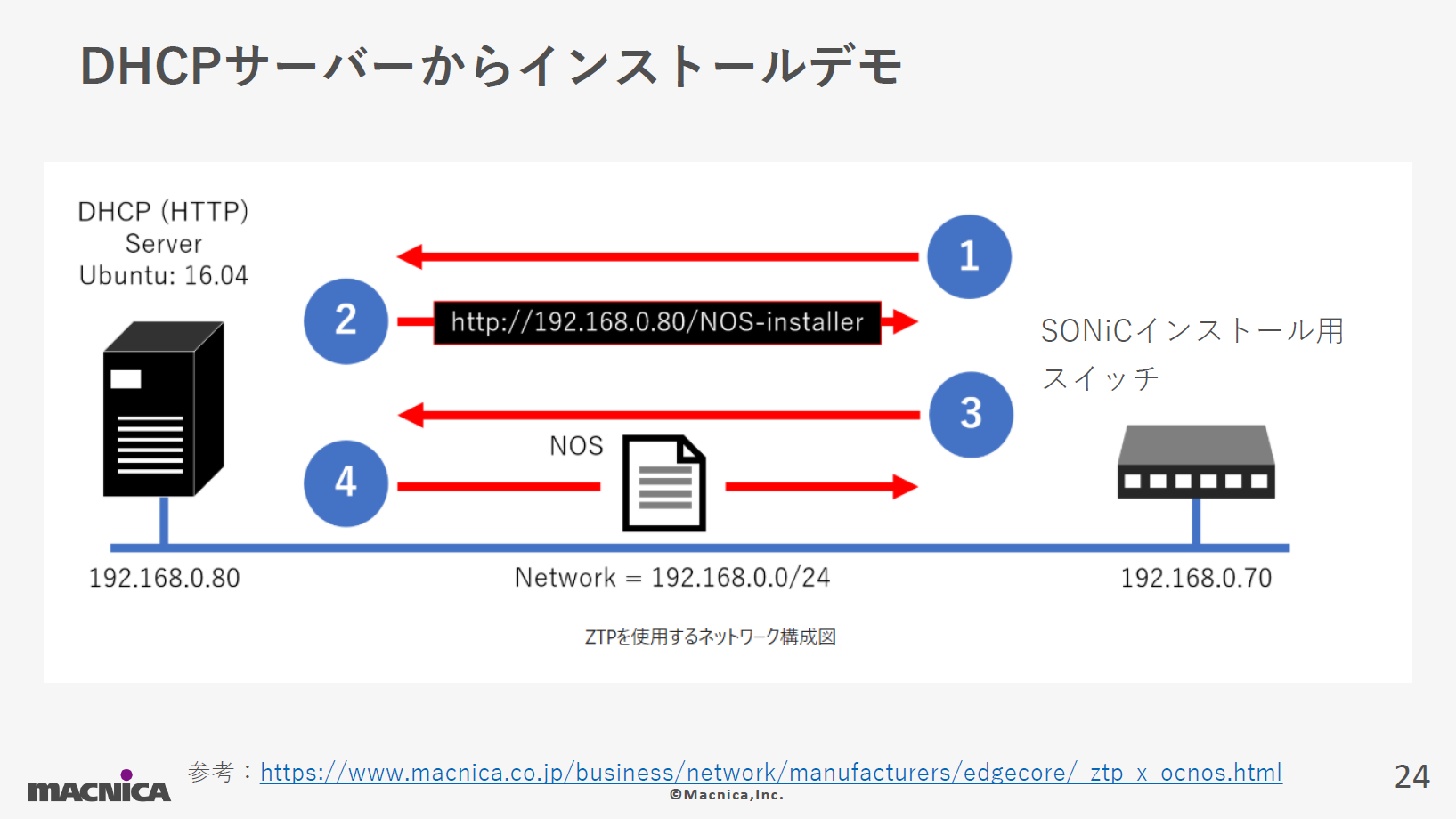
*Reference materials can be found here
Summary
In this article, we have systematically introduced SONiC 's basic architecture and ecosystem, the differences between each version, use cases, and even how to install it, so that even first-time users can easily understand it.
SONiC is an open-source network operating system that is flexible and scalable enough for use in commercial environments. In particular, when combined with white Box switches, it offers both cost-effectiveness and technical flexibility, which is why it is popular with many companies.
In Part 2, we will provide a detailed explanation of the "command system" that is essential for operating SONiC.
We plan to introduce the CLI (Command Line Interface) used in actual operations, as well as the main commands that are useful for configuration and monitoring.
If you are thinking, "I want to acquire knowledge that will be useful for construction and operation," please also take a look at Part 2.
Related information



Click here for list of materials

In addition to introducing products handled by Macnica,
We publish materials related to open networking, such as BGP cross network automatic construction files and network operation test evaluation reports.
Click here for details
Product Page Top

Aviz Networks
We are pioneers of SONiC, an open source network operating system, providing observability, configuration automation tools and support from a team of SONiC experts.

Edgecore Networks
We continue to be a pioneer in open networking by developing and selling products related to OpenNetworking/white Box switches.

IP Infusion
As a market leader among open networking providers, we provide reliable network solutions to over 600 customers, including carriers, service providers, and data centers.
Inquiry/Document request
In charge of Macnica Edgecore Networks
- TEL:045-470-9831
- E-mail:projectmonstar@macnica.co.jp
Weekdays: 9:00-17:00