Learn AI Agents and Data Infrastructure from Scratch | Databricks Agent Bricks Beginner's Guide
2025: The First Year of AI Agents: A Trend in Business Transformation
The use of AI is evolving from traditional chatbots to "AI agents that handle decision-making and action."
AI, which was previously a people-centered, advisory role, now works as an agent that "autonomously collects information, makes decisions, and takes action," linking with various systems within the company.
A future where work can proceed simply by people confirming and approving AI decisions is becoming a reality.

An AI agent is an AI that can understand a situation, make decisions, and actually take action.
Until now, AI has basically been in a position to support human work. For example, you could ask a chatbot, "What should I do about this?", and then use the answer to gather internal information yourself, organize the information, and document it. These processes were ultimately carried out by humans.
However, in the future, various internal systems will work in conjunction with AI agents, allowing the AI to acquire the necessary information and take action on its own. It is said that a future in which "humans simply need to check and approve the results, and work will proceed," is drawing closer to reality.
In this way, AI is evolving from simply being a "conversational entity" to being an "entity that acts on its own," and this is exactly the major trend in AI agents today.
Autonomous or semi-autonomous software that applies AI techniques to perceive situations, make decisions, take actions, and achieve goals in digital and physical environments

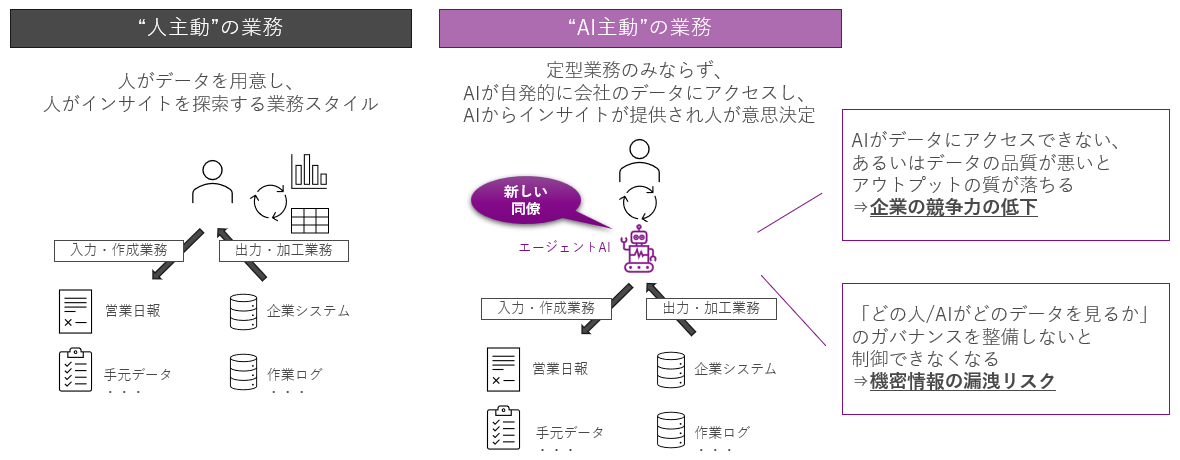
Driving this trend is the change in data structure associated with AI use within companies. According to a PwC survey, more than 70% of the data handled by generative AI is internal business data. Increasing numbers of companies are trying to generate more practical output by using AI not only to use open information, but also to utilize their own company-specific data, such as sales data, inventory data, and application logs.

PwC Japan Group, "Survey on Generative AI: Comparison of Five Countries, Spring 2025," accessed July 14, 2025
In this trend, AI Agents are attracting attention as entities that "act autonomously using a company's own data," but at the same time, it is also necessary to pay attention to points such as "data quality, governance, and access management."
Specific use cases and implementation effects
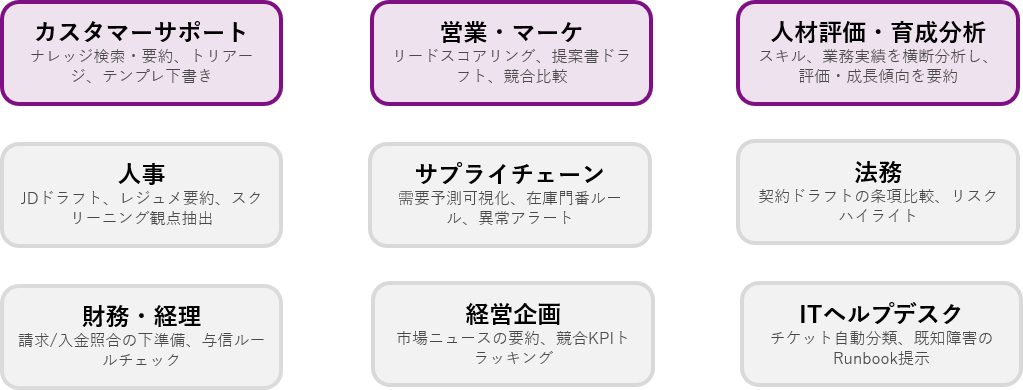
AI agents can streamline various internal business processes by automatically searching, judging, and executing on information.
for example,
- Knowledge search and inquiry draft generation for customer support
- Lead scoring and proposal drafting for sales and marketing
- Evaluating and reporting on HR operations and forecasting supply chain demand
- Learning support and risk analysis in educational settings
Such
By linking multiple specialized AIs (multi-agents), we can simultaneously ensure "advanced problem-solving," "high-speed and flexible processing," and "scalability/ease of operation."
This demo video will show how AI agents can be used in business, including data analysis and decision support using natural language.
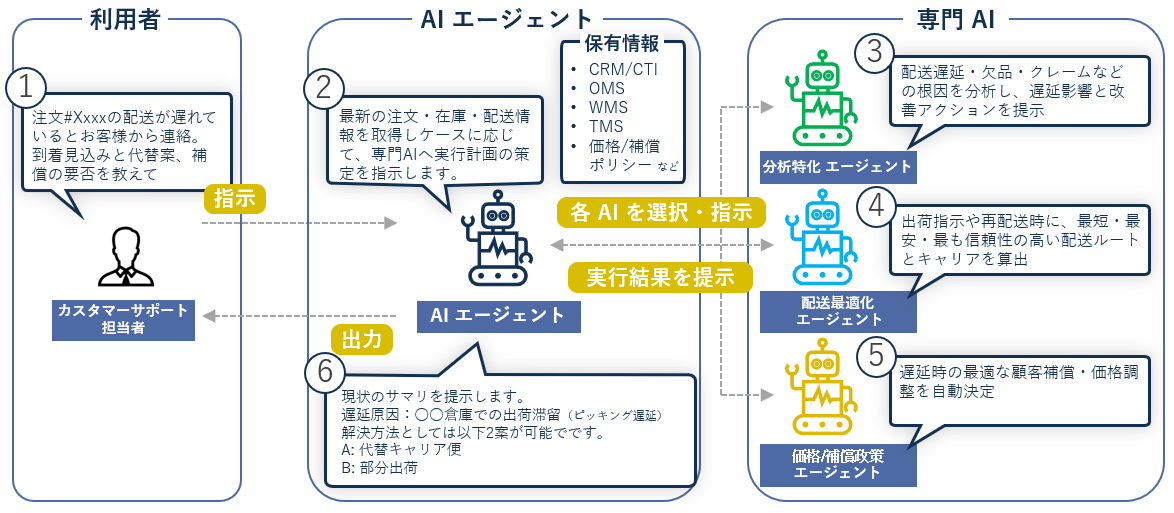
Use case example: Operational flow of a multi-agent system
Let me introduce a specific use case as an example.
User: Customer support representative
Usage scenario: Responding to inquiries about shipping delays, inventory shortages, etc.
- Instruct the AI agent to share the situation and present alternatives
- The AI agent references the necessary information from internal systems such as CRM and OMS, and determines which specialized AI should be assigned to handle the task (e.g., an agent specialized in analysis analyzes past trends and identifies the cause).
- Delivery optimization agent proposes specific delivery plans
- Pricing/Compensation Policy Agent automatically adjusts optimal customer protection plans and prices
- The AI agent compiles the results of these executions and presents them to the person in charge.
Use case example: Customer support in the supply chain area
Development environment
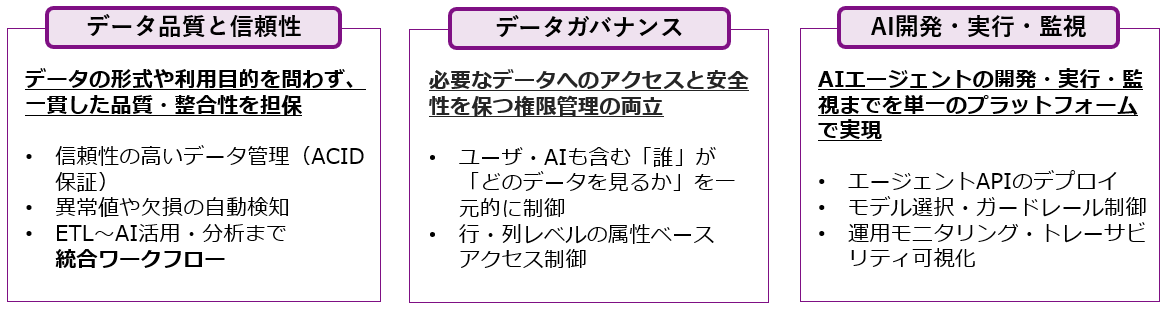
Finally, we will introduce solutions that enable the development of AI agents, while focusing on the key points that must be met when using AI agents: data quality, governance, and access management.
Data Intelligence Platform: Databricks
A single platform can handle everything from data collection, processing, and analysis to building and operating AI models.
In addition, by using the latest feature, "Agent Bricks," it is possible to automate the process from "problem definition → model selection and tuning → automatic construction of AI system → operational optimization."
Key features and functions:
- Build and integrate AI agents without coding (data on Lakehouse can also be used)
- Flexible use case deployment including "information extraction," "custom LLM," "knowledge assistant," and "multi-agent support"
- Strengthened security and governance (including visibility into permission management and data history)
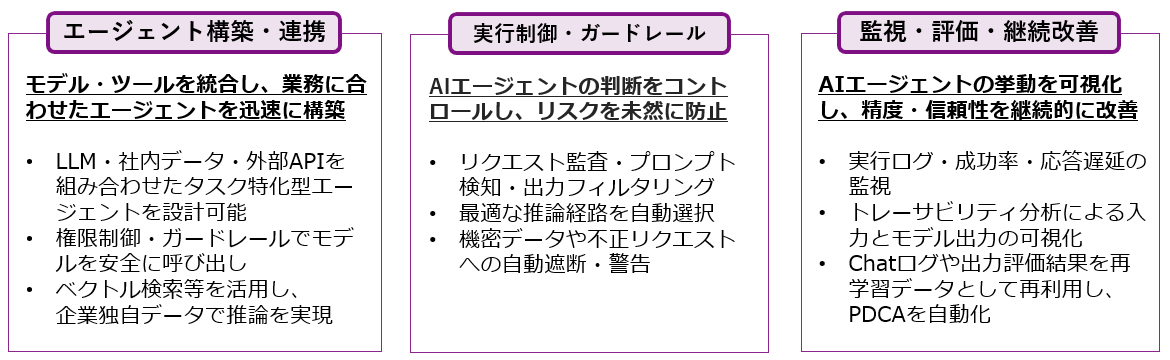
- Ensuring the safety and explainability of AI decisions through execution controls and guardrails
- Continuous automatic retraining of models improves performance and quality
- Serverless system & minimal charges (scale-to-zero when not in operation)
Agent Bricks automates much of the AI agent development process, facilitating efficient collaboration with field and business unit requirements.
<Databricks Features>
<Features of Agent Bricks>
Summary: Important points to keep in mind when developing AI agents
What is important when using AI agents?
- Promote the development of an AI agent infrastructure, including understanding business processes and sharing knowledge held by the company.
- Focus on the key points of "ensuring high-quality data," "governance design," and "secure access control."
is
Why not take advantage of new technologies that enable simple and flexible construction and operation of AI agents, while also paying attention to data quality and governance, and advance business reform by promoting data utilization and automation in the workplace?
Inquiry/Document request
In charge of Macnica Databricks Co., Ltd.
- TEL:045-476-2010
- E-mail:databricks-sales@macnica.co.jp
Weekdays: 9:00-17:00