Physical Security Technology Trends as Seen at ISC West 2026
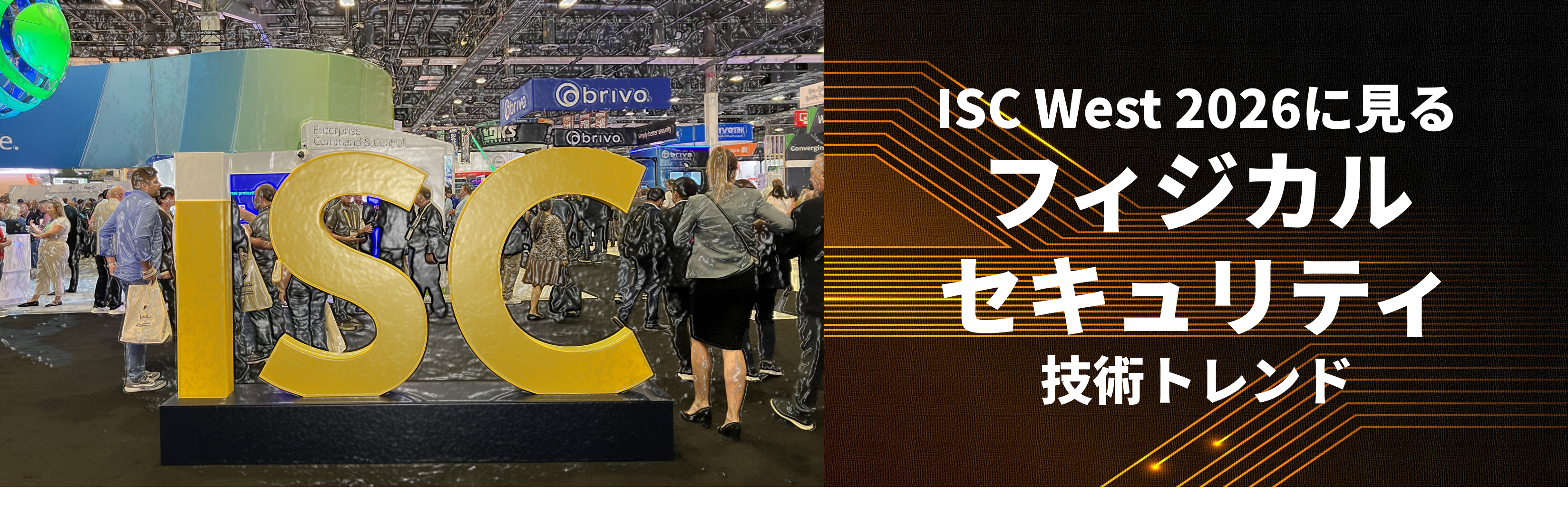
ISC West 2026 (Las Vegas, USA), one of the world's largest security exhibitions, attracted more than 29,000 visitors and over 750 exhibitors, showcasing the latest technologies and market trends in the field of physical security.
This article will not focus on introducing individual vendors' products or discussing their merits and demerits, but rather interpret the technology trends of ISC West 2026 from the perspective of "why these technologies are needed now" and "how these changes will affect security, facility operations, and management."
Macnica aims to revitalize the physical security market by organizing global technology trends through communication with top-performing suppliers in the security industry and participation in leading industry events, and disseminating this information in a way that is meaningful to the domestic market.
ISC West 2026 Overview
Date: March 23-27, 2026
Venue: The Venetian Expo (Las Vegas)
Scale: Over 29,000 visitors / Over 750 exhibitors / Participants from over 80 countries
Main themes: Physical Security / Cybersecurity / Digital Trust & Identity / AI / Access Control / Detection & Response
ISC West is more than just a product exhibition venue; its importance is growing year by year as an indicator for understanding the trends in the security market over the next few years.
Security Technology Trends ①
Expanding the scope of AI applications (from detection to judgment and response - Agentic AI)
The biggest change in 2026 will be the expansion of AI's role from "detection" to "judgment and response."
- Integration with existing cameras, access control systems, and various sensors.
- Removes noise and automatically extracts incidents that require attention.
- Automation and acceleration of responses through standardized workflows
In security and surveillance settings, the challenge of "detection is possible, but human response is insufficient" has become apparent. As a result, "Agentic AI," where AI handles decision-making and initial response, is now being discussed as a realistic option.
Agentic AI is no longer an advanced feature, but is becoming a prerequisite for the future of security and surveillance operations.
Security Technology Trends ②
Accelerating integration with other companies' systems (openness/ecosystem)
At ISC West 2026, there was a clear decrease in the appeal of standalone, self-contained products.
What came to the forefront instead was the following cross-layer integration:
- Aggregation of video and non-video data using an integrated platform (VMS/PSIM)
- Visualization of the entire operation through video and entry/exit information.
- Automation of operations and standardization of response flows using AI
- Designed with the assumption that AI analysis functions will be added or expanded later.
VMS is no longer merely a "video management system," but is increasingly being positioned as an operating system that supports overall physical security.
To meet increasingly sophisticated on-site requirements, it is essential to design an architecture that prioritizes integration and scalability, rather than focusing on individually optimized products.
Security Technology Trends ③
Expanding presence of NVIDIA-related solutions
As AI is increasingly implemented in society, solutions based on NVIDIA's technology stack have become even more prominent.
- AI learning video data platform designed with regulatory compliance in mind
• High-performance video analysis utilizing GPU, edge AI, and Vision AI
- Processing regression and distributed processing from the cloud to the edge
In the field of physical security, AI is also shifting from something to "experiment with" to something to "continue to operate stably."
In the future, not only AI algorithms, but also the choice of computing and operational infrastructure supporting AI will determine competitiveness.
Security Technology Trends ④
Rather than just robots, "AI software/integration/automation"
The exhibition of individual robots is limited, and the widespread adoption of security robots in private facilities remains a significant challenge.
In the background,
- The limited number of use cases in which ROI is achieved.
• Litigation risks associated with physical contact (especially in Europe and the US)
• Cybersecurity concerns
These are some of the factors involved.
On the other hand, in the context of "AI software x integration x automation," including robots, there was an increase in highly practical proposals.
The key evaluation criterion is whether the system as a whole can provide value, rather than just the hardware itself.
Security Technology Trends 5
While pushing the cloud to the forefront, on-premises remains the main focus.
While many vendors emphasized cloud services, the reality is that on-premises/edge solutions remain the main players.
• Regulatory and compliance requirements
- Clarification of the points of responsibility
• Real-time and low latency requirements
For these reasons, a complete migration to the cloud has not progressed.
In the future,
- Cloud-based management, analysis, and AI only.
Detection and control are available on-premise/at the edge.
This hybrid configuration is expected to become the mainstream.
Rather than idealistic theories, a configuration selection that aligns with real-world operational requirements is needed.
The essential questions we must confront now
The exhibits at ISC West 2026 raise the following questions:
Have you clearly defined which tasks should be handled by humans and which should be entrusted to AI?
- In terms of physical security, is the system not fragmented?
- Can you explain the value of security investments from a management perspective?
These are not only technical issues, but also organizational and management challenges.
Macnica 's efforts
Macnica,
While accurately incorporating cutting-edge AI technology
Based on an integrated solution centered around Genetec
- Promote reliable implementation on-site through collaboration with security companies.
In this way, we will continue to contribute to solving social and business challenges starting from physical security.
We are not merely product providers; we aspire to be a company that continuously interprets the evolution of physical security from both structural and practical perspectives, and presents meaningful options for the market.
Going forward, Macnica will continue to provide valuable information based on global technology trends, including those at ISC West.
Contact Us


 Latest Information
 Case Study
 Blog
Blog Document List