Macnica and TGES begin joint demonstration project to realize autonomous inspection of plant and utility equipment using physical AI - verifying next-generation inspection and operation models using humanoid robots and digital twins -
Tokyo Gas Engineering Solutions Co., Ltd. (President: Takayuki Uenaka, hereinafter "TGES") and Macnica (President: Kazumasa Hara, hereinafter "Macnica") have signed a Memorandum of Understanding (MOU) to promote the use of physical AI in daily inspection operations of plant and utility facilities, and will commence joint demonstration (hereinafter "this demonstration").
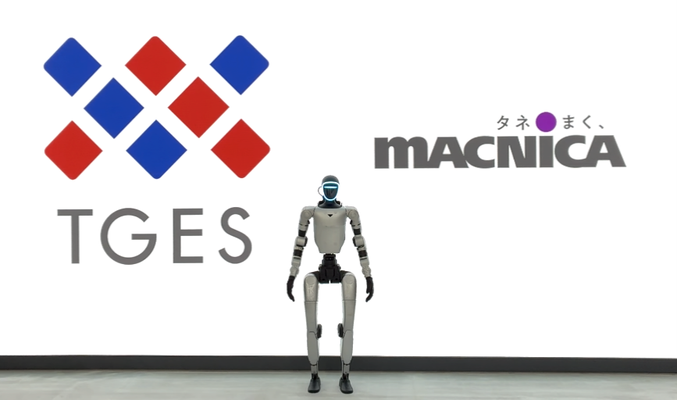
TGES and Macnica collaborate to verify a next-generation inspection and operation model.
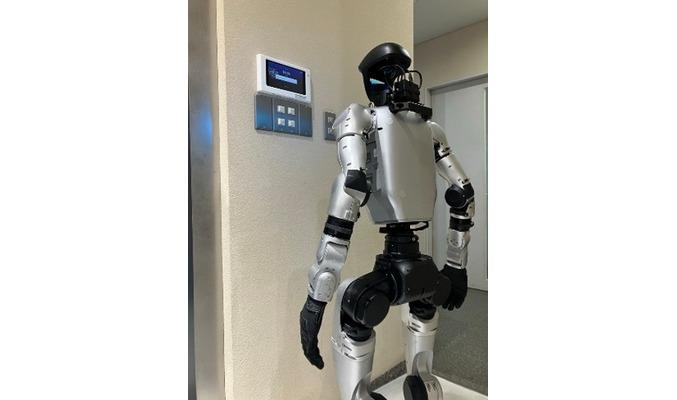
Image of a patrol inspection
This demonstration project aims to verify the feasibility of using humanoid robots in the daily inspection of plant and utility facilities, with the goal of realizing autonomous inspections using physical AI in the future. TGES will combine its inspection knowledge and operational expertise, cultivated over more than half a century of O&M for district heating and cooling systems and on-site energy service management, with Macnica 's AI and robotics technologies. The project will begin with verification of basic movements such as autonomous walking. Going forward, the scope of verification will be gradually expanded to include patrols, information acquisition, and equipment operation, with the aim of establishing an inspection model in which humans and robots collaborate.
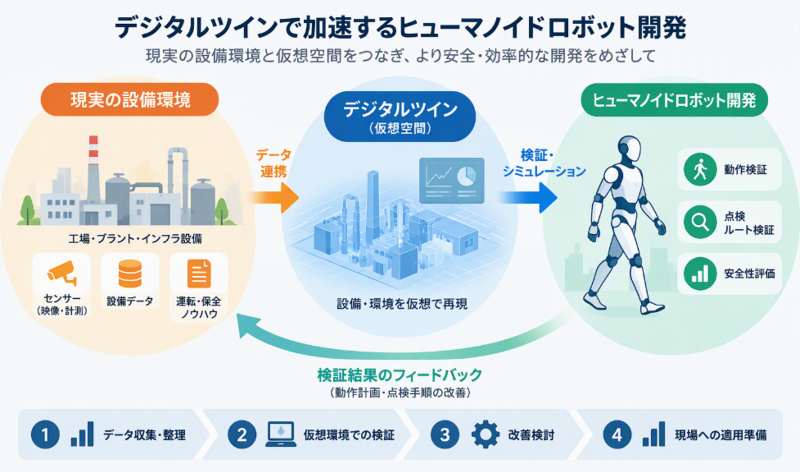
Verification in a virtual space (digital twin)
Specifically, we envision building a digital twin environment *2 by utilizing environmental data of actual facilities acquired through 3D laser scanning and the NVIDIA Omniverse™ *1 library. We will gradually improve the robot's operational accuracy through the Sim2Real *3 cycle, which reflects data acquired in the actual field into simulations and returns the learning and verification results in the virtual space to the actual robot. We will also utilize simulations in which multiple robots are operated in parallel in the virtual space to improve the efficiency of learning and verification.
Existing plant and utility facilities are designed with the assumption that people will move around and operate them, and therefore have stairs, steps, doors, narrow passages, and switches positioned for human operation. By utilizing humanoid robots with similar forms and ranges of motion to humans, we aim to adapt to these environments without significantly modifying existing facilities, and in the future, have them handle everything from inspection and information acquisition to equipment operation.
■ Background of the initiative
Maintaining stable operation of plant and utility facilities requires daily inspections, including patrols, instrument checks, visual inspections, and record keeping. However, in 24-hour operation environments, securing inspection personnel, passing on skilled techniques, and managing the burden of nighttime and holiday work are challenges to sustaining facility management. To address these challenges, we believe it is necessary to shift operations where robots handle routine movement, inspection, and record-keeping tasks, allowing humans to focus on more advanced tasks such as anomaly detection, root cause analysis, improvement planning, and maintenance planning, rather than simply replacing human work with robots.
■ Roles of both companies
| TGES | - Development of a demonstration environment (provision of on-site energy plant facilities and use cases) - Requirements definition based on on-site needs |
| Macnica | - Support for the implementation of physical AI (AI model development, data collection infrastructure, and simulation environment construction) • Collaboration with technology partners (including NVIDIA and other leading technology ecosystems) |
TGES incorporates inspection points and management standards accumulated for each piece of equipment into robot-based inspection plans and evaluation of acquired data. It also organizes the actions, viewpoints, and inspection sequences of skilled workers as data necessary for robot learning. Macnica utilizes this field knowledge and demonstration environment to accumulate data and insights for future automation and sophistication by repeatedly conducting simulations and actual machine verifications.
Going forward, we plan to formulate a demonstration plan during fiscal year 2026 and begin verifying basic operations in a test environment where risks can be minimized. Based on the knowledge gained through this demonstration, we will gradually expand the scope of application, aiming to realize autonomous inspection of plant equipment around 2030. Furthermore, we will promote technical cooperation with multiple companies, including robot manufacturers, and work towards proposing this as a solution that contributes to solving equipment management challenges in various industries and business types.
■ Company Overview
Tokyo Gas Engineering Solutions Co., Ltd.
| location | 1-2-3 Kaigan, Minato-ku, Tokyo, Shiodome Shiba Rikyu Building |
| representative | Takayuki Uenaka, Representative Board Director, President and Executive Officer |
| Established | April 1, 2015 |
| Business | Gas and electricity sales and on-site energy services (including renewable energy) / Heat supply business / Engineering business for energy infrastructure such as LNG terminals / Solutions business for corporations |
Macnica
| location | 1-6-3 Shin-Yokohama, Kohoku-ku, Yokohama City, Kanagawa Prefecture |
| representative | Kazumasa Hara, Representative Director and President |
| Established | October 30, 1972 |
| Business | Semiconductor business importing and selling semiconductors and electronic components; Cybersecurity business importing and selling network and cybersecurity products; CPS solutions business providing Services & Solutions related to smart cities, mobility, and the circular economy. |
*1: NVIDIA's development platform that reproduces real-world environments in a digital space, enabling robot motion learning, simulation, and verification.
*2: A virtual environment that reproduces real-world facilities and spaces in a digital space and performs simulations that mimic the real environment.
*3: A method for applying robot movements and control learned and verified in a virtual environment to a real-world environment.
Inquiries from the press regarding this matter
Macnica://www.macnica.co.jp
Public Relations Office Miyahara E-mail: macpr@macnica.co.jp
Macnica Building 1, 1-6-3 Shin-Yokohama, Kohoku-ku, Yokohama 222-8561
 Latest Information
 Case Study
 Blog
 Document List