
New business development is an essential measure for corporate growth. Because the mission is to create innovation, many companies start from zero and find themselves stuck without a clear answer.
To provide some hints for solving these problems, this article outlines five common challenges that arise in new business development, and introduces some ideas and actions that can be taken to address them.
How long can we continue with the existing business model?
First, let's summarize the overview of new businesses. Many companies promote their main business activities with the aim of linear growth that is roughly proportional to the resources invested. If a business model continues to work for 10 or 20 years, one of the reasons for this is likely to be that "existing customers always treat us the same way."
However, in recent years, the rapid change in society has made it difficult to predict the future, and there is an increasing risk that existing businesses will no longer be viable due to external changes in the environment and the entry of competitors from other industries. Or, there may be cases where operations will not run smoothly due to a shortage of manpower.
Given this situation, the number of companies wondering, "Is it okay to just continue with the current business model?" is steadily increasing. For this reason, it is inevitable that efforts will be focused on developing new businesses, which is one way to overturn the current model.
However, the reality is that there are many cases where things are not as straightforward as they seem, such as when a new business does not have concrete results or when there is a large gap between the thinking of management and those on the ground, making it difficult to put the idea into action.

5 Common Issues for New Businesses
Next, we will introduce five common challenges faced by new businesses that we have actually encountered in our interactions with customers.
① The means take precedence
The purpose of a new business is basically to "transform the business model." However, it is no exaggeration to say that it is the most common case that the important purpose is overlooked and the means take precedence.
One example is the use of AI, a cutting-edge technology. Around 2018-2019, when AI was particularly popular, many companies requested PoCs from outside, harboring the faint hope that "AI will help us create new business" or "our internal systems will change." The number of cases on the contracting side also increased, and at first glance it was a win-win. However, there were many cases where the contracting side's actions stopped at the PoC because the client's objectives were unclear, and new businesses did not get off the ground and business efficiency could not be improved.
Generative AI has been attracting a lot of attention since 2023, but if you are thinking of using it for reasons such as "I feel like I'll be left behind if I don't use it" or "I want to do 'something' with it," then the yellow light may be flashing.
② The new business development process is unclear
In many cases, new business development is delegated to a person in charge by upper management, who then works with vendors and consultants or works hard on their own to plan the business. A common problem in such cases is that the new business development process is not clear.
This problem makes the evaluation criteria for the planning and concrete stages unclear, which ultimately creates an opportunity for upper management to ask the person in charge to produce a perfect business plan. Of course, it is impossible to get a perfect score from the beginning for a new business, but a person in charge who is stuck will have no choice but to create a proposal "for upper management" or proceed with a business development process "for upper management". Once you fall into this situation, it will be difficult to expect a new business launch, no matter how talented the people involved in the project, including the person in charge, are.
3) Unable to escape from the accumulation of logic
New business development is generally entrusted to people with no experience and no starting point, so they tend to rely on logic. Some people follow marketing common sense and use the STP (Segmentation, Targeting, Positioning) framework to select the market, decide on their target, and think about what to do with themselves.
In particular, the more enthusiastic people are, the better they are at building up logic and the more time they have to spend on things. There are probably many cases where failure can lead to a negative evaluation, so this kind of response is unavoidable.
However, in reality, this caution is the entrance to a maze with no exit, and is not a good idea from the perspective of project promotion. In the first place, new business development is influenced by not only internal factors but also an infinite number of external factors in a complex manner. In other words, there is no correct answer that is determined from the beginning. However, there is a risk that you will waste time by endlessly developing logic such as "Is the goal over there?" or "Is there a higher probability over there?" and not taking action.

4. The company’s core is unclear
To put it another way, starting a new business is a game of finding out "in what field of business can your company have an advantage?", so it is necessary to have a core competency and a source of strength beforehand. However, it is common to jump on anything that catches your eye, thinking "this looks like it could be a business" without considering this rule.
If you do not recognize your company's core elements and strengths, you will likely just end up discussing it, wasting time, and not being able to scale.
5) Lack of understanding of the company structure and workplace
A vertically divided organization and an environment where the work of others is unclear also makes it difficult to see the purpose of a new business. For example, a company has various departments such as planning, development, sales, and customer success, but it is difficult to know in detail what you are contributing to the supply chain and how you are contributing to the company's management strategy, and to link these to your daily work. On the other hand, managers such as section managers and department heads can look around from a relatively high perspective, but on the other hand, it can be a problem that they have difficulty seeing issues at the field level.
These are quite natural things, but they can lead to a situation where the means and the ends do not match, especially when developing a new business.

The road to success
So how can we solve the problems mentioned above? Let's take a look at some possible solutions.
Our Group's Purpose-driven
In many cases, the means take precedence in new business development because the company was not clear about what it wanted to do in the first place before the project started, or it became unclear during the project. Sometimes conversations with vendors or consultants can help you realize your goals, but it is still advisable to clarify the direction of the new business in-house beforehand.
In this situation, it is important to utilize the unchanging Our Group's Purpose (reason for the company's existence). For example, in the case of our company, semiconductors tend to be the topic of conversation in the general public, but we are actually also working on an unusual new business, "growing the highest quality wasabi in containers."
Our purpose is to "discover all kinds of technologies from around the world and implement them in society." In addition, while working on more than 10 new businesses in different fields, everyone from Our Group's Purpose to the field understands the importance of searching for cutting-edge technologies from around the world and focusing on social implementation. This allows the field to boldly take on new business challenges, and new businesses are born that do not deviate from the business strategy.
To succeed in a new business, you need to deeply understand your company's strengths and reason for existence, and visualize the core of corporate development that will maximize those strengths. Our Group's Purpose serves as a compass that shows you the way forward. However, I think many companies call it a corporate philosophy instead of Our Group's Purpose. Even if the expression is different, if you have been able to verbalize your core in some way, it is a good idea to use that as a compass for your new business.

Appoint a facilitator
When it is difficult to build horizontal connections within the company, it can be effective to have a "facilitator" who acts as a buffer to grasp and organize information such as the company's business model, stakeholders, and challenges.
There are many things you can expect from a facilitator, but what is especially important in new business development is for the facilitator to prioritize efforts by aligning the perspectives of management and the field. This allows management to understand the issues at the field level, and the field to understand the purpose of new business development, so that both parties can approach the project with a good understanding.

Let's consider a specific case.
First, let's say a company has an issue where salespeople are unable to share minutes of sales negotiations with their teams. From the perspective of the salespeople, this may be fine because they remember it. However, from the manager's perspective, it may be a serious issue because they are unable to develop a business strategy because no information is coming from sales.
Customer success may be dissatisfied with not being able to understand customer feedback and their level of satisfaction, and developers may be dissatisfied with not being able to get hints for what to develop next. Furthermore, marketing staff may have to promote products that developers have worked so hard to create, which may result in the product not selling.
It is obvious that the reason for the failure in this case was not "development was unable to create a good product" or "marketing staff's promotion was poor." However, it is difficult to notice this because the whole picture cannot be seen from the field. In other words, the presence and perspective of a third party, a facilitator, which you may be thinking right now, "Isn't it necessary to make sure that sales staff can properly keep daily reports?" is essential to align the means and ends of a new business.
Repeat short cycles many times
As mentioned above, new business development can sometimes rely on the accumulation of logic, but the way things should be is "observation, proof, and improvement." In other words, it's about "how to scale a business model while repeating challenges and making improvements." The idea is not to use logic to find the goal of a maze, but to actually go forward and, if you hit a wall, go back and immediately look for another path.
By the way, one framework that encourages such quick decision-making and action is the OODA loop, which stands for Observe, Orient, Decide, and Act.
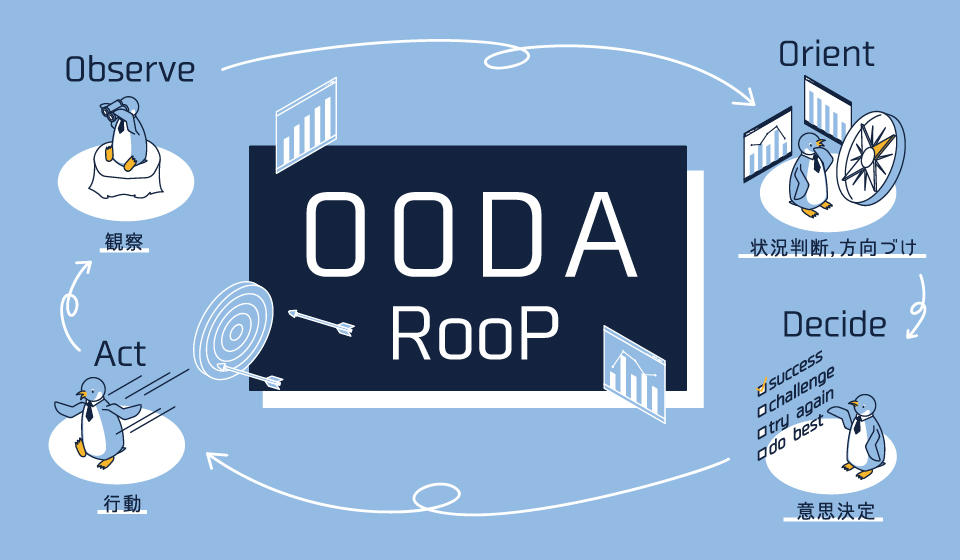
In new business development, it is very unlikely that every challenge will be a hit, so it is very important to try as many as possible. At the same time, it is important to keep in mind that the results of the challenge should not be seen as a negative factor such as "failure," but as a positive factor of "verification and learning." To do this, it will be necessary for management in particular to change their perspective by understanding the process of new business development and the efforts and challenges on the ground.
The "make it first" approach that changed us

We have introduced various challenges in new business development so far, but we have experienced the same difficulties as you. For example, when we tried to develop our own product, we had a bitter failure in which we were unable to produce a single output after a year. At that time, we had repeated fruitless discussions and our logic trees kept growing endlessly every day.
What put an end to this situation was the idea of "create first," which one day came out of the head of the department. As the words suggest, the aim was to first create something and take even one step forward with the product. And as a result of all the members of the department working together to "create first," things started to go smoothly, as if the past had never happened before, and they succeeded in creating four products in just six months.
This "create first" approach is different from so-called agile development. Rather, it is a way of thinking that should be practiced by those who are worried that "agile development is difficult and doesn't work..." by relaxing a little. Even something small can become a material to persuade others in new business development, or open up a world that was previously invisible. If you are interested, please take a look at the detailed materials.
\Click here to apply for materials detailing new business development/

Summary
In this article, we introduced the challenges and solutions for new business development. Focus on Our Group's Purpose, appoint a facilitator, and run many short cycles. By keeping these three points in mind, the path you should take in the future will naturally open up. On the other hand, it is important to be careful not to prioritize the means alone or to not become too focused on piling up logic. In addition, in today's increasingly complex environment, it is becoming more difficult for a company to solve various issues on its own.
Therefore, we are holding free consultation sessions to help resolve the concerns of customers working on new business development (as of July 2024. The situation is subject to change).
In this initiative, we will pursue the exploration and implementation of cutting-edge technology while thoroughly supporting our customers in solving all kinds of issues under the motto of "Create first," and maximizing our strengths as a trading company. No preparation is required for the consultation, and it is open to all industries, so please feel free to contact us!
Click here for details on the free consultation session.

\Click here for details on Re:Alize/

 Latest Information
 Case Study
 Blog
Blog Document List