- Semiconductor BusinessHOME
- Products and Services of Macnica,Inc.
-
technical information

-
Events and Seminars
- Handling Manufacturer
- Support
- Inquiry
- Click here to purchase products
- Semiconductor business e-mail magazine registration


 Narrow down by specifying conditions
現在2240件がヒットしています。check

When creating a board to mount an Altera® FPGA, designers create a circuit diagram by referring to the documents published by the manufacturer.
Here, we will guide you to the points that you should pay special attention to.
The Altera®
In addition to checking the circuit diagram with
Target FPGA
・ Altera® Cyclone® 10 GX
Advance preparation
Here are some documents that can be used as reference when creating circuit diagrams.
|
Pin connection guidelines |
Schematic review worksheet |
|
Pin Connection Guidelines (All Devices Except Agilex™) *Altera® Agilex™ familyHere |
|
| Cyclone ® 10 GX Device Family Pin Connection Guidelines | Cyclone ® 10 GX Devices Schematic Review Worksheet |
Cyclone® 10 GX Overview (FPGA TOP)
The figure below shows the pins that need special attention when designing the Cyclone 10 GX board.
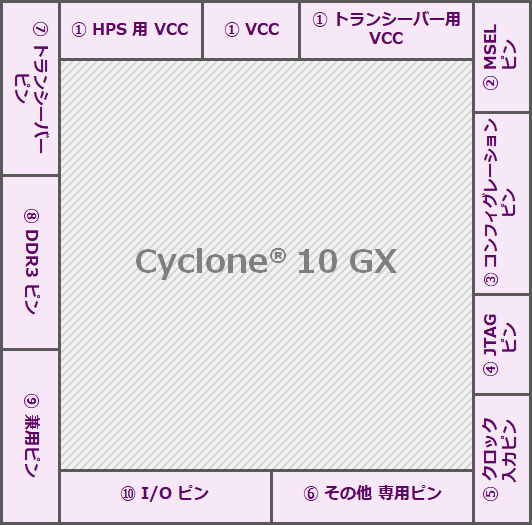
* The layout in the diagram has nothing to do with the actual device.
Click each item to see the check points.
| ① VCC, VCC for HPS, VCC for transceiver | ② MSEL pin | ③ Configuration pin |
| ④ JTAG pins | ⑤ Clock input pin | ⑥ Other dedicated pins |
| ⑦ Transceiver Pins | ⑧ DDR3 pin | ⑨ Multipurpose pin |
| ⑩ I/O pins |
― |
― |
① VCC, VCC for HPS, VCC for transceiver
|
● Establish a measurement point near the FPGA ・Be ready to measure the power supply in case of trouble |
|
● If all transceivers, fPLLs, and IOPLLs on the same side are unused, VCCT_GXB can be connected to GND (Check pin connection guidelines for details)
|
|
● Decoupling capacitor ・Estimate with reference to the PDN tool ・For a more detailed estimate, use a dedicated tool <Reference> Power Delivery Network (PDN) Analysis Tool Part 9 Confirmation and Review of Capacity in FPGA Power Supply Design |
|
● Power sequence
For more information, please see this document (Power Sequencing Considerations for Altera® Cyclone 10 GX Devices). |


② MSEL pin
Please see below for Cyclone 10 GX MSEL pin information.
|
MSEL Pin Settings |
Inserting pull-up/pull-down resistors(1)(2) |
|
* Refer to "MSEL Pin Settings" on the link |
(see linked documentation) |
(1) A Weak Pull-Down Resistor (25kΩ) is inserted inside.
(2) If you want to switch the configuration mode, insert a 0Ω resistor to switch to VCCPGM/GND.
(3) Do not drive the MSEL pins with a microprocessor or other device.
See here for a list of MSEL pins.
③ Configuration pin
|
● DCLK ・Recommend inserting damping resistor (minimum 0Ω) 10-50Ω ・In AS mode, take care of the trace length (see the document below) Trace Length Guideline (from “Configuration, Design Security, and Remote SystemUpgrades in Altera® Cyclone 10 GX Devices”) |
|
● nCONFIG, nSTATUS ・Pull up to VCCPGM via 10kΩ resistor |
|
● CONF_DONE ・Pull up to VCCPGM via 10kΩ resistor ・Do not connect to the LED as it is. - Due to lack of drive current, it may not light up without applying FET |
|
● CLKUSR ・ Must be entered before configuration - For AS mode, input 100MHz clock - For PS, FPP mode, input 100 ~ 125MHz clock ・When using a transceiver, use CLKUSR as the calibration clock (required) |
|
● For migrating from EPCS/EPCQ to EPCQ-A, refer to AN822: Altera® FPGA Configuration Device Migration Guideline. |
|
● When FPGAs are cascaded, nSTATUS and CONF_DONE are pulled up in common. |
|
● nCE ・Connect to GND for single device configuration. ・This signal determines whether the FPGA is cascaded. |
|
● When using nCEO, pull up to VCCPGM through a 10kΩ resistor. |
④ JTAG pins
|
● Check Point ・It is recommended to insert a 0Ω damping resistor for TCK. - To support cases where writing is not possible due to problems with the clock system |
|
● Pin processing ・TCK: pull down via 1kΩ resistor ・TDI: Pulled up to VCCPGM via 1kΩ to 10kΩ resistor ・TMS: Pulled up to VCCPGM via 1kΩ to 10kΩ resistor ・TDO : No pull-up/pull-down ・TRST : Option used. Pull up to VCCPGM through a 1 kΩ resistor if unused. |
| ● When cascading three or more FPGAs, insert buffers on the TCK and TMS lines. |
⑤ Clock input pin
|
● When using a single-ended clock, assign it to the p-channel (Does not ride on global clock directly on n-channel. Limitation when using ALTCLKCTRL buffer) |
|
● Pay attention to AC/DC coupling when inputting differentially. |
|
● If you are using a PLL, pull down the RREF pin through a 2kΩ resistor (resistor accuracy is ±1%). |
|
● CLK and PLL pins can be left unconnected if not used. |
* Refer to "Clock and PLL Pins" in Cyclone 10 GX Device Family Pin Connection Guidelines for clock input pin names.
⑥ Other dedicated pins
|
pin name |
comment |
| RREF_[T,B][L] |
Pulled down through a 2kΩ±1% resistor |
| VREFB* | Tie to VCCIO or GND in the same bank if not used as a dedicated pin |
| VREFP_ADC / VREFN_ADC | Connect to GND if not used as a dedicated pin. |
|
TEMPDIODEp/n |
Connect to GND if not used as a dedicated pin. |
⑦ Transceiver Pins
|
● When not using the transceiver ・Clocks (REFCLK_GXB*_CHp/n) are individually connected to GND or collectively pulled down via a 10kΩ resistor. ・RX (GXB*_RX_*p/n) is connected to GND ・TX (GXB*_TX_CHp/n) is floating |
|
● AC/DC coupling ・Adjust to I/O Standard |
⑧ DDR3 pin
Please refer to the document below.
・ External Memory Interface (EMIF) Schematic Check Items [Altera® Cyclone® 10 GX FPGA]
⑨ Multipurpose pin
|
● Connect to GND if not used as a function pin and not used as a user I/O pin. ・ CLKUSR ・ DEV_OE ・ DEV_CLR |
| ● If nPERSTL0 is used as a reset pin for PCIe hard IP, shift down the voltage from 3.3V LVTTL to 1.8V and connect it through a level translator. |
⑩ I/O pins
The RZQ pin must be processed when performing internal calibration.
Recommended to use the RZQ pin to enable the internal calibration feature.
If using 2.5/3.0-V, check if the device supports it.
Appendix: Cyclone 10 GX MSEL Pin List
MSEL Pin Settings (FPGA Configuration)
|
Device Family |
Configuration Mode |
VCCPGM(V) |
POR Delay |
MSEL[2:0] |
|
Cyclone 10GX |
AS (x1, x4) |
1.8 |
Fast |
010 |
| Standard |
011 |
|||
|
PS, FPP (x8, x16, x32) |
1.2/1.5/1.8 |
Fast |
000 |
|
| Standard |
001 |
Click here for recommended articles/materials
Altera® Agilex™ FPGA & SoC External Memory Interface (EMIF) Schematic Checklist
Feasibility study Design guidelines
EMIF Design & Debug Guidelines
Active Serial Configuration Design & Debug Guidelines
Timing & Implementation Design & Debug Guidelines