
On February 22, 2025, a "talk event with a perovskite solar cell researcher + dye-sensitized solar cell craft experience" was held at the Hamagin Children's Space Science Museum (Yokodai, Isogo-ku, Yokohama).
This event was hosted by Macnica, Pexel Technologies, Inc., and the Kanagawa Prefecture Environmental and Agricultural Administration Bureau Decarbonization Strategy Headquarters Office. The event was aimed at children from the first grade of elementary school to the third grade of junior high school and their parents, and included two activities: a talk about "perovskite solar cells," "the next-generation technology from Kanagawa," and a hands-on craft experience to make solar cells. This article will report on the day.

▲Hamagin Children's Space Science Museum. The museum was crowded with many families.

▲This time, advance registration was required, and there were apparently 1.5 times as many applications as the capacity. It was a huge success!
Exhibition
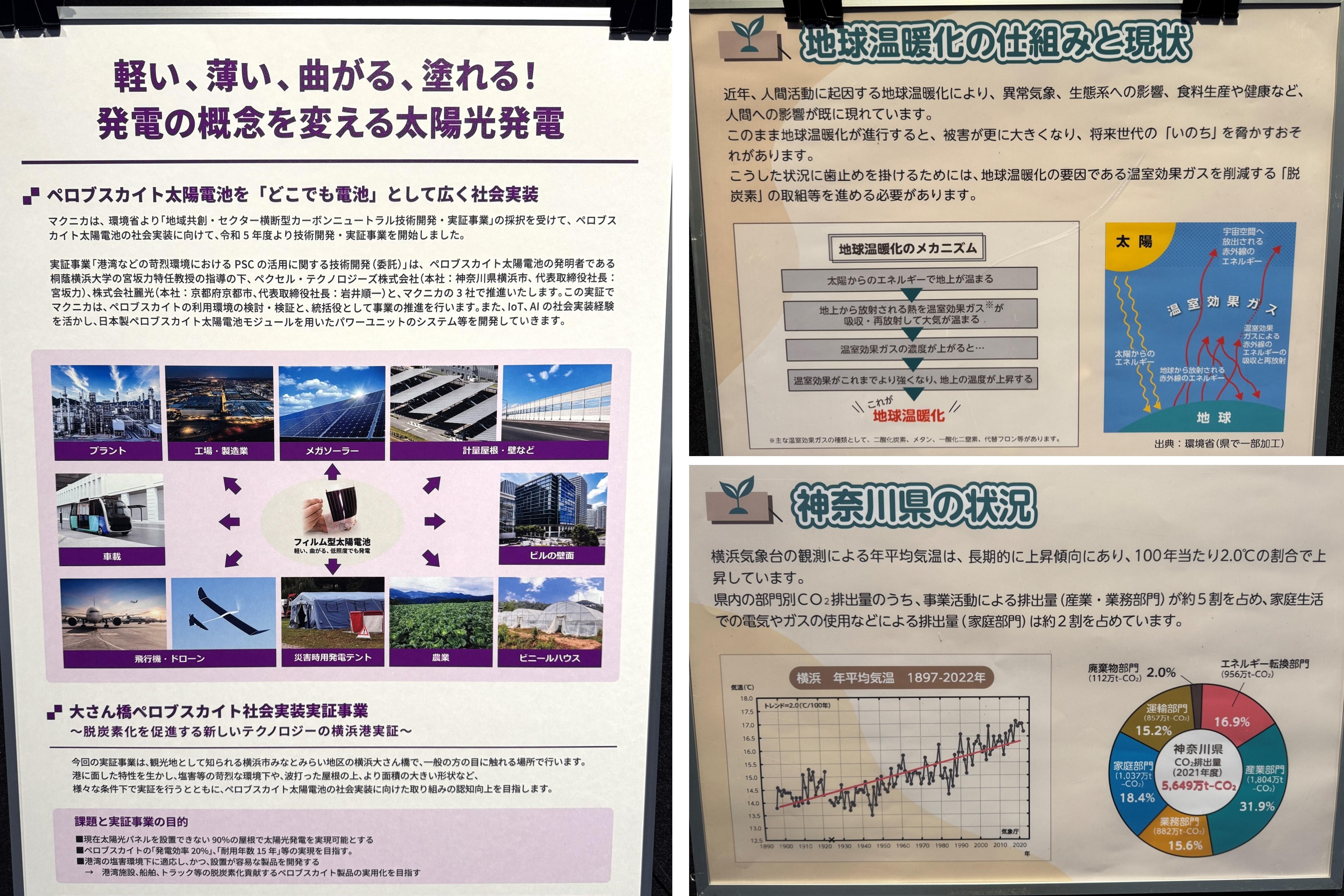
In addition to the panels, there was an actual perovskite solar cell exhibit at the venue. Many visitors stopped to take a look and enjoyed the interesting things that were happening, such as a train running on battery power and an electronic music box.

▲The perovskite solar cells are placed around the edge of the table. Even though they are so small, they can still generate electricity!
Talk event 1: Macnica: Wakisaka
The talk event began with Masaomi Wakisaka, general manager of Macnica 's Circular Economy Business Division, taking the stage.
Wakisaka: I'll start by talking about global warming. I think that in your home, when you press a switch, the lights come on. But does anyone know why the lights come on?
Participant: Solar power and wind power!
Wakisaka: That's right. The electricity that is produced flows, so when you flick a switch the lights come on. Most of this electricity is produced by thermal power plants, accounting for about 70 % of the electricity in Japan. There have been trees on Earth since before the dinosaurs, and coal is the fossilized form of these trees. Burning this coal produces electricity, but the problem is that burning things also produces a lot of CO2, carbon dioxide.

A lot of sunlight reaches the Earth, but CO2 has the property of trapping warm air, so as CO2 levels increase, the Earth gets warmer and warmer. It may be fun to go to the pool every day, but if it gets too hot, then no one will be able to survive, so it's very important not to increase CO2 levels.

This is where renewable energy, which accounts for the remaining 20 % or so of electricity produced in Japan, becomes important. If we generate electricity using wind and solar power, as mentioned earlier, or hydroelectric power, we can produce electricity while reducing CO2 emissions.
There are many different types of renewable energy, but the largest source is sunlight. Today I'd like to talk to you about perovskite solar cells, which utilize sunlight.

Talk event 2: Toin University of Yokohama: Professor Ikegami
Next, Professor Masashi Ikegami, who specializes in photochemistry and photoelectrochemistry at Toin University of Yokohama, where Katsutomu Miyasaka, the inventor of perovskite solar cells, serves as a specially appointed professor, took the stage.
Ikegami: I think we are seeing more and more solar cells in our daily lives, but recently a new type of solar cell called a perovskite solar cell has been developed. Today, I would be happy if you could remember what is so great about this type of solar cell.
First, let's learn about solar energy. Have you ever heard of the word "watt"?
Animals use energy to move, but in fact, humans move at about 100 watts per person. So how much power (energy) reaches the Earth from the sun? It is said to be about 1,000 watts per square meter. We are conducting research into how to harness this energy as electricity.

Plants are also examples of things that utilize solar energy. Plants absorb carbon dioxide and produce oxygen, which involves electrolysis. In other words, there is a strong relationship between solar energy and electrical energy.

It was the famous Einstein who discovered the mechanism by which light is converted into electricity. He was researching a phenomenon called the "photoelectric effect," in which electrons fly out when light hits a metal plate. This is exactly what a solar cell is. Incidentally, light can actually be counted as a number, and the unit used for this is "Einstein." It might be a good idea to remember this as background knowledge.
The perovskite solar cells that we are creating through the power of science have three distinctive features: they are thin, light, and bendable. Ordinary solar cells are about 0.3 mm thick (the thickness of three sheets of paper), but perovskite solar cells are an astonishingly thin 1 micrometer (1/1000 of a mm). The secret to their bendability lies in their thinness.


Perovskite solar cells can also be made by painting them. This is quite amazing, and I would like you to experience this today. Next, I would like to think together with you about what we can do with these solar cells.
Talk event ③ Two-person presentation
The third program of the talk event featured a joint speech by Wakisaka and Professor Ikegami.
Ikegami: Regular solar cells are heavy, so they are difficult to install unless they are placed in a nearly horizontal location. However, perovskite solar cells can be hung vertically, and by taking advantage of their bending properties, they can be attached to parasols, clothing, umbrellas, and other items.

Wakisaka: I don't think that normal solar cells generate electricity inside the home, but if you look at the bottom left of the picture, you can see that they are generating electricity inside the home.
Ikegami: That's right. They are not only used outdoors, but also around electricity. In fact, perovskite solar cells can generate electricity with high efficiency not only from sunlight, but also from light generated indoors. This opens up new possibilities for use.
Wakisaka: If you place many perovskite solar cells around the house, they will absorb the electricity you use while reading a book or eating a meal and convert it into more electricity.
Ikegami: Yes, it's like recycling energy.
Wakisaka: If it's light and flexible, it could be used in things like farm greenhouses. In the picture, it's also attached to a school bag.
Ikegami: It's fine to use it on a tent. We are also working with JAXA to turn balloon curtains into solar panels. GPS and monitoring sensors can also generate electricity with sunlight, so we may be able to use safe devices that don't use batteries.
Wakisaka: It seems like it could be used in a variety of places, does anyone have any ideas?
Participant: Satellite!
Ikegami: That's right. Today we are at the Space Science Museum, and Mars, for example, is far from the sun. The only fuel for current artificial satellites is basically solar cells, so solar cells that can generate electricity even in the dark are important for space development. Perovskite solar cells can fulfill that role, so they are attracting a lot of attention.
Participant: Litter in the ocean is becoming a problem. Is it possible to attach this to a boat and collect trash?
Wakisaka: That's a great idea. Today we've been talking about solar power and renewable energy, but it's true that waste is also a big problem when it comes to recycling resources. Shipping companies are also considering whether they could install perovskite solar cells on large ships and use their power to run the ships.
Ikegami: If a ship is heavy, it requires a lot of electricity to run, so the light weight of perovskite solar cells is useful.
Talk Event 4: Question Corner
We asked for questions from the audience, and many of them came in! Here are some of the questions we received.
Participant: Is it okay if it gets wet?
Ikegami: That's a good question! Just until yesterday, we were doing seawater tests (laughs). We are also installing it at Osanbashi Pier in Yokohama to see if it can withstand the sea breeze. Next, we would like to make a perovskite solar cell that is resistant to saltwater.
Participant: Can it be installed on trains?
Ikegami: They can also be attached to trains, but the surface area of the train alone would not generate enough power to run them. However, we are calculating whether we could run trains by attaching them to the sides of railroad tracks. JR Central has begun research into attaching perovskites to Shinkansen stations, so in the future, there may come a day when trains can run on solar panels alone.
Participant: Can it withstand lightning and other flashes?
Ikegami: Maybe lightning would cause it to burn (laughs). We can create light that is 10 times stronger than sunlight in the laboratory, but if that light is applied to perovskite solar cells, they will melt. I think there must be a limit after all.
Participant: How can perovskite solar cells generate electricity without using sunlight?
Ikegami: That's a very technical question, and even a university student might have a hard time answering it. The intensity of the light affects the momentum of the electrons that come out. Ordinary solar cells are thick, so weak light weakens the momentum of the electrons that come out. However, perovskite solar cells are very thin, so even weak light can produce electrons with force, meaning they can generate energy efficiently. I hope you will study it thoroughly and gain a deeper understanding.
Parents and children can experience crafting together!
After the talk event, the program moved on to the second half, where participants were given the hands-on craft experience. The children, who were the main participants, enjoyed making solar cells with their parents.

▲He worked hard while looking at the instructions together with his dad.

▲ Fix the plastic film with cellophane tape. Can you stick it properly?

▲Spreading the titanium oxide paste onto the film with a short pencil. A tense moment...

▲The stainless steel plate is painted black with a pencil. It really does look like craftsmanship.

▲This is what it looks like when you put together the parts prepared through various steps.

▲The finished product. The electronic music box is connected to the top, and the stainless steel plate held in place by the clip is the solar cell. If you shine light on it and it makes a sound, it's a great success!

▲The moment the light was shone on it. It was impressive to see the children with satisfied looks on their faces as they said, "It rang!"
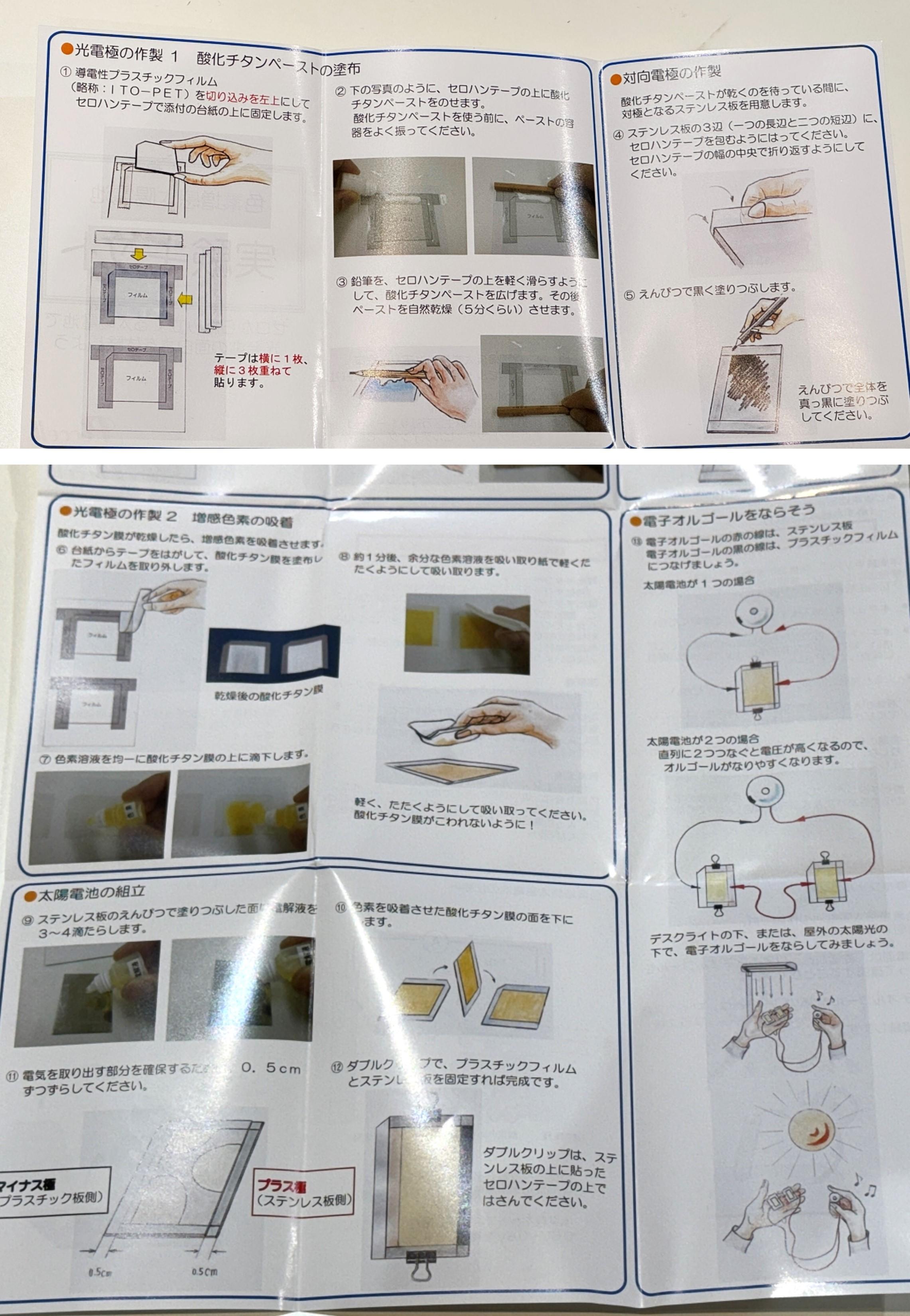
▲The whole process looks like this. There were many younger elementary school students in the group this time, but they all worked together with their parents to get to the end!
in conclusion
This time, we reported on the "Talk event by a perovskite solar cell researcher + dye-sensitized solar cell craft experience." This follows the event held in 2024 at the nature-rich facility "Meibyou Valley Biotopia" in Oimachi, western Kanagawa Prefecture, and we are very honored that so many people were interested in perovskite solar cells.
Macnica will continue to work with relevant parties to contribute to improving the global environment.