- Semiconductor BusinessHOME
- Products and Services of Macnica,Inc.
-
technical information

-
Events and Seminars
- Handling Manufacturer
- Support
- Inquiry
- Click here to purchase products
- Semiconductor business e-mail magazine registration


 Narrow down by specifying conditions
現在2240件がヒットしています。check

This time, we will discuss power supply accuracy.
After you've designed the power supply for your FPGA/CPLD, you'll likely pick up the finished board and check on the actual device to see if the power is outputting as designed. At that point, it's unlikely you'll observe the voltage exactly as designed.
- Well, it can't be helped even if it's slightly off. But how far can you go?
- What are the specifications on the FPGA side?
- What are the specifications on the power supply side?
This time, I would like to answer such a question.
What is power supply accuracy?
For example, suppose the output of the power supply IC was 1.1V. Even if it is designed to be 1.1V, it is unlikely that the value is exactly 1.1V when measured with an actual device. It may be 1.0V, it may be 1.2V. Although it depends on the specifications of the power supply IC, the index of output voltage within what percentage, including individual differences, is called accuracy. FPGAs have recommended conditions for the accuracy of the supply voltage for each power supply line.
From now on, I will use the Cyclone® V FPGA as an example to proceed with the discussion. First, let's check how much accuracy is required for the core power supply.
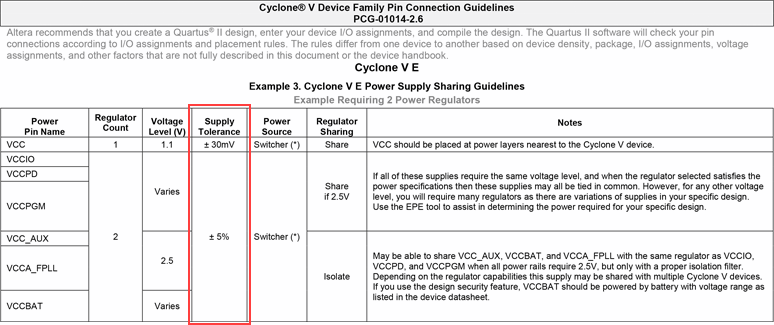
The image above is an excerpt from the Cyclone® V FPGA pin connection guidelines. The required voltage for each power line is listed in the Voltage Level (V) column. Furthermore, the required accuracy is written in the Supply Tolerance column. It can be seen that the Cyclone® V FPGA requires ±30mV for VCC (core power) and ±5% accuracy for all other power supplies. While ±5% is manageable, ±30mV seems quite demanding. For example, can a commonly used 1A EN5311 capacitor be kept within ±30mV?
Below, we will examine the required elements in order. First, the required VCC accuracy for the Cyclone® V FPGA is 1.1V ± 30mV, which is summarized in the following diagram.
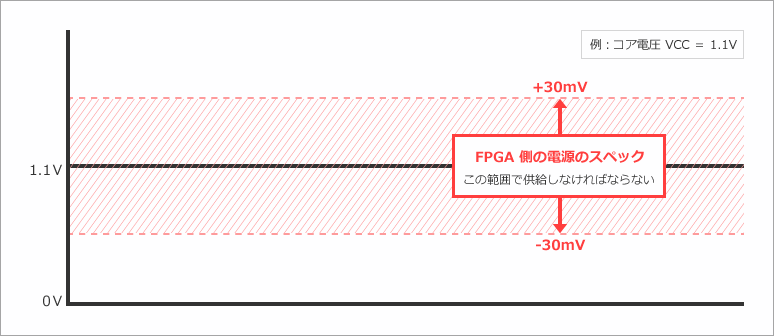
Now that we know the required precision of the FPGA, we next check whether the output of the power supply IC is within this specified value.
How do you check the accuracy of a power supply IC? (VID mode)
I checked the EN5311 datasheet and found the following table:
| PARAMETER | SYMBOL | TEST CONDITIONS | MIN | TYP | MAX | UNITS |
| Vout Initial Accuracy (VID) |
Vout | 2.4V ≤ Vin ≤ 5.5V, Iload = 100mA; Ta = 25°C |
-2.0 | - | +2.0 | % |
| Vout Variation for all Causes (VID) |
Vout | 2.4V ≤ Vin ≤ 5.5V, Iload = 0-1A, Ta = -40°C to +85°C |
-3.0 | - | +3.0 | % |
| Feedback Pin Voltage | Vfb | 2.4V ≤ Vin ≤ 6.6V, Iload = 100mA Ta = 25°C; VSO = VS1 = VS2 = 1 |
0.591 | 0.603 | 0.615 | V |
| Feedback Pin Voltage | Vfb | 2.4V ≤ Vin ≤ 6.6V, Iload = 0-1A, Ta = -40°C to +85°C; VSO=VS1=VS2=1 |
0.585 | 0.603 | 0.621 | V |
There are two descriptions of Vout and Vfb in the Symbol column. Vout is the EN5311 output accuracy in VID mode and Vfb is the output accuracy in Vfb mode. There are two types of descriptions for each of Vout / Vfb. The difference is the Test Condition. First, consider the difference in VID mode.
For ±2% accuracy: Ta = 25°C / Iload = 100mA
For ±3% accuracy: -40°C < Ta < 80°C / 0A < Iload < 1A
Ta is the ambient temperature of the device and Iload is the output current. As you can see, the Test Condition is quite restrictive when the accuracy is good. Considering the operation of the actual device, it is more realistic to consider the case where the test conditions are -40°C < Ta < 80°C / 0A < Iload < 1A. Therefore, when checking the accuracy of a power supply, it is necessary to be aware of what the guaranteed accuracy is in any state within the range of recommended conditions.
Also take a look at Vfb (Vfb mode).
For ±2% accuracy: Ta = 25°C / Iload = 100mA
For ±3% accuracy: -40°C < Ta < 80°C / 0A < Iload < 1A
The concept of Vfb is basically the same as that of Vout. Please refer to Test Condition -40℃ < Ta < 80℃ / 0A < Iload < 1A. Therefore, consider ±3% when considering actual operation. However, Vfb mode does not end there. There are other elements that must be considered, but for the time being, the image so far is illustrated below.
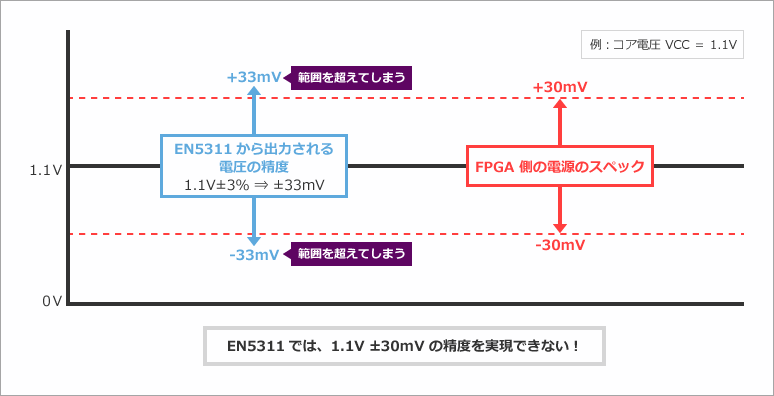
Wait a minute? If we consider ±3% accuracy, it exceeds ±30mV. This won't meet the FPGA's required accuracy. In fact, all Enpirion® series starting with EN53** or EP53** have ±3% accuracy, so they cannot handle power lines that require 1.1V ±30mV. For this reason, we do not recommend EN53**/EP53** for power supplies that require this level of accuracy for the core or transceiver, such as in the Cyclone® V FPGA.
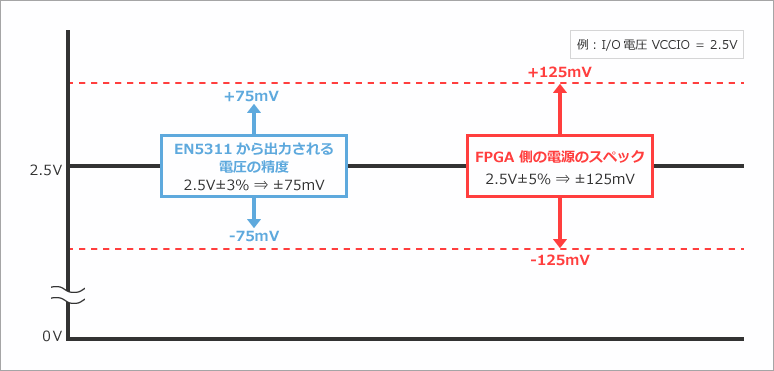
So, what about the ±5% accuracy power supply mentioned earlier? For example, if the power supply for I/O is 2.5V, the required accuracy is ±5%, so it would be Max: 2.625V / Min: 2.375V. This can be illustrated as follows. When we also added the EN53** accuracy of ±3%, we found that it falls within the ±125mV range, which is the ±5% accuracy required by the Cyclone® V FPGA.
What else should I check?
Once you have confirmed that the power supply accuracy is within the FPGA's required specifications, the next step is to check the power supply ripple in the datasheet. I checked the EN5311 datasheet and found the following information:
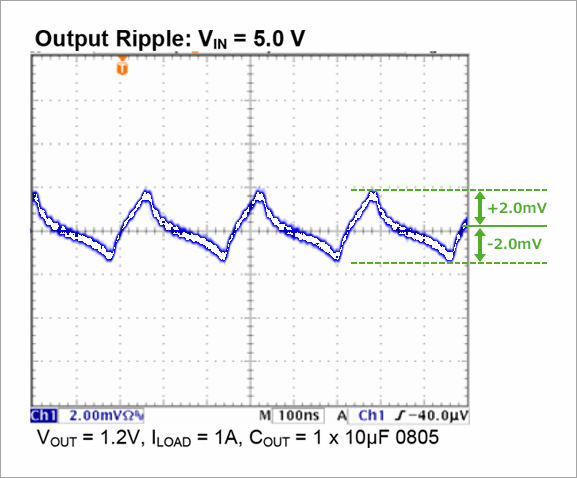
Since it is 5Vin/ 1.2Vout, it is different from the target this time, but I will refer to this value for now. It looks like ±2mV, so add this to the previous accuracy and see if it satisfies the FPGA's required specifications.
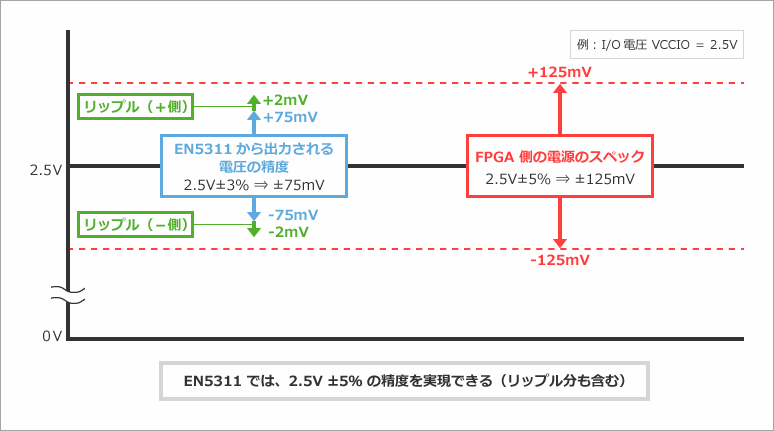
When I checked it, I found that it was ±77mV. The FPGA requirement is ±125mV, so we know we meet the requirement. We found that EN5311 can be used if the required accuracy is ±5%. For ±5% accuracy requirements, consider EN5311. However, if more than 1A of current is required, please consider another series starting with EN53. We also have a line of devices that meet the requirements for ±5% accuracy.
How was it?
- How do I find out the accuracy of the power supply I need for my FPGA?
- How do you choose a power supply to fit in there?
- How exactly should it be calculated?
I think I now understand that. Furthermore, since Enpirion®'s EN53** series has an accuracy of ±3%, I found that it is ideal for power lines that require an accuracy of within ±5% for FPGA I/O and PLL power supplies.
In "What is Power Supply Accuracy? (Part 2)," I would like to discuss Enpirion® devices that support FPGA cores and transceivers.
Click here for recommended articles/materials
Analog Circuits for Absolute Beginners: Enpirion® Series, Part 1 - What are the essential power supply elements for FPGAs?
Analog Circuits for Absolute Beginners: Enpirion® Series, Part 2 - What is the Power Consumption of an FPGA?
Analog Circuits for Absolute Beginners: Enpirion® Series, Part 4: What is Power Supply Accuracy? (Part 2)
FPGA power consumption types and calculation methods
Altera® FPGA Development Flow / Homepage