- Semiconductor BusinessHOME
- Products and Services of Macnica,Inc.
-
technical information

-
Events and Seminars
- Handling Manufacturer
- Support
- Inquiry
- Click here to purchase products
- Semiconductor business e-mail magazine registration


 Narrow down by specifying conditions
現在2240件がヒットしています。check
Are you challenging yourself with new goals every day? I'm in my eighth year of FPGA technical support, and I'm currently taking on the challenge of providing technical support for Enpirion® products, starting from zero analog knowledge.
Enpirion® products are power supply products, not programmable logic devices (PLDs) like FPGAs/CPLDs. They offer excellent compatibility with FPGAs/CPLDs, and because they incorporate inductors and FETs, they require fewer external components, making board design very easy. Therefore, they are very user-friendly for analog beginners and those designing power supplies alongside FPGAs/CPLDs.
As is often the case with technology, you can't truly understand it without actually trying it out. So, I'll be evaluating the device in consultation with our in-house Enpirion® technical team and sharing our insights on ease of use and design points with you all. In short, this is essential reading for beginners in FPGA power supply design.
You cannot select a power supply device without knowing the voltage supplied to the FPGA. Modern FPGAs typically supply multiple power voltages, such as power for the core, PLL, and I/O. Therefore, check the documentation for your FPGA to determine the required voltages.
What is the power consumption of FPGA?
Once you know the voltage to be supplied, the next step is to determine the required current. Knowing this will reveal the necessary power supply device. But how do you determine the required current?
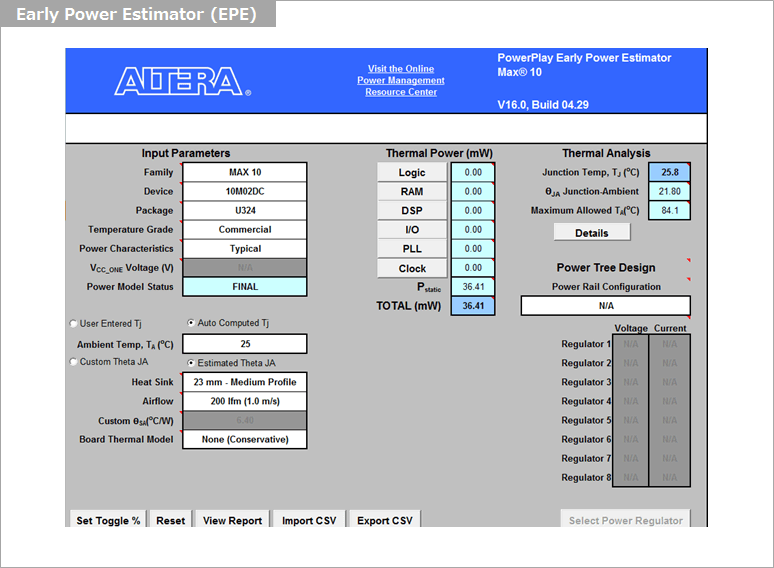
In reality, there are many cases where you need to create a circuit board even before the FPGA design (circuit) is finalized. For such situations, Altera® FPGAs provide an Excel-based tool called PowerPlay Early Power Estimator, abbreviated as EPE. By inputting various information (resources used), such as the number of I/Os, logic units, internal memory, DSP blocks, and transceivers, into EPE, the power consumption is calculated. You can also input conditions such as ambient temperature and airflow, allowing you to estimate power consumption before creating the circuit board.
Click here for details...
What Power Supply Accuracy Do FPGAs Need?
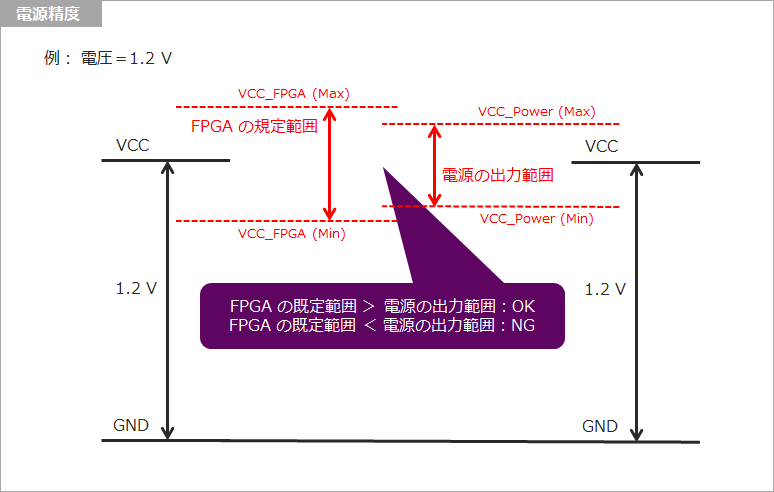
Even when a power supply device generates the voltage required by an FPGA, it's difficult to output the exact design value; there will be some deviation. The extent of this deviation depends on how the power supply device is used and under what conditions. So, what range should the voltage be kept within? It should be within the supply voltage range required by the FPGA. This will allow you to start the FPGA while meeting the recommended operating conditions. This document summarizes information regarding power supply accuracy.
What is the required power rise time for the FPGA?
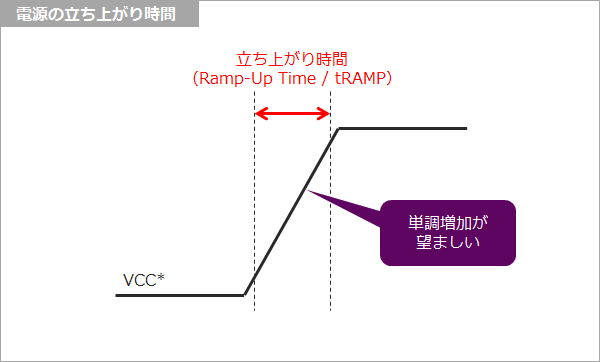
Even if you can find a power supply that meets the current value and accuracy required by the FPGA, the FPGA has a power supply rise time requirement. If this is not met, FPGA configuration may not go well, so it is a very important check item. You can check the rise time by looking at your FPGA's documentation. We have also summarized how to find the information you need from the documentation.
What did you think?
To use an FPGA, you need to check in advance the type of power supply required, how to estimate power consumption, and even the accuracy and rise time of the power supply. Some FPGAs also have specified power-up sequences, which are called power-up sequences. While we won't go into detail about power-up sequences here, if you're using an FPGA with a specified power-up sequence, be sure to carefully check the documentation for the power-on order and conditions. Don't forget to also check the power-down sequence.
Please take these points into consideration when designing power supplies for FPGAs to ensure safety and reliability.
Click here for recommended articles/materials
Analog Circuits for Absolute Beginners: Enpirion® Series, Part 2 - What is the Power Consumption of an FPGA?
Analog Circuits for Absolute Beginners: Enpirion® Series, Part 3: What is Power Supply Accuracy? (Part 1)
Analog Circuits for Absolute Beginners: Enpirion® Series, Part 4: What is Power Supply Accuracy? (Part 2)
FPGA power consumption types and calculation methods
Altera® FPGA Development Flow / Homepage