Desk calculations have reached their limit, and reworking line investments is a constant
In the production management, production technology, and manufacturing departments of factories, we often see people making calculations on their desks (spreadsheet software and manual calculations) on everything from setting up new buildings and new lines to making daily improvements.
However, judging only from desk calculations...
・Design validity could not be fully verified, leading to rework
- Productivity declines due to inability to optimize the flow of equipment, people, and goods
・It is not possible to grasp the movement of bottlenecks due to changes in the 4Ms (people, things, equipment, and production methods)
--These limitations become apparent. As a result, the risk of additional investment and delivery delays increases.
Solution: Virtual Reality Simulation
When considering such issues, ideally it is necessary to comprehensively consider drawings/layout information, equipment information, and the 4Ms (people, things, equipment, and production methods).
However, when proceeding based on desk calculations, there are technical gaps between these two - the "barriers of time" and "barriers of space" - making it difficult to conduct highly accurate advance verification.
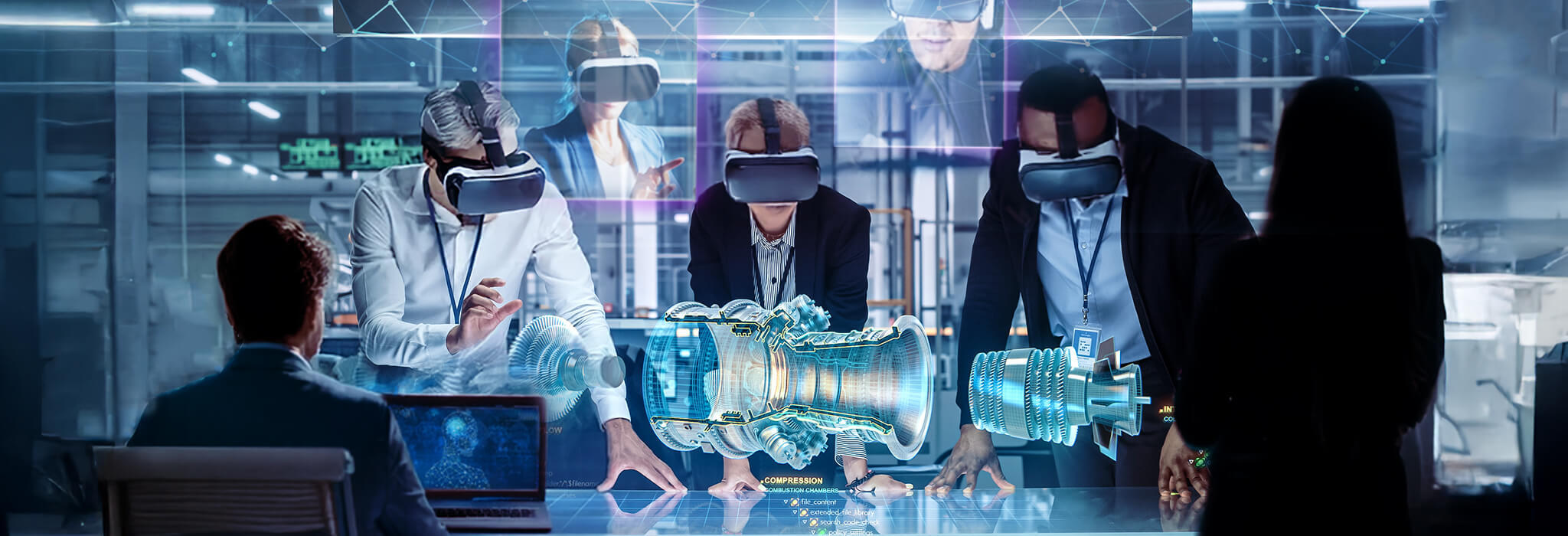
In contrast, production simulation goes beyond these gaps (the "limits of desk calculations") and allows for an integrated representation on a single simulator.
By using a production simulator, it is possible to instantly visualize line operating rates and bottlenecks using 3D models and graphical graphs/charts, which is expected to facilitate consensus building among stakeholders, shorten construction periods, and prevent rework.

Integrate the data and "check while moving it repeatedly"
By utilizing production simulation, you can assume various scenarios and repeatedly verify the following data conditions while changing them.
You can change the layout, staff shifts, etc., and check the information you want to observe, such as utilization rate and inventory trends, while running the simulation.
|
data |
Effect/purpose |
| Drawing and layout information | Reproducing the spatial constraints of a factory in a virtual space |
| Equipment catalog information | Calculate the number of additional equipment units to be installed based on specifications and capabilities |
| 4M Master Information | Dynamically reflects changes in people, things, equipment, and methods |
Facilitate consensus building with clear output
- Instant display of bottlenecks and effects using 3D models and graphical graphs and charts
・Easy-to-understand and highly accurate output makes it easy to reach consensus with stakeholders
・As a result, construction time can be shortened and the risk of additional investment can be reduced.
Use case: Preliminary verification of the effects of introducing AGVs
One use case would be considering introducing AGVs into a factory.
By using a production simulator, the transportation efficiency of AGVs and the productivity of the entire factory can be quantitatively evaluated in advance by reproducing the number of vehicles, routes, station layout, etc. in a virtual space.


Document download

Implementation support services
The production simulator can be applied not only to AGVs but also to the following themes.
・Minimizing logistics and internal costs
- Inventory cost, inventory area
・Minimizing waiting time for shipments and receipts, and minimizing waiting time and delays within the facility
・Minimize stockouts and missed delivery dates, maximize production volume, and minimize setup time
From building simulation models to verifying scenarios and establishing them on-site -- through our digital factory implementation support services and process optimization services, we support the implementation and start-up of your factory operations, aiming to prevent or reduce rework on line investments and speed up the improvement cycle on-site.
Inquiry
Please feel free to contact us
Document list
We have materials available for viewing and downloading.