
Reasons why it can be implemented throughout the entire factory
Transform the success of one production line into overall factory-wide results.
DSF Cyclone is designed to start with small steps at the factory floor and lead to a continuous improvement cycle that extends throughout the entire factory and up to management.
We will unravel the reasons why a phased implementation is possible.


Start with just one line. Begin small and steadily produce results.
Without requiring large-scale capital investment or system overhauls, you can start with a single line or process on the ground, such as floor morning meetings or performance reports. Because you can proceed to the next step while confirming the effects, it lowers the hurdle for investment decisions.
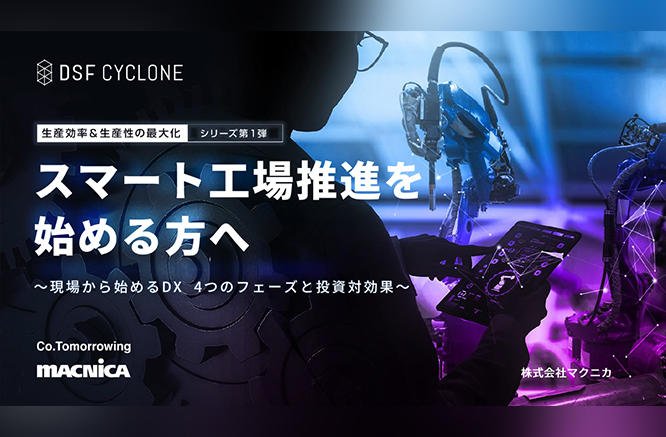
For those starting to promote smart factories
Starting DX from the Front Lines: 4 Phases and Return on Investment
*Registration is required to download.
Building a data infrastructure that can be used throughout the entire factory.
Standardizing data is crucial for achieving horizontal expansion.
In manufacturing facilities, data is often managed in different formats for each piece of equipment and process. This makes it difficult to compare data across lines or analyze data across the entire factory.
DSF Cyclone provides an environment where data from different processes and equipment can be centrally utilized by managing equipment data, manufacturing results, and quality information using a common data model.
This makes it possible to extend improvement activities implemented on a specific line to other lines, and to manage common KPIs across the entire factory. It can be used as a foundation to connect improvement activities from individual optimization to overall optimization.
Because it's a system that customers can implement themselves, it can expand.
A common challenge in expanding a system after its initial implementation is vendor dependency.
If a specialist engineer is required every time a line is added or a configuration is changed, the deployment speed will be slower and costs will increase.
DSF Cyclone emphasizes the ability for customers to take the lead in its use and deployment. Production technology departments and improvement promotion departments can take the lead in continuously adding new lines, expanding the managed equipment, and adding improvement analysis items to the dashboard.
Because the improvement know-how cultivated on-site can be directly applied to the entire factory, it functions as a system that supports continuous improvement activities.
Along with horizontal expansion, digital talent will also be cultivated.
To successfully implement smart factories, not only are systems essential, but also the people who can utilize them effectively are indispensable.
Through the implementation of DSF Cyclone, data-driven improvement activities will become an integral part of daily operations at the operational level.
By practicing how to view and analyze data, and how to set improvement themes in the field, data utilization skills, problem-solving abilities, and improvement proposal capabilities are accumulated within the organization. A major feature of DSF Cyclone is that it not only introduces a system, but also simultaneously promotes a culture of improvement in the workplace and develops digital talent.

Factory DX practitioners share their journey to successful DX centered on systems and data.
Here are user interviews about DSF Cyclone, which helps create highly productive factories.
*Registration is required to download.
From line improvement to overall factory optimization
DSF Cyclone is more than just a manufacturing performance system. It's a data utilization platform that leverages data collected on-site to drive line improvements, process improvements, overall factory optimization, and enhanced management decision-making.
By accumulating common data such as production results, equipment operating status, defect information, and improvement activity outcomes, DSF Cyclone creates an environment where the same information can be shared from the factory floor to management and executive levels. The reason why DSF Cyclone is used in so many manufacturing sites is that it can lead to improvements in the productivity and profitability of the entire factory, rather than just stopping at improvements to individual lines.