The need for digital transformation (DX) has been emphasized for several years, and many companies are working to promote it. Many companies in the manufacturing industry are also promoting DX, but many feel that progress is not going as expected.
In this article, based on Macnica 's experience in accompanying and supporting numerous DX projects, we will introduce the reasons why DX is not progressing in the manufacturing industry, the key points to increase the success of DX projects, and the precautions and solutions for utilizing data, which is the basis for various projects.
First of all, what does it mean for DX to not progress in the manufacturing industry?
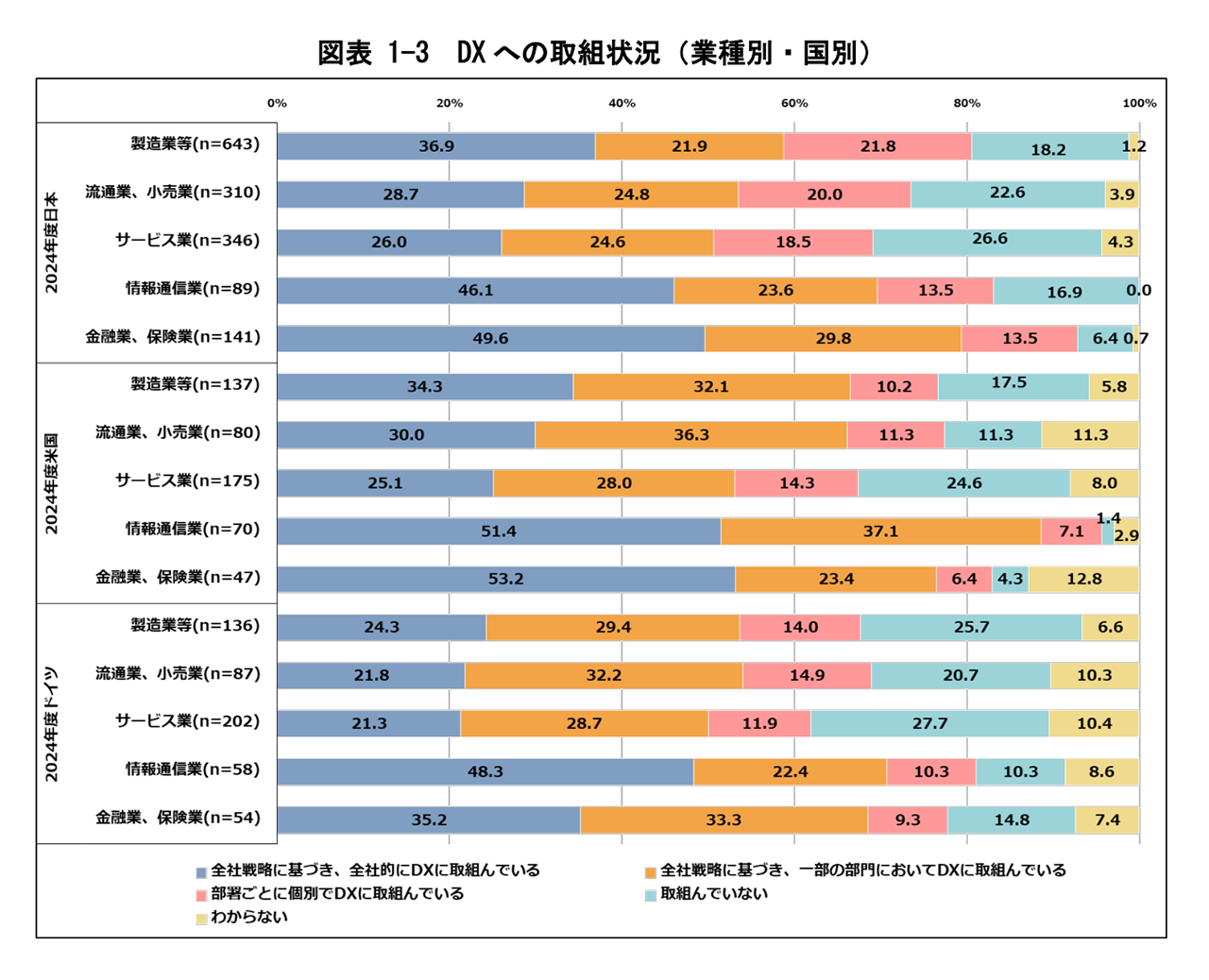
According to "DX Trends 2025" by the Information-technology Promotion Agency, Japan, Japan, the Japanese manufacturing industry is highly committed to DX, with approximately 80% of companies already working on DX.
On the other hand, compared to the financial and insurance industry, which is said to be making progress in DX, the percentage of DX initiatives linked to company-wide strategies (total of blue and orange in the figure below) is low.
In other words, when comparing industries, in the context of DX linked to company-wide strategies, it can be said that Japan is "not making much progress" compared to more advanced industries.
Furthermore, when looking at the "Results of DX Initiatives" section of the same survey, the number of companies in Japan that are seeing results from their DX initiatives is significantly stagnant between 2022 and 2024.
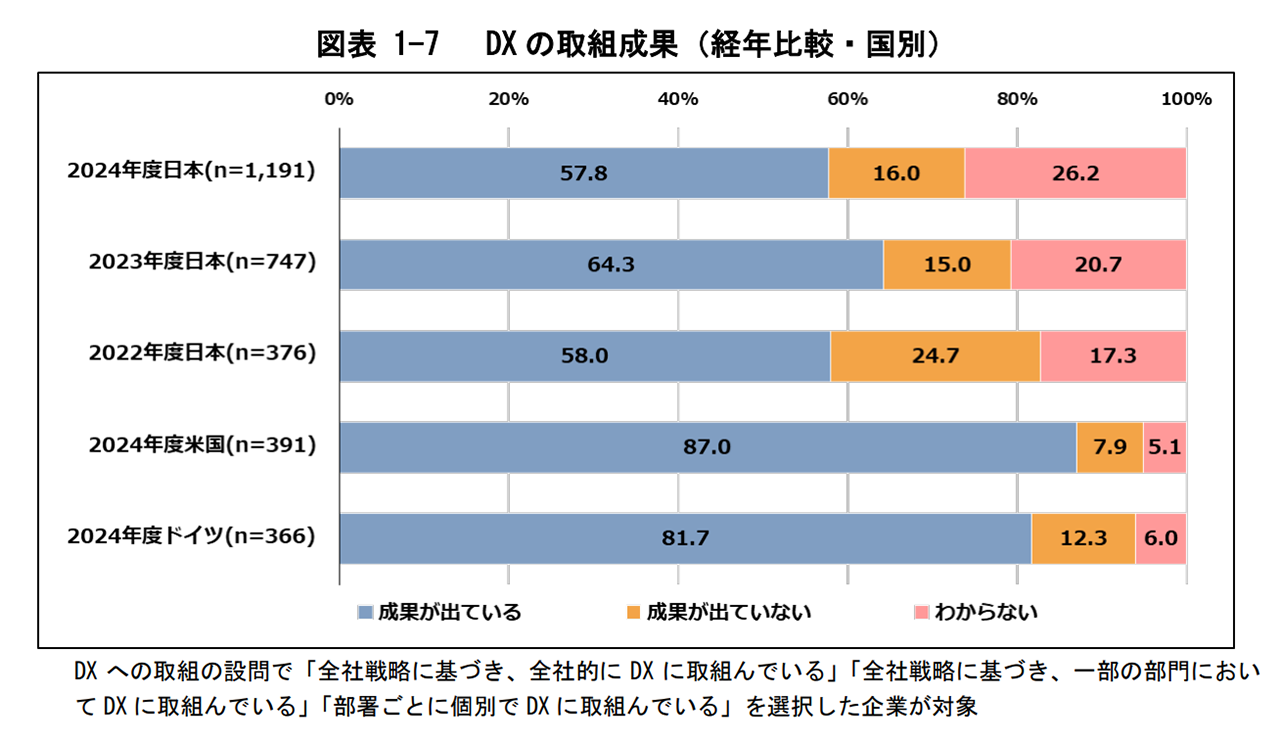
In other words, the lack of progress in DX across Japanese companies, including those in the manufacturing industry, suggests that companies are actively working on it but are not seeing the results they hoped for.
From the above, it seems that "DX is not progressing well in the manufacturing industry" refers to a situation where "DX linked to overall strategy is not progressing as well as in industries where DX is progressing well," or a situation where "DX is being worked on but results are not being seen."
Why DX in the manufacturing industry is not progressing
There are several factors behind the lack of progress in DX in the manufacturing industry, including a lack of purpose and results, budget, human resources, and organizational culture. Here we will introduce some of the main reasons why DX in the manufacturing industry is not progressing.
Not having a clear goal or outcome
One of the reasons why DX in the manufacturing industry is not progressing is that projects are carried out without clearly defining the objectives and outcomes.
DX projects are difficult due to the complexity of consensus building, resistance to change, and the difficulty of seeing the return on investment in the short term. Furthermore, because there is no precedent within the company, it is difficult to set appropriate quantitative results and evaluation methods.
As a result, projects progress without clearly defining objectives and outcomes, and people end up feeling that "there is no goal to begin with, so we don't know how to make progress," or "we're not seeing any results."
The budget available for DX is limited
Another factor slowing progress in digital transformation in the manufacturing industry is the difficulty in getting a concrete image of the costs involved. Terms like AI, IoT, and system renewal often lead people to believe that large-scale, expensive investments are required, making it difficult to secure the budget.
In addition, DX budgets are not secured continuously every fiscal year, and many companies require approval each time, meaning that budgets are often cut off if there is no sense of short-term results or effectiveness.
Furthermore, in small and medium-sized manufacturing companies, capital investment tends to take priority, and budgets for IT and digital fields can be put on the back burner. As a result, DX is often considered but not implemented.
Lack of IT personnel and promoters
Another major challenge facing DX in the manufacturing industry is the lack of IT personnel and dedicated staff to promote DX.
Even if an IT department has personnel with expertise in digital systems, in many cases, the maintenance and operation of existing systems piles up as a backlog, preventing them from starting new DX development. Continued reliance on outsourcing stagnates development speed, leading to a chronic inability to meet business demands.
In some companies, the number of people in charge is small, and information systems managers and on-site managers handle the process while also handling their existing duties. However, this puts a heavy workload on promoters, preventing them from concentrating on promoting DX, and DX does not progress as expected.
One practical solution to these challenges is to build an in-house development system by utilizing a low-code platform. By adopting low-code development, which can significantly reduce programming man-hours, even with limited IT personnel, it becomes possible to run agile development cycles, clear backlogs, and advance digital transformation (DX). Macnica provides in-house development support using the enterprise-grade low-code platform "Mendix," and has a track record of integration with existing core systems such as ERP and PLM.
Data infrastructure facilities are difficult to install
In the manufacturing industry, there are many legacy systems and equipment that have been in use for many years, making it difficult to establish a foundation for acquiring and integrating data. Each piece of equipment has different specifications and communication methods, and data is often fragmented.
Furthermore, craftsmanship, supported by the experience and intuition of experts, is deeply rooted in business operations, and the lack of visualization of work procedures and decisions as data is also a barrier to promoting DX. As a result, many companies stumble even before they can utilize data, and are unable to take the first step toward DX.
Barriers to DX in the manufacturing industry and five key points for success
From here, we will introduce in detail the content of the lecture by Haga of Macnica, in which he talked about"barriers to promoting manufacturing DX and the key points to overcoming them."
▪️Speaker Information
Macnica
Innovation Strategy Business Headquarters Digital Industry Division
Manager of Professional Services Division 1, Section 1
Myotaka Haga
The growing concerns of AI/DX promoters
First, Haga "I feel that in the manufacturing industry, thinking about AI has changed dramatically over the past few years. As a result, I think the scope of the role required of DX personnel is expanding," he says.
When you are assigned to utilize AI and promote DX, you are naturally expected to produce results.
Furthermore, with numerous projects underway, decisions must be made based on factors such as cost, effectiveness, and balance. Furthermore, once a project is fully launched, tasks that were previously not emphasized, such as interdepartmental collaboration and streamlining of work flows, begin to pile up. Meanwhile, there are very few issues that the DX promotion department can solve on its own.
In this situation, what are the barriers that DX promoters face in achieving results through DX, and how can they overcome these obstacles?
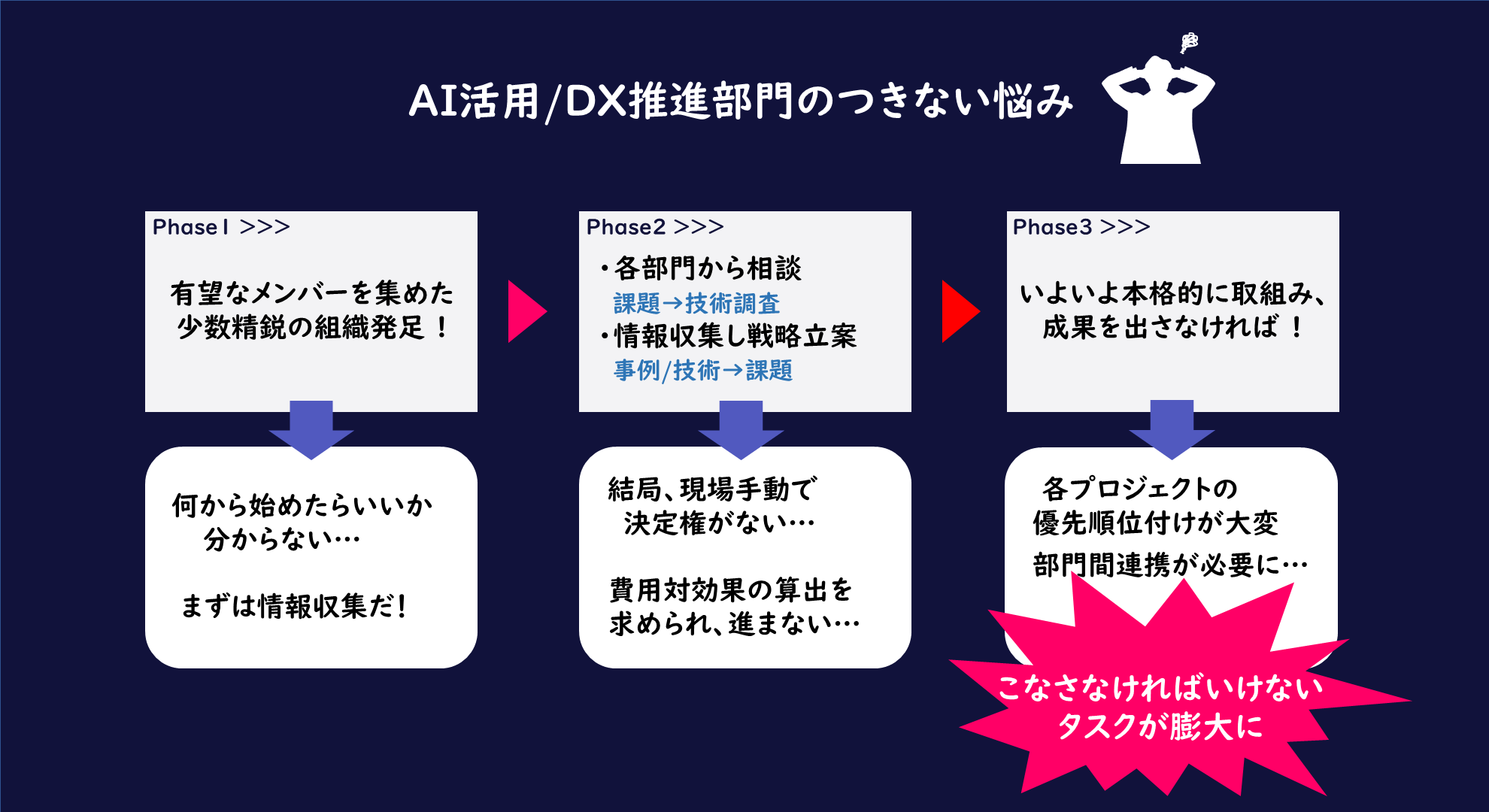
The role required of the DX promotion department continues to increase
The keywords are "vision, collaboration, external utilization, and development"
"One of the common stumbling blocks in DX projects is not having a clear vision or roadmap. As a result, there are many cases where projects end up stalling midway because they lose sight of their objectives and priorities.
"In many projects, the division of roles between internal and external stakeholders is unclear, preventing smooth collaboration. There are also cases where projects don't get off the ground smoothly due to a lack of personnel with the necessary knowledge and skills to advance DX," says Haga.
"To overcome the barriers that hinder digital transformation, it is necessary to coordinate and integrate projects and departments that are running separately, and to create an overall plan.
There are three possible solutions: develop human resources in-house, utilize external partners, or do both. It is quite rare to get by with in-house human resources alone, and in most cases, the knowledge of partners with specialized knowledge is utilized.
However, most companies first need personnel who can converse at the same level as partners, so they are also working on developing personnel at the same time." (Haga)
Five success points common to leading manufacturing DX companies
While many companies have hit a dead end in their DX efforts, there are also companies that have successfully advanced to the point of actually using AI. Companies that are making progress in DX are characterized by the fact that they clarify"the purpose of the change"before simply introducing tools, and have established a system of internal and external cooperation while designing the spread of DX throughout the company. "Successful companies have five points in common," says Haga.
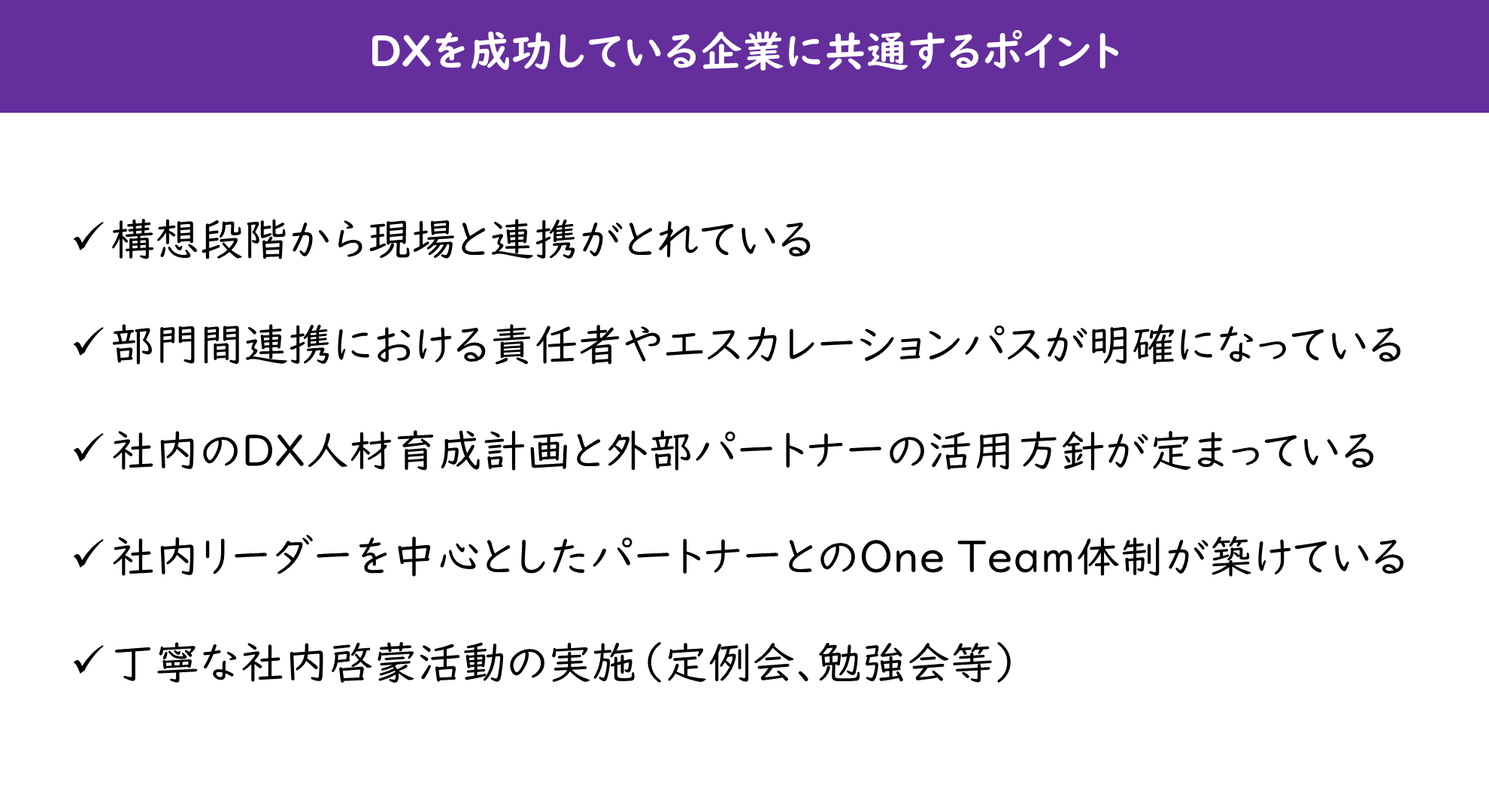
Adopting common points of successful companies is a shortcut to promoting DX
Regarding the key point of"clarifying the person in charge and escalation paths for collaboration between departments," Haga explains,"This is especially noticeable in situations where people of the same level are working together. For example, if the head of the DX Promotion Department and the head of the Manufacturing Department are involved in the same project, unless it is clear who has the decision-making authority and responsibility, disputes will arise or things will not move forward due to ambiguity."
Handling difficult data unique to the manufacturing industry
In addition to the systems and mechanisms mentioned above, data collection is also a barrier to manufacturing DX. While everyone recognizes that data is the most important factor in the practical operation of AI, it seems that the majority of DX projects fail due to a lack of data collection.
The data required by IT and OT differs
"Data collection is an unavoidable issue for the manufacturing industry if it is to effectively utilize data and continue to develop and grow in the future. The quality and structure of data are completely different depending on whether you focus on IT or OT, so you need to be creative with the data acquisition and processing methods, which is very 'steady' and difficult," says Haga.
The OT side is not a world where all you need is data, and the logic that comes from big data analysis is almost useless. Unstructured and complex data and fine-grained data are not easy to use just because they are collected.
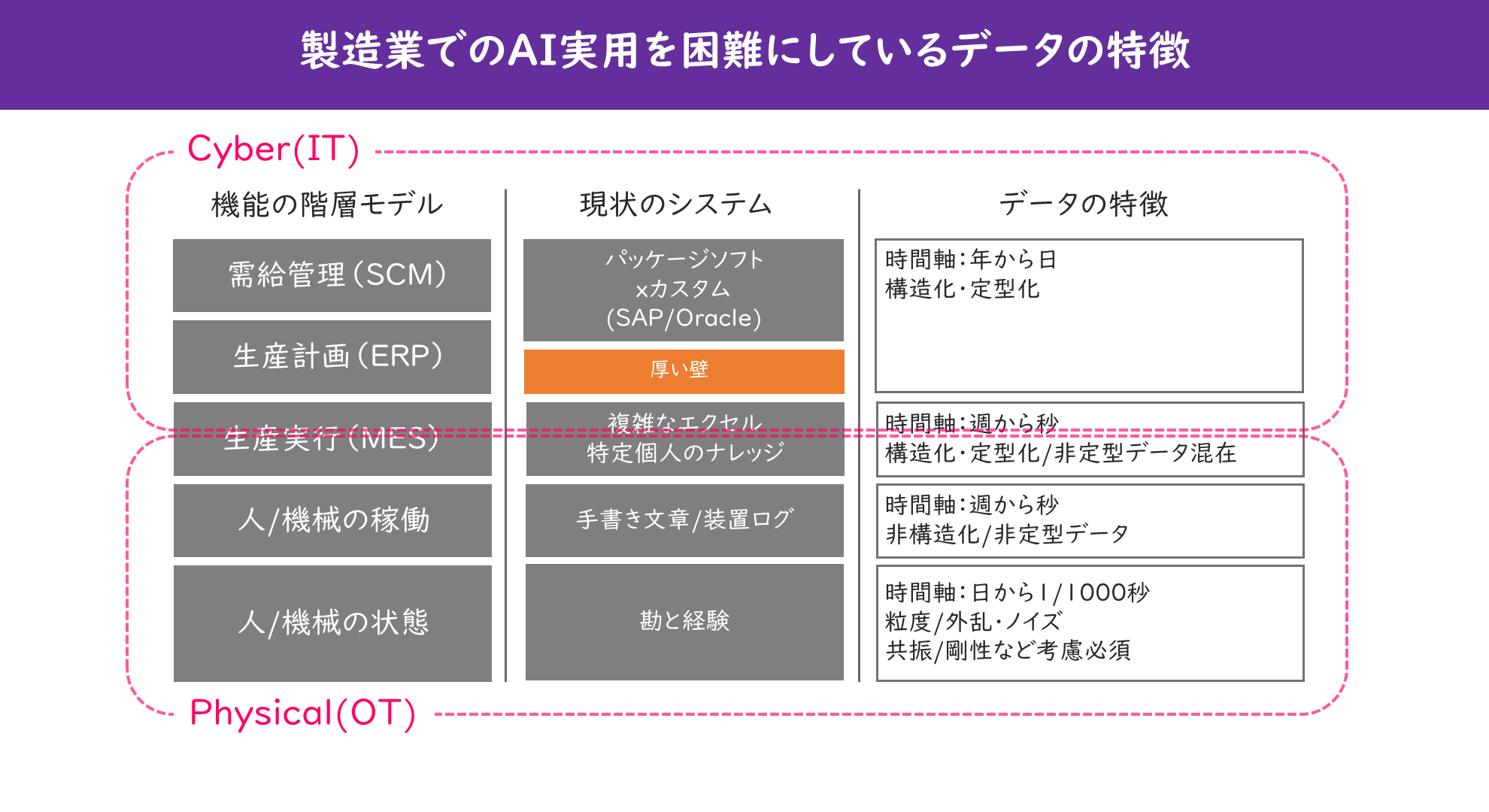
The manufacturing industry is characterized by the difficulty of handling data compared to other fields.
The pitfalls of data collection in manufacturing digital transformation
Haga goes on to explain that there are three pitfalls in data collection, and if these are not done properly, you will get stuck in the data verification phase.
The risk of collecting data without analysis
"You often hear stories of sensors being installed and data being collected, but the data not being at a level that can be analyzed. There's no problem if you collect data on the assumption that it may be unusable and then take an agile approach to course correction, but the longer you wait to realize this, the greater the impact it will have on the project. With sensing, the idea that it's okay to just collect data doesn't work," says Haga.
High difficulty in collecting equipment operation data
"This means that collecting equipment operation data is more difficult than expected. You might think it's natural to be able to obtain information about the status of existing equipment, such as operational information. Management, who are particularly far from the site, tend to think that collecting data isn't difficult. This is because there is an inherent desire to avoid spending money and time on the'observation'stage, but in reality, there are many cases where issues arise." (Haga)
Lack of definition of data structure with an eye to utilization
“It is important to firmly define the storage format of the data that will be output as a data mart. , It is important to create a system with an image of the number of digits in the lot number, manufacturing model number, etc. Since the resolution of the data in the process is often different, this definition requires experience and sense. (Haga)
Important points to keep in mind when managing AI systems
Just because data is collected successfully doesn't mean everything will go smoothly. AI systems require ongoing management that differs from other IT systems. Haga has the following to say about the operation and management of AI systems:
Continuous operation and monitoring required for AI systems
"Generally, IT systems are designed and developed according to requirements definitions, and are guaranteed in accordance with those definitions. However, when AI models are included, the story changes a little. Systems are built on the assumption that the AI will function as expected, but guaranteeing the accuracy of AI is difficult. Therefore, it is necessary to monitor the accuracy of the AI and data drift to ensure that the AI is behaving as expected." (Haga)
Factory data in particular is complex, and various factors can affect and change the trends in the data. These unexpected changes can also change the answers that AI derives, so by the time you realize something is completely wrong, it's already too late. For this reason, it's important to carefully track changes.
In addition, to respond to changes, it is necessary to have a system for managing versions of AI models and applying the most appropriate model. Without this system, no matter how good the system's judgments were when it was created, its accuracy will simply deteriorate over time.
It is also true that recent advances in AI technology have reduced the burden of such operations.
For example, with the emergence of AutoML model retraining, the development of MLOps tools, and even mechanisms for automatically detecting data drift, the environment for keeping AI systems running is steadily coming into place.
However, this does not mean that the operation and management of AI systems is no longer necessary. Rather, it should be seen as an increase in options to make tasks that have previously been performed manually easier to carry out and continue.
Key points to keep in mind regarding the three major themes of DX in the manufacturing industry
Haga cited "advanced production planning and labor-saving," "quality improvement," and "standardization of personalized processes" as the three major themes of DX in the manufacturing industry.
Current situation analysis is important for advanced production planning and labor saving
Regarding "advanced production planning and labor-saving," there is a growing need for advanced production planning to respond to sudden fluctuations in demand and small-lot production of a wide variety of products, as well as digital transformation and the use of AI to reduce and standardize the number of personnel involved in planning work.
"When creating optimal production plans, what data to look at and how to make decisions vary from person to person. To standardize this work, which is dependent on individual skills, it is necessary to visualize the current business process and create decision-making rules. Understanding the situation on-site is a more important process than developing AI models or improving accuracy." (Haga)
Current situation analysis is an important process, but the resolution tends to be rough, and it may not be used as a basis for introducing new systems and mechanisms.
The reasons for this include the heavy burden on those involved in the survey and concerns about the reliability of the survey results.Since efficiency analysis using simulators is also effective for analyzing the current situation and redesigning business processes, it is a good idea to consider this before introducing AI.
Quality improvement and standardization of personalized processes are considered together
It is best to consider both "quality improvement" and "standardization of personalized processes" at the same time, rather than thinking about them separately.
Quality control is a source of competitiveness, and many companies invest large amounts of human resources in it. However, because quality control often relies on the know-how of experienced workers, an increasing number of companies are becoming aware of the risks to its continued maintenance and development.
"With regard to quality improvement, themes such as defect causes, quality prediction, and optimal control can be raised. For example, we can analyze the causes of defects and use this knowledge in manufacturing know-how, predict the results to reduce inspection man-hours, and derive optimal parameters to perform appropriate control.
Some companies are considering automated operations that ultimately feed optimal settings back to machines, but currently the mainstream approach is to build systems that assume coexistence with humans." (Haga)
Haga concluded by saying, "I imagine that the missions and projects that you are all taking on are not all easy. I hope that by avoiding common pitfalls and referring to success patterns, you can increase your chances of success, even if just a little."
Breaking through the barriers to digital transformation in manufacturing: The option of in-house low-code development.
The reasons why DX is not progressing, as we have seen so far—lack of purpose, budget constraints, backlog of IT personnel, and difficulties with data infrastructure—all have one thing in common: "there is no development speed that can keep up with change." To address this challenge, Macnica proposes building an in-house development system utilizing the enterprise-grade low-code platform "Mendix."
Mendix is a low-code development platform that significantly reduces programming effort and has a proven track record of integration with core manufacturing systems such as ERP, PLM, and MES. Because it allows for an agile development cycle built on small successes, it is a platform that directly addresses challenges unique to manufacturing DX, such as "not being able to demonstrate results before the budget is cut" and "not being able to resolve the IT department's backlog."
If you recognize any of the issues described in this article, please first check the Mendix product details.