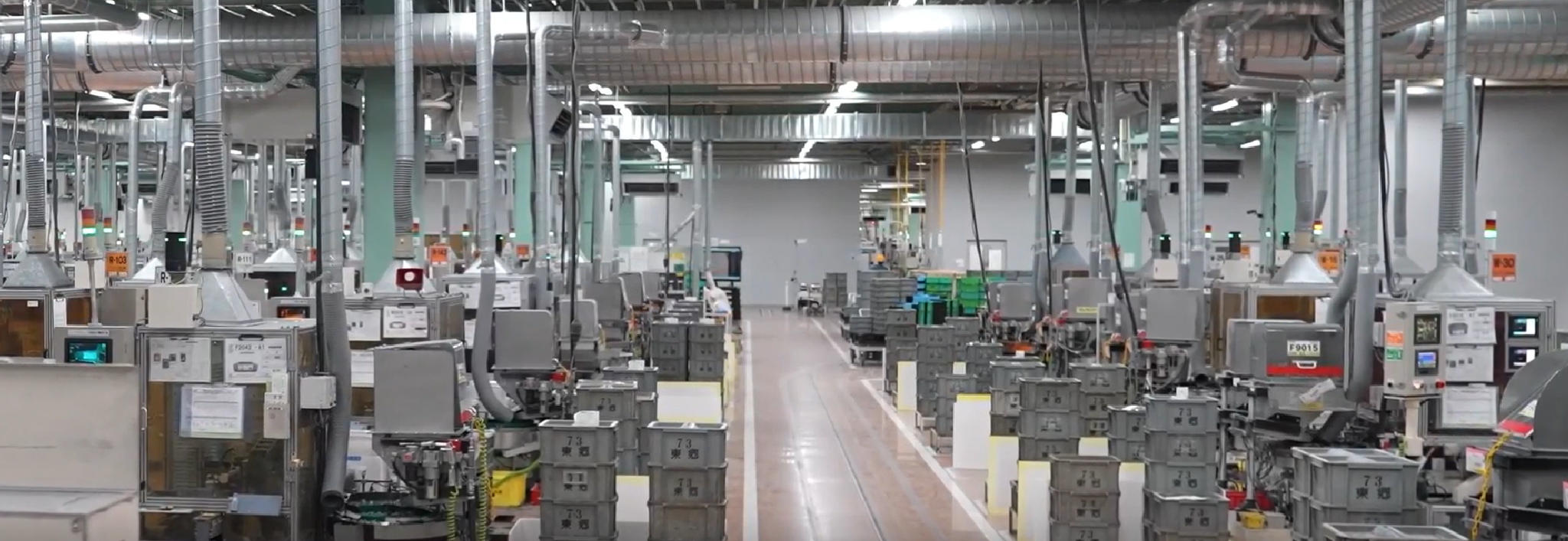
One year after its introduction: Factories transformed by the power of digital technology
──Togo Manufacturing's Challenges and Achievements
"Spring department store" takes on smart technology
──Togo Manufacturing Co., Ltd.
Founded in 1881 as a village blacksmith, Togo Manufacturing Co., Ltd., affectionately known as"Togo Springs,"has expanded its global business, focusing on small automotive springs, and has produced a variety of products, including hose clamps. Guided by its company motto of "Serving society with better products than yesterday," the company has continued to hone its quality and technical capabilities over the years, and in 2020 was selected as a Global Niche Company by the Ministry of Economy, Trade and Industry.
Leading the company's manufacturing DX is the Digital Promotion Department, which was launched in April 2023. The Digital Promotion Office, which has been responsible for introducing IoT, and the General Affairs Department's System Development Section, which is responsible for the company's internal systems, have been integrated, and the department now functions as a core organization that acts as a bridge between the field and core systems.
Transforming real-world information into valuable data and optimizing operations across the company—DSF Cyclone is at the heart of this. Togo Manufacturing visualizes and analyzes equipment operation information, abnormal signals, production results, and more in real time, uncovering clues for improvement that would not be possible with intuition or experience alone.
Togo Manufacturing is taking on the challenge of becoming a smart factory from the perspective of "utilizing information." This initiative is a sure stepping stone for the next generation of manufacturing.
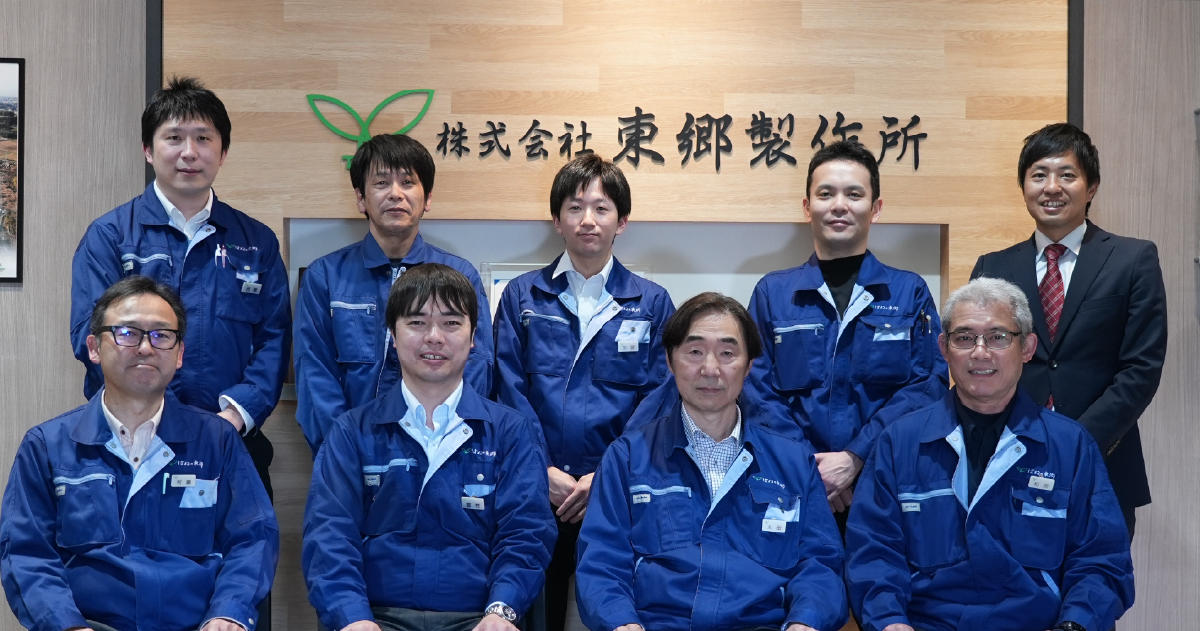
Participating members of this project
People from Togo Seisakusho Co., Ltd.
- Hiroyuki Matsubara, Section Chief, Second Section, Toyoake Manufacturing Division, Manufacturing Department
- Mr. Akihiko Nakamura, Group Manager, Second Section, Toyoake Manufacturing Division, Manufacturing Department
- Takaya Ota, Director and General Manager of the TPS and Digital Promotion Department
- Takuya Murase, Section Manager, Digital Promotion Section, TPS & Digital Promotion Department
- Masatoshi Takada, Digital Promotion Section, TPS & Digital Promotion Department
- Taku Miyamura, Digital Promotion Section, TPS & Digital Promotion Department
- Tsubasa Nishio, Digital Promotion Section, TPS & Digital Promotion Department
- Daichi Kato, Digital Promotion Section, TPS & Digital Promotion Department
Macnica
- Yuta Kageyama, Section Manager, Professional Services Division 2, Section 3, Digital Industry Business Department
- Task
-
- Limitations of handwritten paper records and personal, self-made systems
- Data utilization remains limited to partial optimization and does not lead to overall optimization
- Purpose
-
- Establishing a "common yardstick" that oversees the entire factory and enables cross-sectional improvements
- Rather than leaving improvement activities to the field, we are moving to a system that can be replicated across the entire organization.
- The same KPIs are shared between the field and management, enabling quick and accurate decision-making.
- effect
-
- Transforming workplace culture from "intuition-based" to "evidence-based improvement"
- Stabilizing production through real-time anomaly detection and quick response
- Building a foundation for a system that looks ahead to four domestic factories and future overseas expansion
Despite digitalization, paper operations remain
The limitations of handwritten records: a fundamental issue hindering the promotion of digital transformation
Ota: We had been working on cutting-edge initiatives such as in-house image processing and training AI personnel, but there were still many analog aspects to our manufacturing processes, such as recording production numbers for each process by hand.
What we realized through our image processing efforts is that we need to "digitize" and "visualize" the entire factory line. If we can see the entire process, rather than just individual processes, we can see the flow of intermediate inventory and grasp the cash flow of each factory. This will provide the foundation for making more accurate production plans.
A common yardstick that reaches both the workplace and management
The choice we arrived at in search of a system that could cover the entire system with standard functions
Murase: Up until now, we've been creating our own systems using Raspberry Pi and magnetic sensors. For example, we've used magnetic sensors attached to molding machines to record the number of presses, and retrieve error codes from assembly machine sequencers. We've also used BI tools to create our own screens tailored to the needs of the workplace.
However, as the number of sensors and devices increased, the burden of maintaining the system and analyzing the data also increased. It took so much time and effort to prepare the environment that it became difficult to focus on improvement activities.
Moreover, it's not enough to just visualize the manufacturing site. The data obtained on-site must be presented in a way that can be communicated to management, otherwise it won't lead to true overall optimization. With that in mind, I felt it would be difficult to achieve this without a system that could cover the entire system with standard functions.
We considered several options and chose Macnica 's DSF Cyclone. It not only provides the operational status and defect rate information needed by the site, but also provides consistent visualization of indicators that can be used for management decisions, such as overall equipment effectiveness. This was the deciding factor.
Previously, we looked at utilization rates and operational rates, but that made it difficult to see aspects like product quality and yield. By using overall equipment effectiveness as a "common yardstick," we can make cross-sectional comparisons of productivity, transcending differences in product types and processes.
Ota: We considered using a cloud environment, but when we considered the initial costs, maintenance system, and flexibility in-house operation, we decided that it would be more realistic to develop the system in-house on-premise.
Another big factor was that it was a server license. It wasn't limited by the number of users, and members from different departments could work together to view the same screen and make improvements. I think that was a prerequisite for aiming for "total optimization."
Murase: Speed was also important. If we were to create a system from scratch, who knows how many years it would take. To make improvements in our daily work, we need to be able to start right away and see results right away. In that sense, the speed of implementing a package was a realistic option for us.
DSF Cyclone usage case study video
You can see how Togo Manufacturing is using DSF Cyclone in the video below, divided into four cases, along with actual footage from the site.
CASE1: Morning floor assembly
In manufacturing, on-site monitors are used to share data on abnormal shutdowns and defects from the previous day at morning meetings. We will introduce how trends can be identified early and used to implement countermeasures.
CASE 2: Real-time monitoring
In manufacturing, progress and abnormality status for each line are visualized on a monitor. We will introduce initiatives that leaders take to address delays and improve productivity.
CASE 3: Production efficiency analysis
In production technology, we visualize daily production volume and overall equipment efficiency, and introduce our efforts to quickly identify areas for improvement and lead to continuous improvement.
CASE4: Performance report
In production management, we will introduce a system that automatically collects performance data and automates the creation of reports, supporting business efficiency and accurate decision-making.
Common indicators that "connect" the workplace - Towards a factory with an overview
Cross-sectional KPIs bring evidence to a workplace that previously relied on intuition
Murase: We first introduced DSF Cyclone in the assembly process of our main product, hose clamps. By collecting data from the equipment's PLC and visualizing the time availability rate, performance availability rate, and quality rate for each line, we created an environment where we could understand the operation status of the process and the causes of stoppages at a glance. First of all, we needed to enable everyone to see "what is happening on-site" using the same "yardstick." I feel that by defining common KPIs, we are finally able to have cross-sectional discussions.
What's especially significant is that we can now see trends in defects and outages on a daily basis. Until now, if something abnormal occurred, we had to look back on it all at once later. Now, however, we can immediately identify any abnormalities that occurred on that day, shortening the time lag until improvements can be made and responding in real time.
It really feels like improvement activities have shifted from being based on "feelings" to being based on "evidence." Data-based conversations are now happening naturally on-site, and improvement proposals backed by numbers are on the rise. If we aim for overall optimization, it is essential to use data to look at the "connections" between each process. The efforts that have been implemented in parts up until now are finally starting to spread to the entire factory.
Recently, we have heard comments from the field saying, "We have visibly reduced waste." The "mottainai" (wastefulness) that had not previously been quantified is finally becoming visible, and we feel that an awareness of achieving maximum results with minimum resources is spreading to the field.
Now that losses that previously seemed "a bit high" can be seen in numerical form, discussions can progress and lead to actual improvements. In this way, numbers are no longer just for reporting, but are beginning to function as "material for moving forward," which is a huge change.
Your partner for proposals, improvements, and implementation
Macnica 's presence fostered a "common yardstick"
Mr. Ota: When introducing DSF Cyclone, we needed more than just a system setup; we needed support from the perspective of "how to establish it in the workplace. Macnica, our implementation partner, was there to help us think about this.
In the first phase, we created the dashboard through repeated exchanges of opinions about its structure and display content. We were extremely grateful for the speed with which they were able to observe the reactions of those on-site and quickly suggest ways to make it easier to see. As we continued our improvement activities, Macnica prepared multiple dashboard patterns and carried out initiatives to verify their effectiveness on-site. We feel that these efforts ultimately laid the foundation for creating a "common yardstick."
Also, when we thought about expanding beyond our bases, Macnica 's "anticipatory ability" was very encouraging. They have both a field perspective and a management perspective, and they are proactive in coming up with suggestions such as, "There seems to be an issue here." I think that having someone who can put into words needs that we haven't even noticed yet is more valuable than just a vendor.
Furthermore, building awareness within the company is essential to moving forward with the implementation. Macnica 's presence was significant in that respect as well. Just having one person in a meeting makes a huge difference in how things progress within the company. Having an outside perspective makes the conversation more persuasive, and it has enabled a speed that would not have been possible with the Digital Promotion Department alone.
Smart factories across the nation and the world
Togo Manufacturing's vision for the future of manufacturing
Murase: We are currently in the process of expanding the application to upstream processes, starting with the hose clamp assembly process. We are planning to complete visualization using DSF Cyclone at all four of our domestic factories by 2027. At the same time, a "culture of discussion" aimed at improvements has gradually taken root on-site. Now, rather than simply waiting for instructions, employees are looking at the data and reflecting on why something stopped working and what countermeasures should be taken. I feel that the "ability to think" is gradually beginning to develop on-site.
Ota: In the future, we would like to expand our scope to areas such as optimizing production plans by linking data between factories and utilizing AI, improving yields, and reducing inventory. We want to achieve"efficient manufacturing"not only by relying on on-site intuition, but also by using the power of AI and data. We would like to connect with bases both in Japan and overseas and develop our business more dynamically.
And beyond that lies the "revival of Japanese manufacturing." Now, at a time when Japan is being pushed aside by other countries, we want to show the world from Togo Town, Aichi Prefecture that "Japanese manufacturing is still going strong."
How can we compete not just in terms of product performance, but also in terms of systems and on-site capabilities? I feel that this perspective will be required in future manufacturing.
Togo Manufacturing also hopes to reexamine the future of "Japanese-style manufacturing" from the factory level through its efforts to create smart factories that are friendly to people and easy to work in.
With the power of DX, we hope to once again make Japan shine in manufacturing-that is the challenge we would like to accomplish together with Macnica.

Togo Manufacturing Co., Ltd.
- Business
- Development, design, manufacture and sale of automotive parts used in automobile engines, transmissions, brakes, interiors and exteriors, and hybrid systems
- founding
- 1947
- Number of Employees
- 870 people
- website
- https://www.togoh.co.jp/
PRODUCT/SERVICE
Click here for products and services related to this case study

Improving Production Efficiency × Digital Manufacturing “DSF Cyclone”
A service solution that realizes a highly productive factory by connecting manufacturing results and production plans with structured data
CONTACT
Please feel free to contact us with any inquiries regarding this case study or product implementation.