- 半導体事業HOME
- マクニカの製品・サービス
-
技術情報

-
イベント・セミナー
- 取扱メーカー
- サポート
- お問い合わせ
- 製品購入はこちら
- 半導体事業のメルマガ登録


 条件を指定して絞り込む
現在2240件がヒットしています。check

Altera® FPGA を実装する基板を作成する際、設計者はメーカーが公開しているドキュメントを参考に回路図を作成します。
ここでは、特に気をつけるポイントにしぼってご案内します。
なお Q
対象の FPGA
・ Altera® Arria® 10 FPGA
事前準備
回路図作成時に参考になるドキュメントをご紹介します。
|
ピン・コネクション・ガイドライン |
回路図レビュー・ワークシート |
| Arria 10 デバイス・ファミリ ピン・コネクション・ガイドライン | Arria 10 デバイス 回路図レビュー・ワークシート |
Arria 10 Overview (FPGA TOP)
下図は、Arria 10 の基板設計において、特に気をつけるピンを表しています。
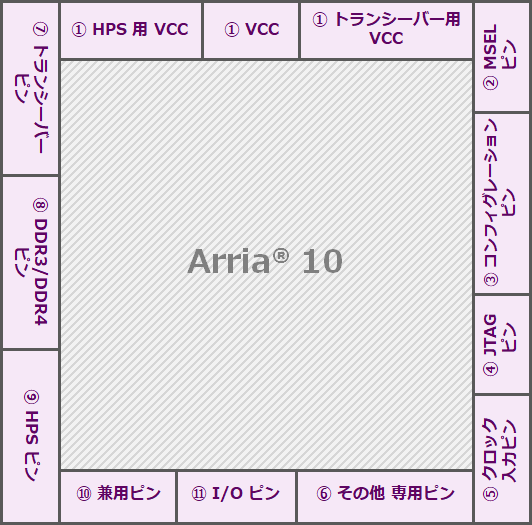
※ 図の配置は実際のデバイスとは関係ありません。
各項目をクリックし、チェック・ポイントをご覧ください。
| ① VCC、HPS 用 VCC、トランシーバー用 VCC | ② MSEL ピン | ③ コンフィグレーション・ピン |
| ④ JTAG ピン | ⑤ クロック入力ピン | ⑥ その他 専用ピン |
| ⑦ トランシーバー・ピン | ⑧ DDR3/DDR4 ピン | ⑨ HPS ピン |
| ⑩ 兼用ピン | ⑪ I/O ピン |
― |
① VCC、HPS 用 VCC、トランシーバー用 VCC
|
● FPGA の近傍に測定ポイントを設ける ・不具合発生時に備えて、電源を計測できるようにしておく |
|
● 同一サイドのトランシーバー、fPLL、IOPLL すべてを未使用の場合は、 ・VCCR_GXB、VCCT_GXB は GND 接続可 ・VCCH_GXBR は GND へ接続可 (詳細は ピン・コネクション・ガイドライン を要確認) |
|
● デカップリング・コンデンサ ・PDN ツール を参考にして見積もる ・より詳細に見積もるには、専用ツールを使用する <参考> |
|
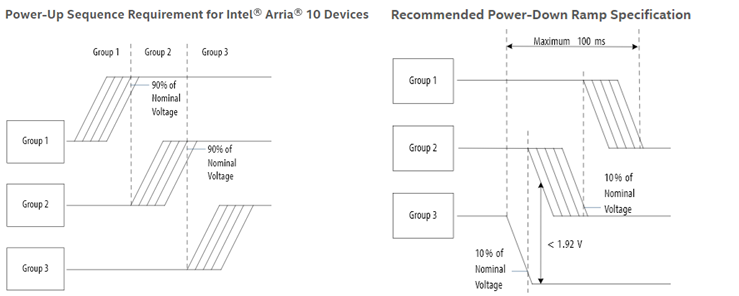
● 電源シーケンス 詳細はこちらのドキュメント(Power Sequencing Considerations for Altera®Arria 10 Devices) をご覧ください。 |
② MSEL ピン
Arria 10 の MSEL ピン情報は、以下をご確認ください。
|
MSEL Pin Settings |
プルアップ/プルダウン抵抗の挿入 (1)(2) |
|
※ リンク先の "MSEL Pin Settings" 参照 |
(リンク先のドキュメントを参照) |
(1) 内部に Weak Pull-Down Resistor (25kΩ) が挿入されています。
(2) コンフィギュレーション・モードを切り替えるようにしたい場合は、0Ω 抵抗挿入で VCCPGM/GND に切り替えるようにしてください。
(3) マイクロプロセッサまたは他のデバイスで MSEL ピンを駆動しないでください。
(4) HPS を介した構成には、PS または FPP MSEL ピン設定を使用します。
MSEL ピンの一覧表は、こちらをご覧ください。
③ コンフィグレーション・ピン
|
● DCLK ・ダンピング抵抗挿入を推奨 (最低限 0Ω) 10-50Ω ・AS モードの場合は、トレース長をケアする (下記ドキュメントを参照) Trace Length Guideline (「Configuration, Design Security, and Remote SystemUpgrades in Altera®l Arria 10 Devices」より) |
|
● nCONFIG、nSTATUS ・10kΩ 抵抗を介して VCCPGM へプルアップ |
|
● CONF_DONE ・10kΩ 抵抗を介して VCCPGM へプルアップ ・そのまま LED に接続しない - ドライブ電流不足により、FET を適用しないと点灯しない可能性がある |
|
● CLKUSR ・トランシーバー、HMC (Hybrid Memory Cube) を使用する場合 - これらのキャリブレーション・クロックとして CLKUSR を使用する(必須) - コンフィグレーション前から入力する必要がある - AS モードの場合は、100MHz のクロックを入力 - PS、FPP モードの場合は、100 ~ 125MHz のクロックを入力 |
|
● EPCS/EPCQ から EPCQ-A への置き換えは、AN822: Altera® FPGA ConfigurationDevice Migration Guideline を参照 |
|
● FPGA をカスケード接続している場合は、nSTATUS や CONF_DONE は共通でプルアップする |
|
● nCE ・シングル デバイス・コンフィグレーションの場合は、GND 接続 ・FPGA がカスケード接続になっているかは、この信号で判断する |
|
● nCEO を使用時は、10kΩ 抵抗を介して VCCPGM へプルアップ |
④ JTAG ピン
|
● チェック・ポイント ・TCK は 0Ω のダンピング抵抗挿入を推奨 ‐ クロック系のトラブルで書き込みができないケースに対応可能にするため |
|
● ピン処理 ・TCK : 1kΩ 抵抗を介してプルダウン ・TDI : 1kΩ ~ 10kΩ 抵抗を介して VCCPGM へプルアップ ・TMS : 1kΩ ~ 10kΩ 抵抗を介して VCCPGM へプルアップ ・TDO : プルアップ/プルダウンなし ・TRST : オプション使用。未使用の場合は、1kΩ 抵抗を介して VCCPGM へプルアップ |
| ● FPGA を3つ以上カスケード接続する場合は、TCK、TMS ラインにバッファーを挿入する |
⑤ クロック入力ピン
|
● シングルエンド・クロックを使用する場合は、p チャンネルにアサインする (n チャンネルではグローバル・クロックにダイレクトに乗らない。ALTCLKCTRL バッファーを使用する場合の制限になる) |
|
● I/O ピンと兼用でないクロック入力ピンを未使用の場合は、GND に接続 |
|
● 差動で入力する場合は、AC/DC カップリングに注意 |
|
● PLL を使用している場合は、RREF ピンを 2kΩ 抵抗を介してプルダウン (抵抗の精度は ±1%) |
|
● CLK および PLL ピンは、未使用時に未接続可 |
※ クロック入力ピン名は Arria 10 Device Family Pin Connection Guidelines の "Clock and PLL Pins" を参照
⑥ その他 専用ピン
|
ピン名 |
コメント |
| RREF_[T,B][L,R] |
2kΩ±1% 抵抗を介してプルダウン |
| VREFB* | 専用ピンとして未使用の場合は、同バンクの VCCIO または GND へ接続 |
| VREFP_ADC / VREFN_ADC | 専用ピンとして未使用の場合は、GND 接続 |
|
TEMPDIODEp/n |
専用ピンとして未使用の場合は、GND 接続 |
⑦ トランシーバー・ピン
|
● トランシーバー未使用の場合は ・クロック (REFCLK_GXB*_CHp/n) は個別に GND 接続、またはまとめて 10kΩ 抵抗を介してプルダウン ・RX (GXB*_RX_*p/n) は GND 接続 ・TX (GXB*_TX_CHp/n) はフローティング |
|
● AC/DC カップリング ・I/O Standard に合わせる |
⑧ DDR3/DDR4 ピン
下記 Web コンテンツを参考にガイドラインに沿って確認。
⑨ HPS ピン
|
Cyclone V SoC ピン名 |
コメント |
|
BOOTSEL[2:0] |
VCCIO 電圧に 4.7kΩ 抵抗を介してプルアップ またはプルダウン |
|
HPS_nRST (双方向ピン) |
VCCIO_HPS 電圧に 1kΩ 抵抗を介してプルアップ |
|
SDMMC |
10kΩ 抵抗を介してプルアップ |
⑩ 兼用ピン
|
● 各機能ピンとして使用せずユーザー I/O ピンとしても使用しない場合は、GND へ接続。 ・ CLKUSR ・ DEV_OE ・ DEV_CLRn ・ PR_REQUEST |
| ● nPERST を PCIe ハード IP のリセット・ピンとして使用する場合は、レベル変換器を介して、3.3V LVTTLから1.8Vに電圧をシフトダウンし接続 |
⑪ I/O ピン
内部キャリブレーションを行う場合は、RZQ ピンの処理が必要。
内部キャリブレーション機能を有効にできるよう RZQ ピンを使用することを推奨。
2.5/3.0-V を使用する場合は対応しているデバイスか確認。
Appendix : Arria 10 MSEL ピン 一覧表
MSEL Pin Settings (FPGA Configuration)
|
Device Family |
Configuration Mode |
VCCPGM(V) |
POR Delay |
MSEL[2:0] |
|
Arria 10 |
AS (x1, x4) |
1.8 |
Fast |
010 |
| Standard |
011 |
|||
|
PS, FPP (x8、x16, x32) |
1.2/1.5/1.8 |
Fast |
000 |
|
| Standard |
001 |
MSEL Pin Settings (HPS Configuration)
|
Device Family |
Configuration Mode |
VCCPGM(V) |
POR Delay |
MSEL[2:0] |
|
Arria 10 SoC |
FPP (x16, x32) |
1.8 |
Fast |
000 |
| Standard |
001 |
おすすめ記事/資料はこちら
FPGA の Power & Thermal デザイン&デバッグ・ガイドライン
アクティブ・シリアル・コンフィグレーション デザイン & デバッグ・ガイドライン