● Points of this article ●
- You can understand the overall picture of ChatGPT's birth background, business use cases, cautions and risks when using
- Learn the points to keep in mind at the in-house ChatGPT study session
- You can get a PDF of the material that can be used as it is at the study session (free)
Hello, I'm Sasaki, a Macnica AI engineer.
ChatGPT is showing excitement in society. I imagine that engineers involved in AI in the company and everyone in the information system department are flooded with requests to explain what ChatGPT is to the business department.
However, when it comes to explaining things, I think some people may find it difficult to put down what is in their minds into documents in an easy-to-understand manner while doing their daily work, as it takes a lot of time and effort.
The reason is that I suddenly received a request from another department and held a study session for the whole company!
Therefore, when we received a similar request this time, we decided to release the materials used in the study session to the public, thinking that our information would be of help to everyone.
Two types of materials were prepared, one with presentation notes and one without. A reference example of the presentation talk is specifically described in the presentation notes. I am conscious of supplementing the content and background that are difficult to understand with slides alone with the presentation talk. We hope that you will use it as a reference when making your presentation.
We hope you find this document helpful.
ChatGPT in-house study materials
- [No presentation notes] ChatGPT revolution_Blog version.pdf
- [Presentation note included] ChatGPT revolution_Blog version.pdf
The key points of this document, the intended target audience, and the key points of the explanation are described below.
Material point
- Introduce case studies to encourage business use of ChatGPT
- Introducing precautions and risks when using
- Prefer to see the big picture and don't go into too much technical detail
- Including a little about the background of ChatGPT and OpenAI
Assumed target audience
This document assumes that a person in charge of an IT-related department, such as an internal information system department, will give an explanation to an internal department.
Explanation point
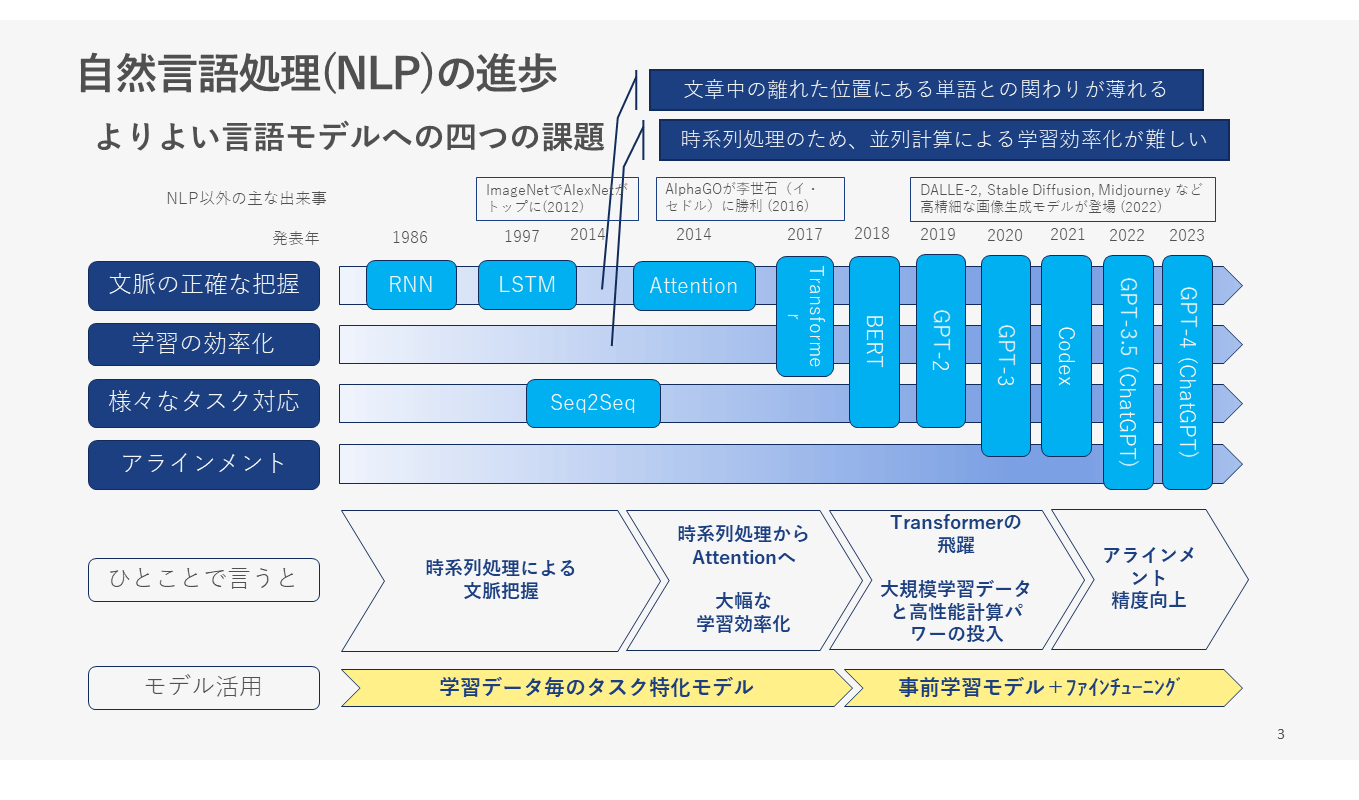
1. How ChatGPT was born
I think it is important to know how ChatGPT was born in order to promote its use. The points are as follows. (In addition, we had to use some AI technical terms in the explanation, so if you find it difficult, you can skip this item.)
- ChatGPT's artificial intelligence didn't happen overnight. It is the result of a huge amount of research and development by scientists over many years.
- One major advance was the adoption of "parallel processing". This is a method of processing multiple pieces of information at the same time. This change was realized by using a technology called Transformer.
- Next, the use of "pre-trained models" has contributed to the progress of natural language processing (technology in which computers understand and generate human language). This is a method of learning a large amount of text data and then further learning (this is called "fine-tuning") for a specific task.
- In addition, large-scale models such as GPT-3 have emerged. These models are so large and accurate that they can now generate texts that look so natural that they are indistinguishable from human-written text.
- However, as the model got larger, new problems arose. This is the "alignment problem", and it is a problem that it is difficult for the model to properly understand and reflect human intentions.
- To solve this alignment problem, human answers were prepared with high accuracy, and fine-tuning was performed using reinforcement learning (a method of learning to improve model behavior). As a result of these efforts, ChatGPT was born.

2. Prerequisite knowledge for business use of ChatGPT
ChatGPT is easy to start using, but you need to know the restrictions in advance for business use. The points are as follows.
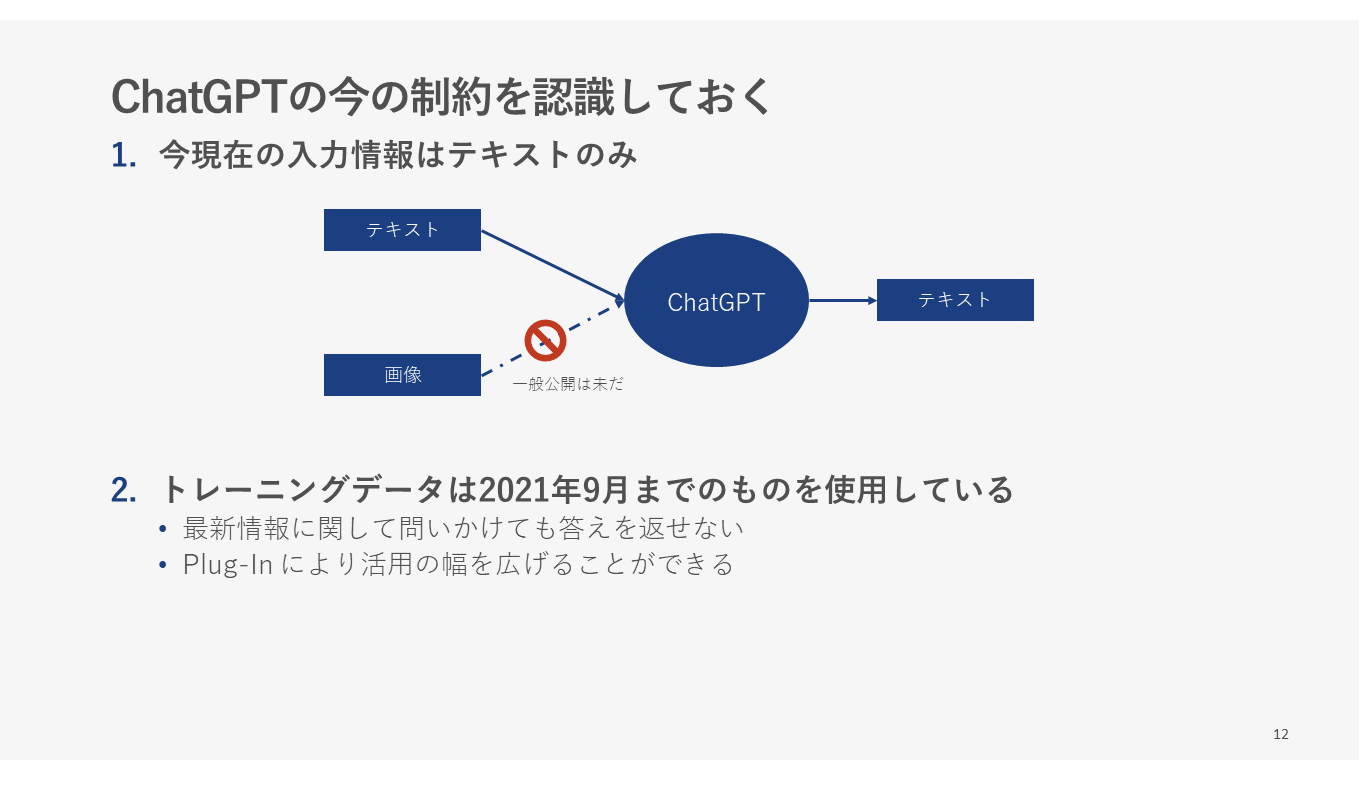
- The artificial intelligence called ChatGPT currently accepts only text (that is, words) as input information from users. A newer version, GPT-4, allows you to input images, but it's not yet available to the public.
- This artificial intelligence is learning information that existed by September 2021. Therefore, I can't answer well about the events and new information that happened after that.
- However, by using a function called "plugin", it is possible to utilize the capabilities of ChatGPT while accessing the latest information.
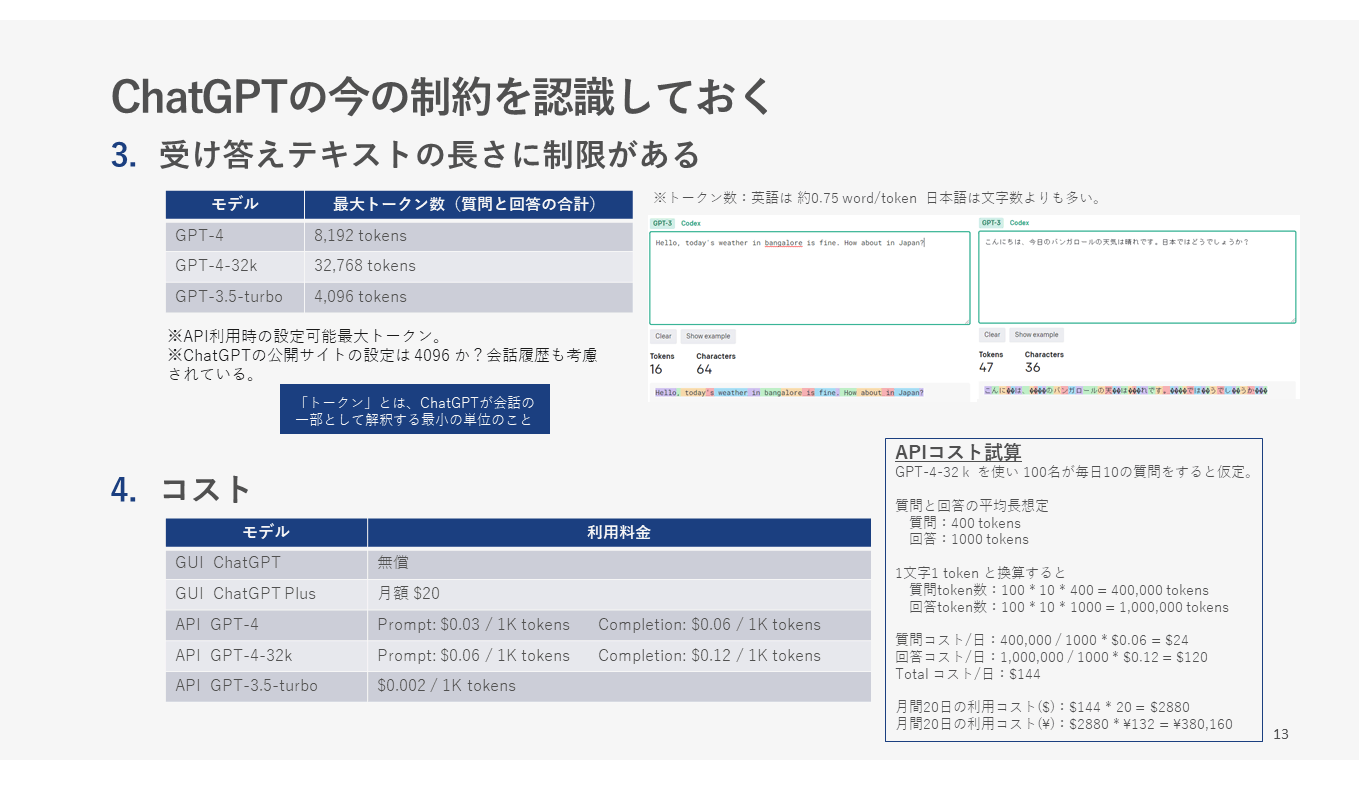
- When talking to ChatGPT, there is a conversation length limit. And that limit depends on what version ChatGPT is (eg public version for public vs. API version for developers).
- Also, in order to use this artificial intelligence, a certain fee is required other than the public version of the free version. For example, the version called "ChatGPT Plus" costs $20 per month, and when used in the form of an API, it is charged in units called tokens.
- A "token" here is the smallest unit that ChatGPT interprets as part of a conversation, something close to the number of characters. And when comparing English and Japanese, Japanese requires more tokens for one utterance. This is because Japanese has a more complex character structure than English.
3. Business use scenes and examples
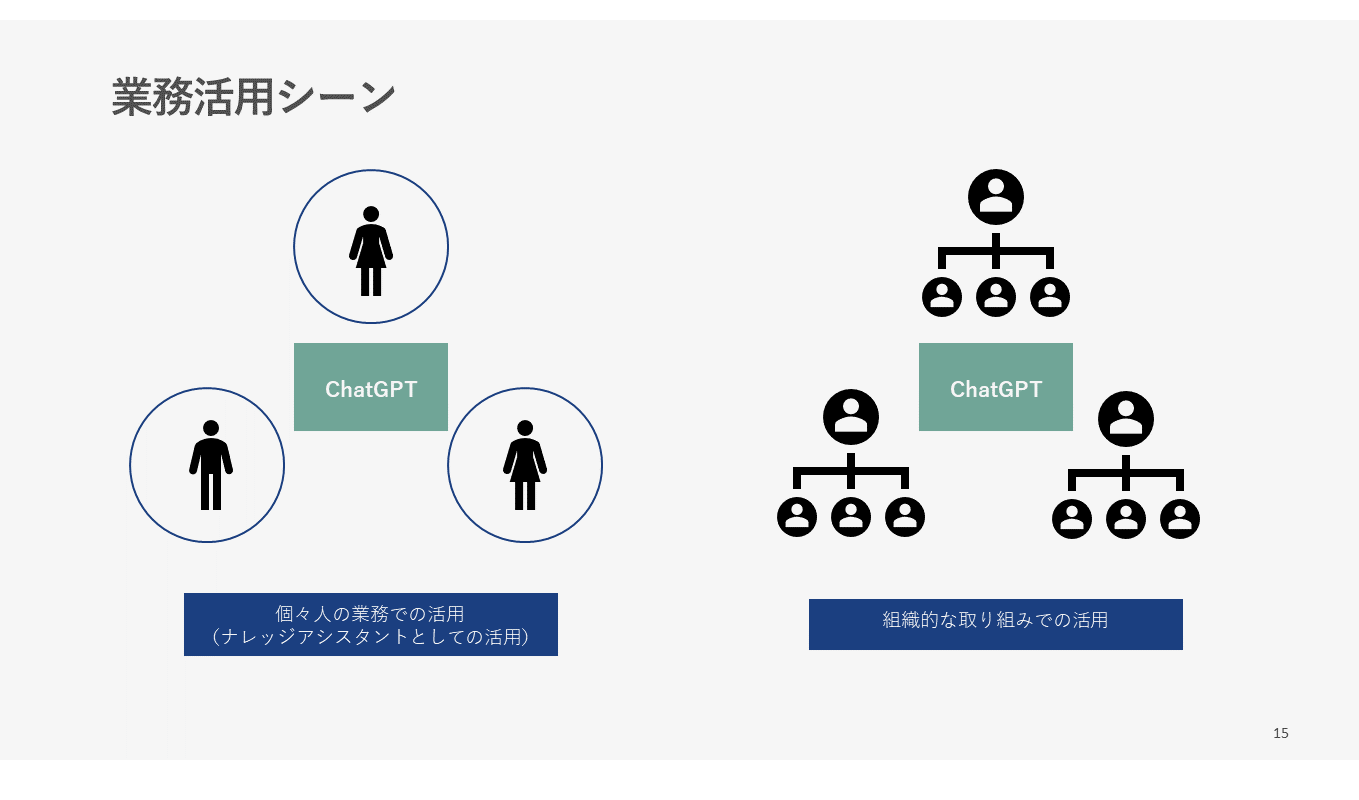
First of all, there are two ways of thinking when using artificial intelligence (AI) “ChatGPT” and its higher version “ChatGPT Plus” in business.
- The first is for each employee to use ChatGPT as an aid in their own work. This is the idea that each employee uses ChatGPT's user interface (that is, screens and functions for exchanging information between humans and computers) and uses it as an assistant to smoothly proceed with individual work.
- Another way to think about it is to work across the organization. It aims to solve a problem facing organizations as a whole by using ChatGPT's APIs (connection points and methods for programs to interact with one another) to develop new applications or "plug-ins". (modules for adding functions to existing software) will be required to be developed.
The company or organization's needs, resources, strategy, etc. should be considered when choosing between these approaches.
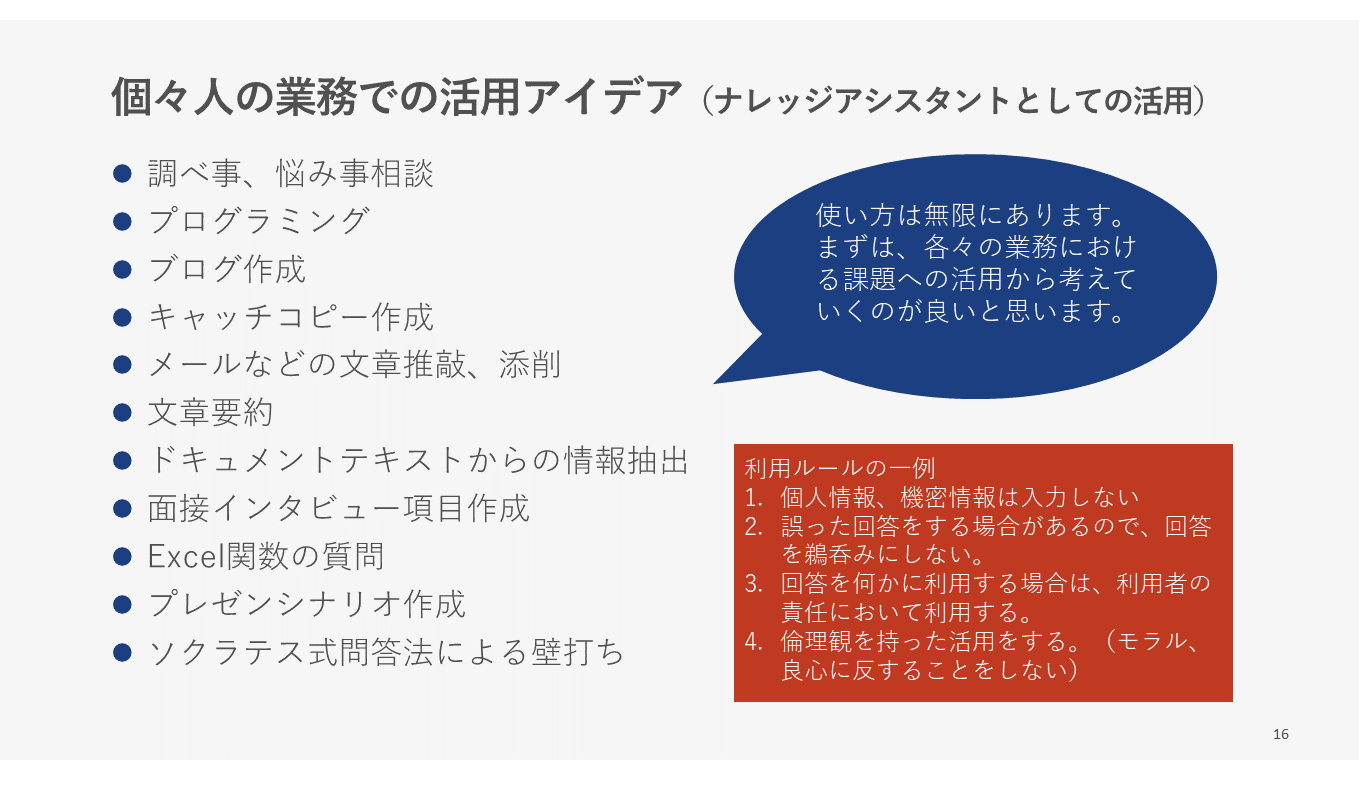
Here, we introduce ideas that will trigger ideas for utilization in individual work. Also, when using “ChatGPT”, an artificial intelligence (AI), at work, it is important to keep in mind the following basic rules and principles. These rules are guidelines for using AI well and appropriately.
- First, avoid entering personal or sensitive information into ChatGPT. AI is very smart, but users still need to be careful about information protection and privacy.
- Also, the answers provided by ChatGPT are not always accurate. Therefore, it is important not to accept the answer uncritically, but to think and check it for yourself.
- And if you use the information you get from ChatGPT for anything, it is your own responsibility. This means that you should verify the accuracy of the information obtained and take responsibility for the results.
- Finally, ethical considerations also require caution when using AI. Be careful not to use it against your morals and conscience. AI is a tool, and how it is used depends greatly on the ethics of the user.
Here are some ideas on how you can leverage ChatGPT as an organization-wide effort. However, this idea is purely from my personal point of view, so take it as an example.
The important thing is that each organization and each company has different business challenges. So this idea doesn't necessarily apply to every organization.
So, focus on the business challenges you face and think about how ChatGPT can help you solve them. I hope my suggestions will help you.

4. Risk of utilization
There are some risks when using ChatGPT artificial intelligence. And it is important to consider measures to reduce or avoid these risks. Below are the specific risks and a brief description of each.
- "Wrong answer": This refers to the possibility that ChatGPT provides incorrect information. Artificial intelligence is not perfect and may misinterpret or make mistakes in information.
- "Jailbreaking Malicious Content Generation": The term "jailbreaking" refers to the AI going beyond its constraints and guidelines to produce unexpected or inappropriate results.
- “Generation for Influence Manipulation”: This refers to the possibility that ChatGPT generates information that attempts to inappropriately manipulate the opinions and behavior of users.
- “Educational Impact”: This refers to the widespread impact of using ChatGPT as an educational tool, especially for children. This includes not only the learning of incorrect information, but also the decline in thinking ability due to over-reliance on AI and the lack of ability to think critically about information from AI.
- “Input Data Leakage”: This refers to the risk that the information that users input into ChatGPT is leaked to the outside.
By understanding these risks and taking appropriate countermeasures, artificial intelligence can be used more safely and effectively.
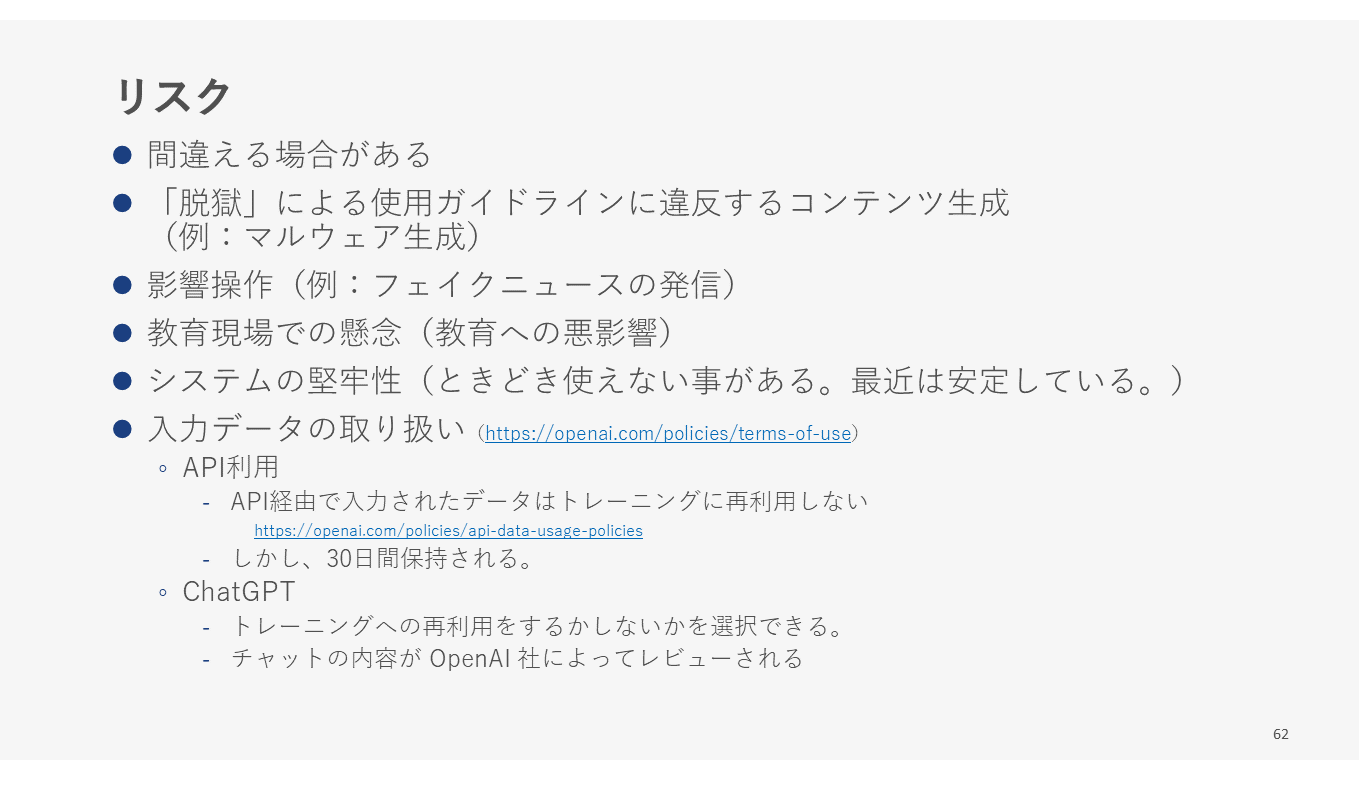
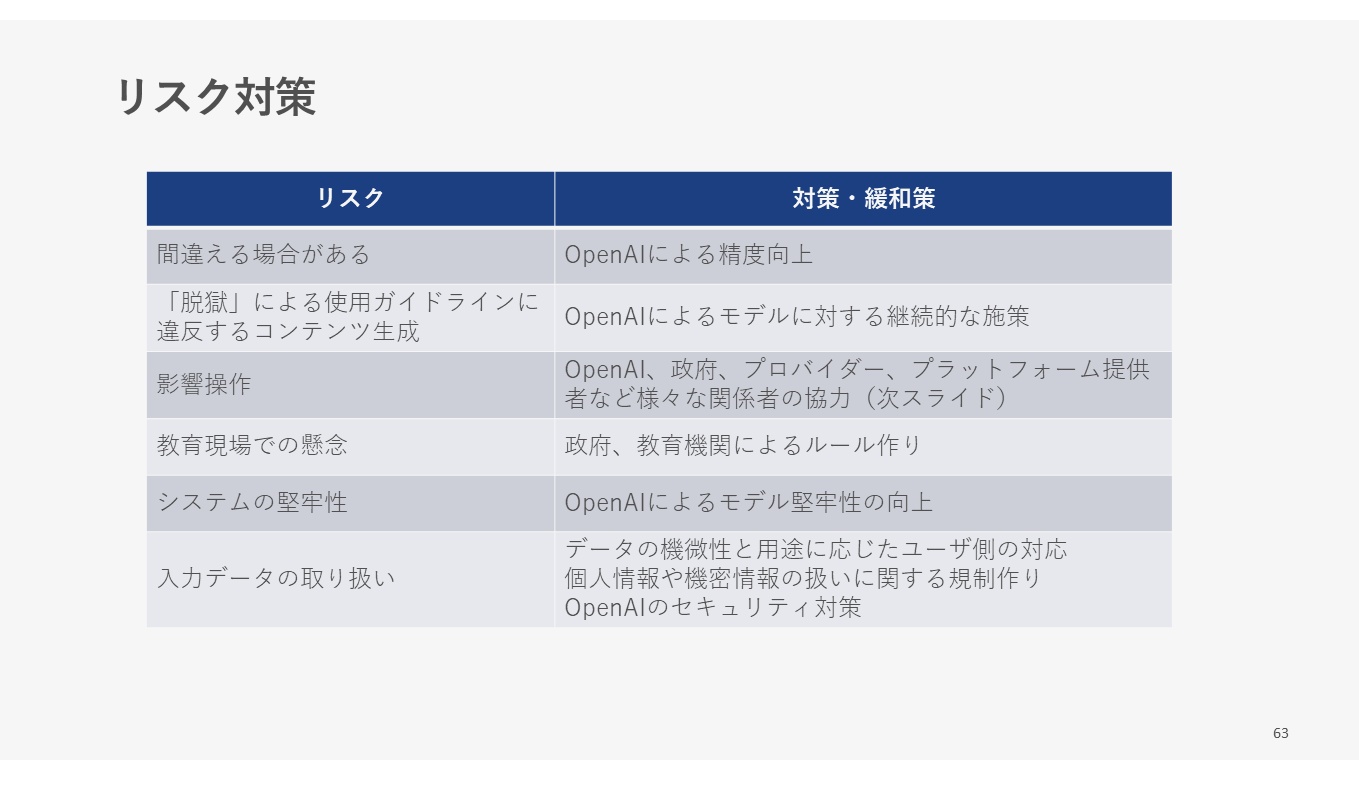
And this slide summarizes it as a countermeasure. This slide discusses what we do to keep ChatGPT safe. The points are as follows.
- “Requirement of measures by both developers and society”: This means that the safe use of AI is not something that only those who make AI should take measures, but that society as a whole should consider measures. For example, laws and regulations, educational improvement, etc.
- "Wrong answers and data handling can be improved": This means that AI developers can be more creative to reduce the number of wrong answers given by AI and to properly protect user data. It means that it is possible.
- “You can choose to use user input data for learning”: This means that you can choose whether or not the information you enter into ChatGPT is used as information for the AI to learn further. If it goes through the API, it is said not to be used as information for further learning.
- ``Influence manipulation and adverse effects on education require a whole-of-society effort'': This is about the possibility of AI spreading misinformation, imposing particular opinions, and adversely affecting children's education. means that society as a whole should work on it, not just take technical measures.
In particular, as a mitigation measure for influence manipulation, slide out a summary of mitigation measures from among the papers on the content of the workshop to mitigate influence manipulation such as agitation and fake news held in October 2021. to As shown in this slide, there is currently no silver bullet for influence manipulation, and I think this is an important issue that needs to be addressed in the future.
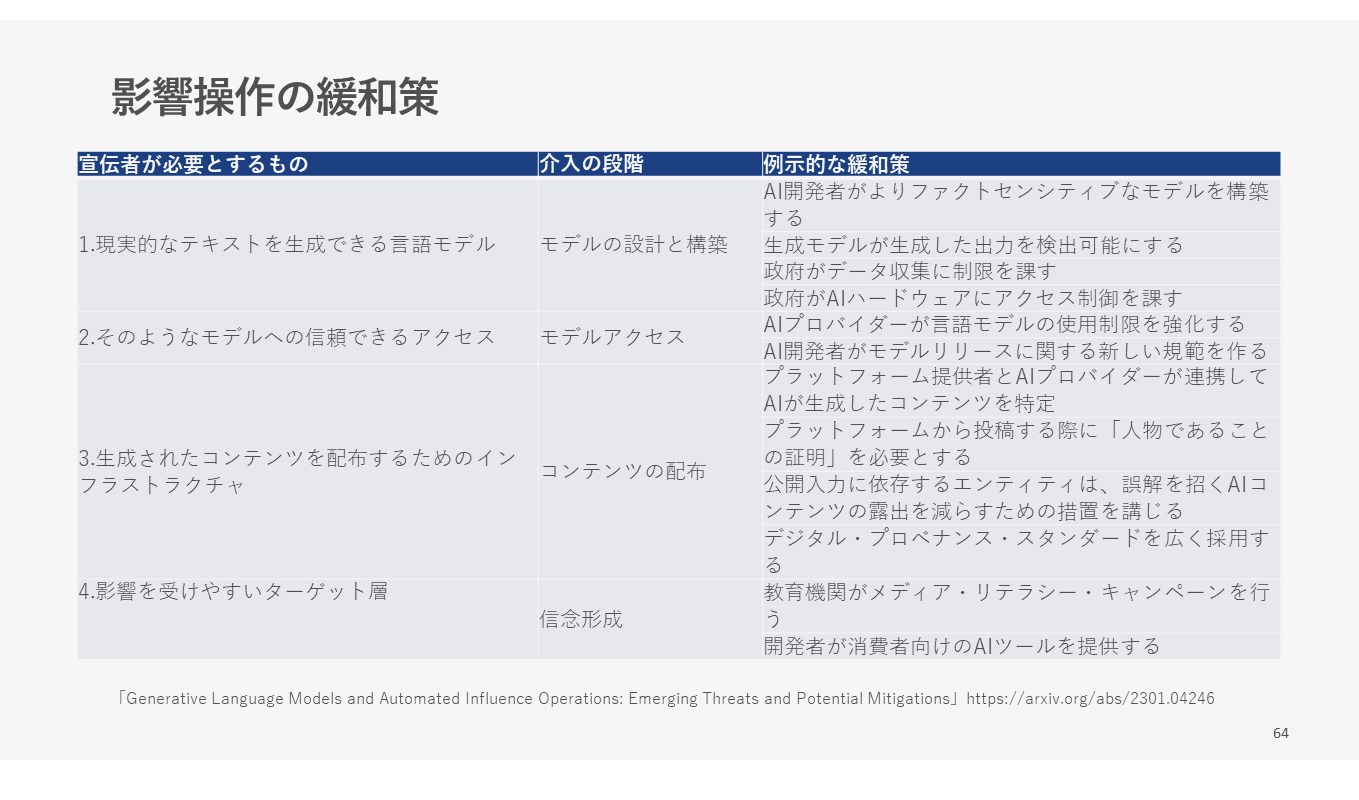
These are the points of this document and the points of explanation. In the materials, we also introduce specific outputs. It would be greatly appreciated if you could use it as a reference for internal explanations.
Hiroshi Sasaki
Macnica AI Engineer Blog Related Articles
- Hands-on GPT-3 series (1) Creating an ad generator
- Practical GPT-3 series ② Will fine-tuning improve accuracy?
- Practical GPT-3 series ③ Will the time come when programming in natural sentences? Code generation experiments with Codex
- What is a foundation model? ~The beginning of a new paradigm shift~
- The future of natural language processing "NLP" -Source code generation experiment report by Codex-
- Current status and future of natural language processing Can AI write sentences that attract humans?
 Latest Information
 Case Study
 Blog
Blog Document List