- Semiconductor BusinessHOME
- Products and Services of Macnica,Inc.
-
technical information

-
Events and Seminars
- Handling Manufacturer
- Support
- Inquiry
- Click here to purchase products
- Semiconductor business e-mail magazine registration


 Narrow down by specifying conditions
現在2220件がヒットしています。check

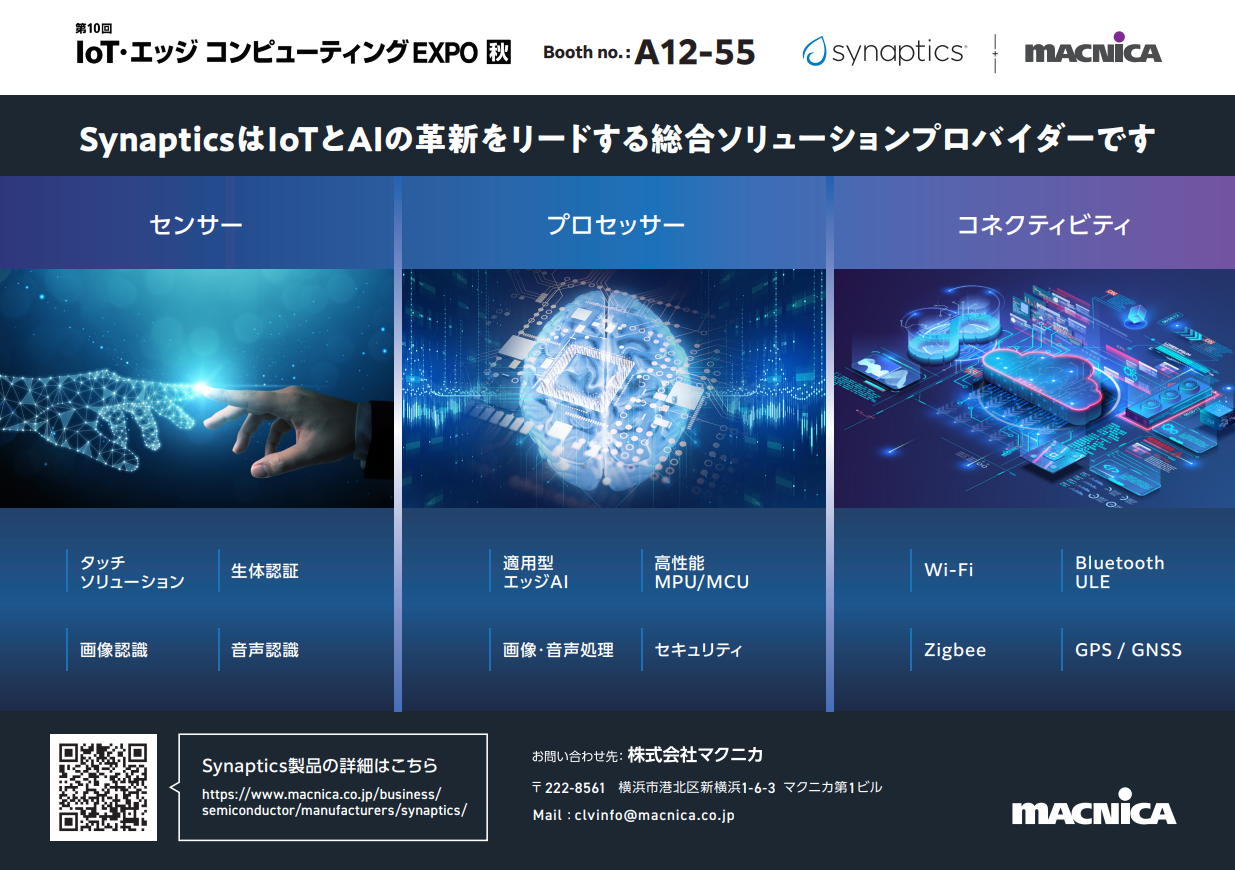
Synaptics and Macnica jointly exhibited at the 10th IoT/Edge Computing EXPO Autumn, held at Makuhari Messe from October 23rd to 25th, 2024. Edge computing, the theme of this exhibition, is being introduced for various purposes, but at the same time, an increasing number of people are having challenges with AI development.

Synaptics, which marks Macnica 's first joint exhibit at the show, is a comprehensive solutions provider founded in San Jose, California, USA in 1986, leading the way in innovation in IoT and AI.
We will publish an event report so that those who were interested in Synaptics at this exhibition can look back on the event, and those who were not able to attend can learn more about Synaptics. Please read to the end.
The following five demonstrations were on display at the booth:
1. Face and object detection/pose estimation
2. Simultaneous video output to 10 screens
3. Person detection
4. Bluetooth distance measurement
5. Wi-Fi Person Detection

PDF file is here
1. Face and object detection/pose estimation
From here on, we will introduce the contents of each demonstration.
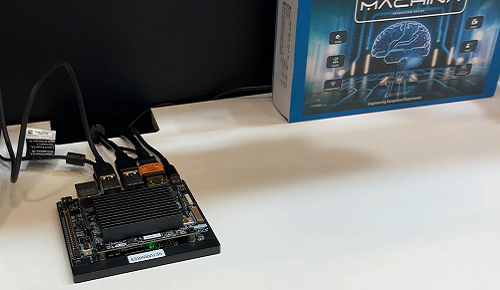
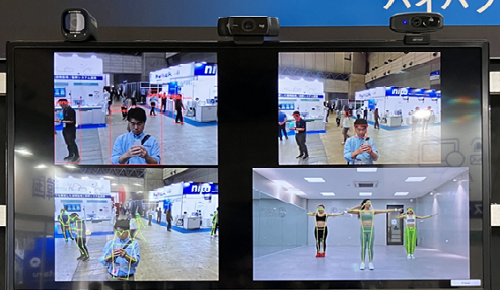
This is a demonstration of simultaneous processing of multiple AI models in an edge environment using an evaluation board equipped with Synaptics' AI processor SL1680. AI image processing is performed simultaneously on images captured by three webcams and videos stored internally, and the results are displayed on the screen.
For the demonstration screen,
・Top left: Object detection demo
・Face detection demo on the top right
・The bottom two are skeleton detection demos
becomes.
The AI model uses the open source Yolo, but it is also possible to perform more advanced processing by building and tuning it independently.
2. Simultaneous video output to 10 screens
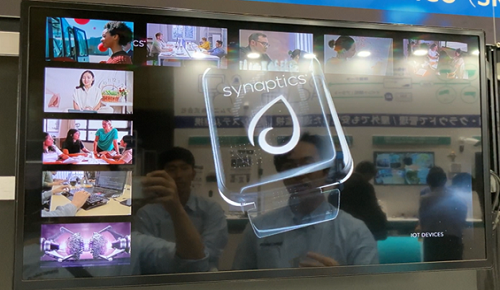
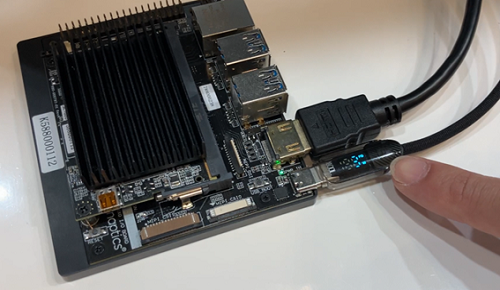
Like "1. Face and object detection/pose estimation," this is also a demonstration using the Astra SL 1680. This demonstration does not use AI technology, but even though it uses the hardware decoder installed in the Astra SL 1680 to simultaneously decode and display 10 videos from H.264, the entire evaluation board achieves low power consumption of around 3W.
It is expected that applications such as digital signage will enable effective marketing by attaching camera sensors in conjunction with advertising displays, and using AI to process the footage and analyze information about people viewing the advertisements.
3. Person detection
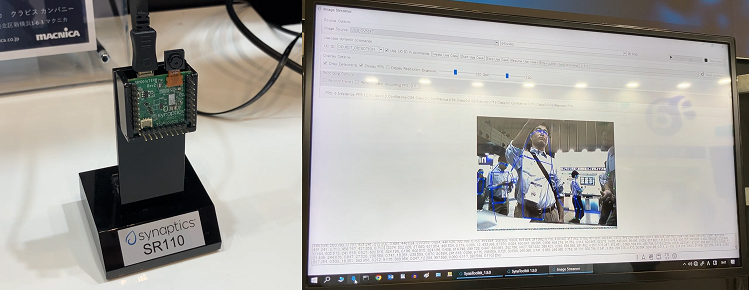
This is a demonstration of human detection using the Astra SR110. Many edge AI processors and microcontrollers on the market require Linux to run, but the SR110 is a microcontroller that runs on an RTOS.
Although the processing power is lower than that of a processor, it works without any problems at the image processing level with a light AI model. Since application software can be written in C or C++, it can be developed in the same environment as conventional microcontroller development.
In addition, the current consumption is significantly lower than that of large-scale chips such as processors; in the demo image, it can operate on approximately 100mW, making it suitable for battery-powered devices and pre-processing applications for inputting images to a host processor.
4. Bluetooth distance measurement
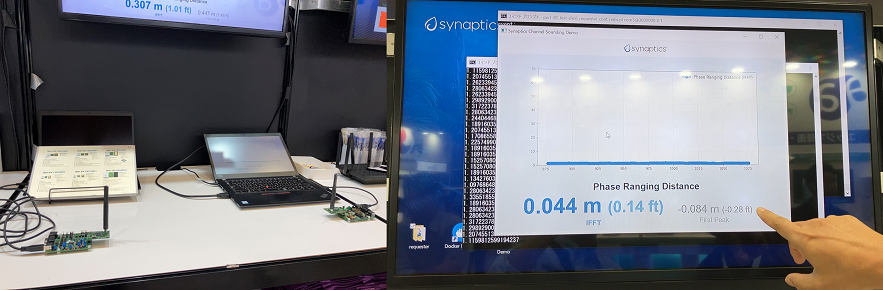
In this demonstration, you can see Bluetooth 6.0 Channel Sounding, a distance measurement technology that will be standardized in 2024. Using Bluetooth's Long Range function, distance measurement is possible up to about 100 meters in good visibility, and an accuracy of about 30 to 50 cm can be expected for short distances. The actual measured distance is displayed on the screen.
One application of this technology is a digital car key. Currently, UWB is mainly used, but the problem is that it consumes a lot of power because it constantly scans various frequency bands. To address this problem, Bluetooth is placed next to UWB, and Bluetooth is used when the distance is long, and UWB when it is close. It is expected that by improving the distance measurement accuracy of Bluetooth, it will be possible to eliminate UWB.
5. Wi-Fi Person Detection
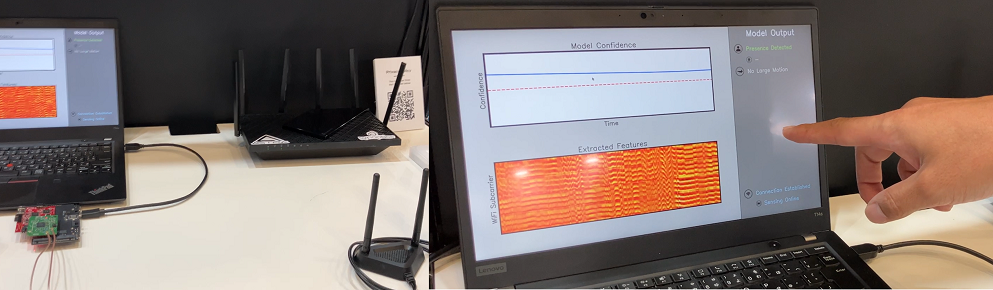
This is a demonstration of Wi-Fi Sensing. The access point and client are connected and communicate 100 times per second. In this demonstration, the signal strength is monitored and displayed on the screen.
The vertical axis represents the subcarrier, the horizontal axis represents the time, and the color represents the amplitude intensity.
The red line indicates the Confidence Level, and the blue color indicates your current location. When the blue line is above the red line, it means there is someone there, and when it is below the red line, it means there is no one there. If you hold the antenna to block the radio waves, you can see how the waves displayed on the screen change.
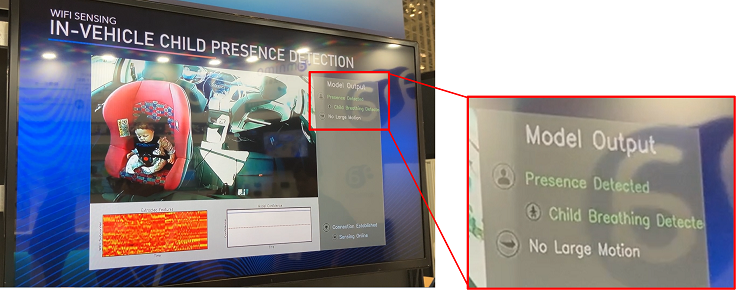
One application of this technology is the detection of children inside a car. Tragic accidents in which children are left behind and die occur not only in Japan, but this technology is expected to help eliminate these accidents. In this video, a Wi-Fi access point is set up in the car navigation system and a communication device is installed above the back seat, creating an environment for detecting the inside of the car.
If the baby is hidden from the camera's footage, it cannot be detected, but by using Wi-Fi radio waves, it is possible to detect the baby even in places where the baby is not visible.
Not only can it detect whether someone is present, but it can also distinguish whether the person is a child or an adult by detecting the difference in breathing between children and adults.
Visitors' comments
"I was looking for an AI development environment, and I was attracted to Astra Machina's functions, cost, and portal HOW-TO."
"I was surprised at how low the power consumption of the SR110 was."
"I became interested in Wi-Fi Sensing because cameras cannot be used in hotel rooms and other places due to privacy concerns."
We were able to attract interest not only from those involved in the design and development of embedded devices, but also from end users in a variety of industries who are considering using AI.
Contact Us
Thank you for reading to the end. If you would like to see the demonstration introduced in this article, or if you are interested in Synaptics' Astra series, Wi-Fi, or Bluetooth solutions, please feel free to contact us.