Why is physical AI attracting so much attention now?
In recent years, the use of robots has been rapidly expanding, particularly in manufacturing, logistics, and service industries.
In fact, according to the "World Robotics 2025 report" (*) published by the International Federation of Robotics (IFR), the number of new industrial robots installed in 2024 reached 542,000 units, more than double the annual number of installations compared to 10 years ago. This trend is driven by the need to address labor shortages, improve productivity, and drive automation.
*Source: IFR "World Robotics 2025 report – INDUSTRIAL ROBOTS – released by IFR"
However, most robots operate according to predefined programs, making it difficult for them to flexibly adapt to changes in the environment or the tasks they perform. For example, if the position of an object changes slightly within a factory, or if a new part needs to be handled, adjustments to the recognition model and motion program may be necessary.
One technology that is attracting attention as a solution to these problems is "physical AI."
Physical AI refers to technology that enables AI to recognize real-world situations, understand human instructions and its surroundings, and act autonomously.
While conventional AI focused on processing in the digital space, such as image recognition and chat, physical AI is characterized by its ability to handle actions in the real world, such as those of robots and autonomous mobile devices.
One of the technologies that has been attracting attention in recent years to support this realization is the VLA (Vision-Language-Action) model. VLA is expected to be an AI model that integrates image recognition, language understanding, and action generation, and understands human instructions to autonomously generate robot actions.
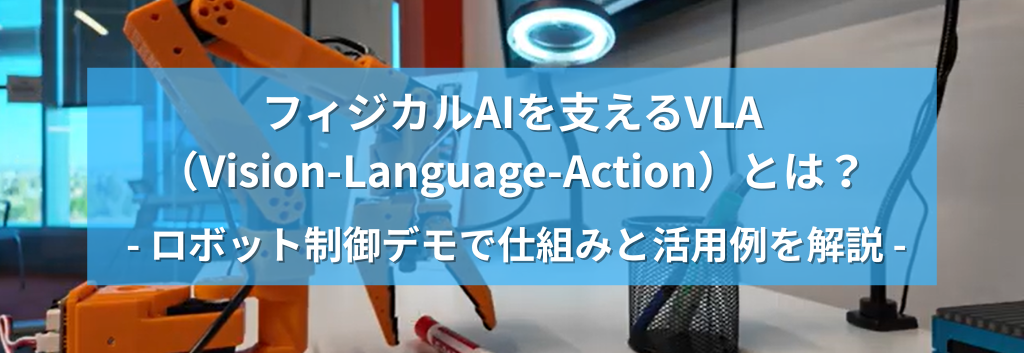
This article explains the mechanism of VLA, which supports physical AI, and its potential applications in the field of robotics, based on a VLA demo video running on SiMa.ai 's MLSoC™ Modalix.
What is VLA (Vision-Language-Action)?
VLA is an AI model that integrates Vision (image recognition), Language (language understanding), and Action (action generation).
Based on images acquired from cameras, the robot understands its surroundings, interprets natural language instructions given by humans, and directly generates robot actions as a result.
In conventional robot systems, it was common practice to design and implement functions such as object recognition using a camera, determination of movement paths and work procedures, and control of robot arms and motors separately.
For example, even when performing a task like "placing a marker in a pen holder," it's necessary to first recognize the object, determine its position, and then individually calculate where to grab the marker and what path to take the arm. As a result, it was often necessary to adjust the recognition model and control logic every time the object or task changed.
On the other hand, VLA receives camera footage and natural language instructions as input and directly generates the actions to be performed. This allows for flexible task execution according to the situation and instructions, without the need to pre-define detailed procedures and rules as in conventional methods.
A prime example of a robot-based model: NVIDIA GR00T
One notable example of a VLA implementation is the "GR00T (Generalist Robot 00 Technology)," a platform model for robots developed by NVIDIA.
GR00T is designed as a VLA model that understands visual information and linguistic instructions to generate robotic behavior. Its key feature is its ability to understand instructions given by humans in natural language and generate appropriate actions while recognizing its surroundings.
Unlike conventional robots that require creating separate programs for each individual task, this robot is expected to serve as a robot platform model that can flexibly handle a variety of tasks.
In this demo, a VLA configuration equivalent to GR00T 1.5 is running on SiMa.ai 's MLSoC™ Modalix. While robot base models that perform advanced image recognition and action generation typically require high computing power, one of the features of this demo is that it achieves this in a low-power edge environment.
Watch the physical AI in action in the VLA demo video.
Now let's take a look at a VLA demo running on SiMa.ai 's MLSoC™ Modalix.
In this demo, you can see a configuration equivalent to GR00T 1.5 implemented on Modalix, demonstrating how a robotic arm is controlled while understanding human commands (video in English).
In the demonstration, markers, pens, and a pen holder are placed within the work area. The robot acquires images from cameras mounted on its wrist and on its upper body to recognize its surroundings.
① Recognize the surrounding situation from the camera footage.
First, the VLA model recognizes objects within the work area based on images acquired from the wrist camera and the top camera.
In this demonstration, there are multiple objects, such as markers, pens, and a pen holder, and their relative positions are also understood.
② Understanding instructions in natural language
Next, enter the natural language instruction, "Please put the marker in the pen holder."
The VLA model not only recognizes objects, but also understands the intent behind instructions, such as which objects to target and what to achieve.
③ Generate actions and execute tasks
Based on the perceived surrounding environment and instructions, the VLA model generates the actions that should be taken.
The robot autonomously determines which object to select, in what order to move the arm, and performs a series of actions to grasp the marker and move it to the pen holder. Finally, it places the marker in the pen holder, completing the task.
Potential use cases that can be considered from the GR00T demo
This demonstration involves a simple task of "putting a marker in a pen holder," but its essence lies in the ability to understand human instructions, recognize objects, and autonomously generate actions.
Therefore, it is expected to have various applications, mainly in the manufacturing and logistics industries.
* Support for supplying parts at the manufacturing site
In manufacturing, the parts and product lines handled are changing frequently due to the expansion of high-mix, low-volume production.
Conventional robots may require pre-configuration or program changes for each target part or transport route, but by utilizing VLA,
"Please bring part X, which will be used in the next step."
"Please transport part X, which is in a blue case."
It is expected that the system will understand instructions such as these, select the target parts, and transport them. As demonstrated in this demo where the system identified and selected markers, it can perform tasks while determining the necessary parts from among multiple parts.
* Assistance with the handover of tools and jigs
Numerous tools and jigs are used in manufacturing and equipment maintenance sites. A robot equipped with VLA can do this.
"Please bring tool X."
"Please hand over tool X, which is inside the red case."
It can understand such natural instructions, select the appropriate tool, and hand it over to the worker.
In particular, in workplaces where the necessary tools vary depending on the task, the ability to judge the object according to the situation, rather than relying on fixed rule-based control, is very useful.
* Picking support at logistics warehouses
In logistics operations, the types of goods handled and their storage locations change daily. By utilizing VLA,
"Please take the box containing product X to the shipping area."
"Please pick item X, the one with the red label, from the shelf on the right."
This technology is expected to enable the creation of robots that can understand such instructions, select the target product, and perform the necessary tasks.
In addition to setting detailed rules for each product as in the past, it will also be possible to respond to flexible work instructions using natural language.
Summary: VLAs supporting physical AI and generative AI running at the edge
In the example presented here, we have created a physical AI that recognizes its surroundings from camera footage, understands natural language instructions from humans, and autonomously generates actions, based on the VLA architecture used in NVIDIA 's robot platform model, GR00T 1.5.
Conventional robots required separate design for object recognition, operation procedure determination, and control logic. In contrast, the VLA model integrates recognition, understanding, and action generation, enabling flexible task execution in response to human instructions.
Furthermore, this demo runs such a robotic platform model on SiMa.ai 's MLSoC™ Modalix. Despite its small size and low power consumption, it achieves highly efficient inference of up to 50 TOPS, enabling immediate execution of advanced AI processing such as physical AI and generative AI at the edge. The flexible development environment provided by the Arm Cortex-A65 is also a major advantage.
We hope this article will be helpful in your consideration of using AI in your work.
Inquiry
Please feel free to contact us with any questions about our products, technical inquiries, sample requests, or estimates.
SiMa.ai Manufacturer Information Top
Edge AI Use Cases (with Demo Videos)
For those looking for ideas for implementing edge AI, we are showcasing a demo utilizing SiMa.ai's MLSoC.