- Semiconductor BusinessHOME
- Products and Services of Macnica,Inc.
-
technical information

-
Events and Seminars
- Handling Manufacturer
- Support
- Inquiry
- Click here to purchase products
- Semiconductor business e-mail magazine registration


 Narrow down by specifying conditions
現在2220件がヒットしています。check
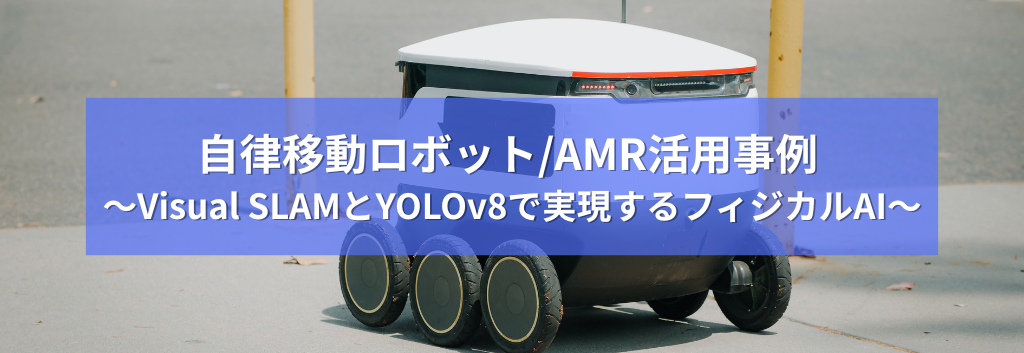
Advanced capabilities and autonomy required for autonomous mobile robots
In recent years, the use of autonomous mobile robots has been expanding, particularly in logistics warehouses, factories, and commercial facilities.
Conventional transport robots have widely utilized AGVs (Automated Guided Vehicles) that move along predetermined routes. While AGVs can achieve stable transport, they have certain limitations in adapting to changes in travel routes or layouts.
On the other hand, AMRs (Autonomous Mobile Robots) have been attracting attention in recent years.
AMRs can move autonomously while recognizing their surroundings,
- It can drive while avoiding obstacles.
- Flexible to change the layout
- It is also easy to adapt to environments where you collaborate with others.
It has the following features.
Against this backdrop, the AMR market continues to expand globally, with the market size projected to grow from approximately $ 3.1 billion in 2025 to $17 billion in 2035 (*). As the use of robots progresses, particularly in logistics and manufacturing, there is a growing need for robots that can not only perform simple transportation but also make autonomous decisions and move independently.
*Source: Global Market Insights “Autonomous Mobile Robots Market Size & Share Report, 2035”
However, in order to achieve such flexible movement, the robot itself needs to be able to perceive its surroundings and make decisions and take action on its own.
For example, it is necessary to perform multiple processes in real time and in coordination, such as self-localization and map generation to determine one's own position, recognition of the surrounding environment, determination of movement paths, and even motor control.
Physical AI, which understands the real world and acts autonomously, has been attracting attention in recent years.
Physical AI requires not only simple image recognition and inference, but also the continuous execution of recognition, judgment, and control.
This article presents examples of robotics applications using physical AI, based on a demonstration of an autonomous mobile robot utilizing SiMa.ai 's MLSoC™ Modalix.
Case study: Autonomous mobile robot utilizing Visual SLAM and object recognition
For a robot to move autonomously, it needs to be able to perceive its surroundings while understanding its own position, and take appropriate control actions based on the situation.
In this case, we are utilizing SiMa.ai 's MLSoC™ Modalix to combine Visual SLAM and object recognition, enabling real-time execution of a series of processes necessary for autonomous mobile robots.
Visual SLAM (Visual Simultaneous Localization and Mapping) is a technology that uses camera footage to create a map of the surrounding environment while simultaneously estimating the robot's own position. Because it allows for simultaneous understanding of the robot's current location and surrounding environment, it is used as one of the important technologies for achieving autonomous navigation.
Furthermore, by combining this with object recognition using YOLOv8, the robot will be able to move while perceiving its surrounding environment.
Furthermore, all of these processes are performed on the robot itself, eliminating the need for external GPUs or cloud connectivity. This allows for real-time recognition, decision-making, and control, regardless of the communication environment. Additionally, the simplified system configuration reduces the design burden in robot development.
Here is a demonstration of an autonomous mobile robot using Visual SLAM and object recognition (video in English).
In this demo, the following processes are executed on MLSoC™ Modalix:
① Map generation using Visual SLAM
② Self-localization using camera, IMU, and odometry
③ Real-time object recognition using YOLOv6
④ System control using ROS2
⑤ Coordinated operation of recognition, position estimation, and control
⑥ Execute all processes within the local environment.
<Glossary>
• IMU (Inertial Measurement Unit): An inertial sensor used to measure acceleration and angular velocity to understand the robot's posture and movement.
Odometry: A technique for estimating distance traveled and changes in position from factors such as the amount of wheel rotation.
YOLOv8: An AI model that detects the location and type of objects in an image in real time.
• ROS2 (Robot Operating System 2): An open-source software platform for robot development.
This will enable the robot to move autonomously while perceiving its surroundings.
Real-time map generation and self-localization using Visual SLAM
For a robot to move autonomously, it needs to be aware of its own location and perceive its surroundings.
In this demo, we utilize Visual SLAM to perform map generation and self-localization.
Visual SLAM processes camera footage in combination with information obtained from the IMU and odometry.
The acquired sensor data is integrated by Cartographer, and real-time map generation and self-localization are performed. Furthermore, the results are visualized on Rviz, allowing the robot's current position and surrounding environment to be checked in real time.
<Glossary>
• Cartographer: SLAM software for map generation and self-localization.
• Rviz: A display tool for visualizing the robot's position and surrounding area.
Real-time object recognition and physical AI realized with YOLOv8
For a robot to understand its surroundings, it's important not only to determine its own position but also to recognize objects present in its environment.
In this demo, object recognition is performed using video footage acquired from a UVC camera. The acquired video is input to a YOLOv8 inference pipeline running on the MLSoC™ Modalix, where objects are detected in real time.
Furthermore, this demo demonstrates the coordinated operation of map generation and self-localization using Visual SLAM, object recognition using YOLOv8, and system control using ROS2, all on a single platform.
This enables a simple system configuration that allows for real-time recognition, position estimation, and control without requiring an external GPU, host CPU, or cloud connection.
Summary: A physical AI platform that integrates recognition, judgment, and control.
In the example presented here, we achieved the environmental awareness necessary for autonomous mobile robots by combining map generation and self-localization using Visual SLAM with object recognition using YOLOv8.
Furthermore, by integrating and executing these processes on MLSoC™ Modalix, we are building a physical AI platform that enables coordinated recognition, position estimation, and control.
Another key feature is its simple configuration, which does not require an external GPU, host CPU, or cloud connection, while simultaneously achieving low power consumption of less than 10W.
The SiMa.ai MLSoC™ Modalix used in this demo is a next-generation chip optimized for realizing AI that can be used in the field.
Despite its compact size and low power consumption, it achieves highly efficient inference of up to 50 TOPS, performing recognition, position estimation, and control in real time. The flexible development environment provided by the Arm Cortex-A65 is also a major advantage of its adoption.
If you are considering introducing physical AI or autonomous mobile robots, we encourage you to use this case study as a reference and consider its applicability to your own system.
We hope you will find this article useful as your first step in utilizing AI.
Inquiry
Please feel free to contact us with any questions about our products, technical inquiries, sample requests, or estimates.
SiMa.ai Manufacturer Information Top
Edge AI Use Cases (with Demo Videos)
For those looking for ideas for implementing edge AI, we are showcasing a demo utilizing SiMa.ai's MLSoC.