- Semiconductor BusinessHOME
- Products and Services of Macnica,Inc.
-
technical information

-
Events and Seminars
- Handling Manufacturer
- Support
- Inquiry
- Click here to purchase products
- Semiconductor business e-mail magazine registration


 Narrow down by specifying conditions
現在2236件がヒットしています。check

There's an old adage in the engineering world: "If it moves, it will break." We all know that mechanical things like fans and relays are usually the first to fail. Any critical system should have a proactive maintenance or replacement program for these items, just in case. It is even worse if those mechanical parts normally operate at high stress levels and must react reliably in an emergency, for example a contact breaker in series with an electric vehicle battery. .
Under these circumstances, the operating current can be hundreds or thousands of amperes in the closed state where the breaker must be opened. The voltage is high, typically 400V DC or higher, and the inductance of the connection makes the spike voltage even higher when the fault current is interrupted. This voltage causes an arc that vaporizes the breaker contacts. Also, since it is direct current, it does not have a zero cross to extinguish an arc like alternating current does. Breakers are also slow to open and close (tens of milliseconds), which can result in damaging penetrating energy in short-circuit conditions.
Also, the older the breaker, the slower it works and the more lossy it gets. The life of high current mechanical circuit breakers is critical, so they must be ruggedly built, sometimes using puffs of compressed gas or magnetic "blowout" coils to eliminate arcing. Special methods are sometimes used.
| Features | solid state breaker (Si/SJ/SiC/IGBT/IGCT) |
electromechanical breaker |
| Full controllability | ☆☆☆☆☆ | ☆☆☆ |
| High speed | ☆☆☆☆☆ | ☆☆ |
| Conduction loss | ☆☆ | ☆☆☆☆☆ |
| No arcing | ☆☆☆☆☆ | ☆☆ |
| Use cycles : no maintenance | ☆☆☆☆☆ | ☆☆ |
| Cost per amp | ☆☆ | ☆☆☆☆☆ |
| Voltage rating vs. on Rds(on) | ☆☆☆ | ☆☆☆☆☆ |
Naturally, solid state circuit breakers (SSCBs) have been designed as an alternative and manufactured using all available semiconductor technologies such as MOSFETs, IGBTs, SCRs, IGCTs, and are less susceptible to arcing and mechanical wear. You have successfully solved the problem. For example, in the case of an IGBT, a voltage drop of 1.7V occurs at 500A, consuming 850W of power. IGCTs have a low voltage drop, but are very large in physical size. MOSFETs do not exhibit a "knee" voltage like IGBTs, but they do have on-resistance.
Improving the MOSFET would require this RDS(on) to be less than 3.4mΩ to achieve a voltage rating greater than 400V, which is currently not possible with a single MOSFET. Many MOSFETs in parallel are possible, but the cost jumps and doubles if bidirectionality is required. Electromechanical circuit breakers aren't cheap, but they still have a cost advantage.
Is there any difference with SiC?
So what new wonders can wide bandgap semiconductors do to fill the gap? Silicon carbide switches offer roughly one-tenth the on-resistance of silicon in the same die area, and with far better thermal conductivity to dissipate heat, they can handle twice the maximum temperatures.
This opens the possibility of improving IGBTs used as SSCBs by paralleling enough die in a small package, making SiC cascode JFETsan ideal candidate. Cascoded SiC JFETs and Si-MOSFETs are easy to drive and have the bestRDS(on)× A figure of merit of any current switch technology. As a SSCB demonstration, ON Semiconductor has paralleled six 1200V dual gate die to achieve an on-resistance of 2.2mΩ at 1200V 300A rating in a SOT-227 package. As shown in Figure 1, the prototype safely interrupted a fault current of nearly 2000A.
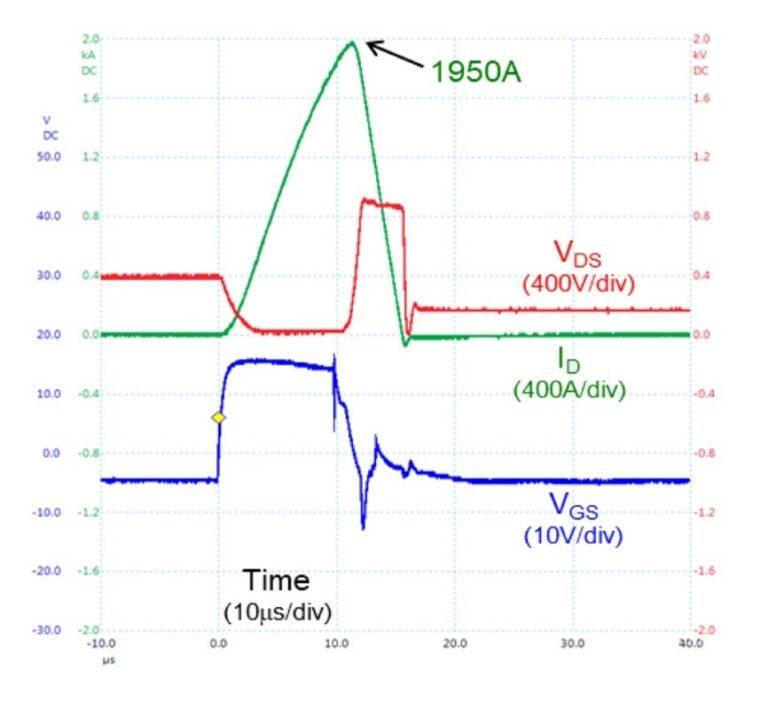
Bringing the internal JFET gate out to a separate pin allows for more direct control of the edge rate in fast switching applications, effectively enabling normally-off or normally-on operation as desired in some applications such as SSCB. can be selected to The on-resistance is also slightly improved by slightly positively biasing the gate of the JFET. However, there is another feature: at positive voltages of 2V and above, the channel is fully conducting and the gate looks like a forward-biased diode. Given a constant low current through it, the actual knee voltage of the diode will have an exact relationship to the temperature of the die. Measuring this and recording temperature trends can be used for rapid overheating detection and even long-term health monitoring.
SiC Cascode JFET SSCBs are a step in the right direction to replace mechanical contacts
SiC cascode JFETs allow SSCB applications to handle higher currents, and losses will decrease with technology advances. Devices can also be paralleled to achieve the same ultimate losses as mechanical circuit breakers, and cost is not necessarily an issue as die improve and reduce the number needed for a given resistance. Also, the cost of SiC wafers is expected to halve over the next few years, allowing economies of scale as the market for circuit breakers expands with the sale of electric vehicles. Furthermore, the argument becomes even more compelling when you consider the maintenance and replacement costs of electromechanical solutions.
There is a saying among engineers: "If it ain't broke, don't fix it." Instead of waiting for it to break, why not consider the SiC Cascode JFET SSCB for a worry-free solution?
Inquiry
If you have any questions regarding this article, please contact us below.
On Semiconductor Manufacturer Information Top Page
If you want to go back to ONSEMI maker information top page, please click below.