- Semiconductor BusinessHOME
- Products and Services of Macnica,Inc.
-
technical information

-
Events and Seminars
- Handling Manufacturer
- Support
- Inquiry
- Click here to purchase products
- Semiconductor business e-mail magazine registration


 Narrow down by specifying conditions
現在2223件がヒットしています。check

Overview
Power conversion is a common element in almost all electronic devices and is implemented in various topologies. However, new applications have unique demands that force engineers to develop AC-DC and DC-DC converters with the optimum balance of performance and efficiency. However, this is not always easy.
Choosing the right topology is just the beginning of the challenge and requires careful selection of power components. Also, as new semiconductor technologies enter the market, engineers have the opportunity to discover and evaluate new solutions to traditional problems.
This article provides background on the development of new semiconductor technologies and provides examples of innovative components arranged to provide appropriate functionality for current and future power conversion applications. In three installments, I will explain why high efficiency is necessary, topologies, and figures of merit.
Semiconductor switches and their figures of merit (FoM)
There are many different types of semiconductor switches that can be used for LLC converters and similar topologies. Traditionally, silicon MOSFETs have been the standard solution, but their use has some limitations and pitfalls to avoid. The output capacitance COSS and stored energy EOSS of a MOSFET are highly nonlinear quantities that can be large and require longer than ideal dead times to discharge. Ensuring that the energy is discharged before switching is important for ZVS, but the act of charging the capacitance dissipates a power of P = fx 0.5 x COSS x V2, which becomes more problematic at higher voltages due to the V2 term.
Obviously EOSS should be as low as possible, but other things being equal, it is also a trade-off with on-resistance. With a larger die, many parallel cells can reduce conduction losses and give a lower RDS(on), but COSS and therefore EOSS will naturally be higher. Therefore, when comparing devices, the FOM RDS*EOSS is important. For similar RDS*EOSS values, another differentiating FOM is RDS-A. A smaller value of this means a smaller device capacitance, which translates into a higher yield from the wafer for a given target on-resistance, resulting in a lower unit cost.
Body diode and diode effect characteristics are important when comparing devices. In resonant converters, the MOSFET's intrinsic diode naturally conducts during soft switching, but it has relatively poor performance, including a large forward voltage drop and slow charge recovery QRR, and at high frequencies with short dead times, switching cycles can be incomplete and cause losses. Wide bandgap devices such as gallium nitride (GaN) HEMT cells do not have diodes and conduct in the "third quadrant" through the main channel from source to drain, rather than the parasitic diode found in MOSFETs. There is no charge recovery in the third quadrant conduction of a HEMT cell, but it also has a very large forward voltage drop and a negative off drive voltage is applied in addition to the gate turn-on threshold voltage.
WBG silicon carbide (SiC) technology MOSFETs have fast parasitic diodes like Schottky diodes, but still have a high forward voltage of about 3V. Although the third quadrant conduction time is short, the diode and diode effects can cause significant losses when highest efficiency is required. As an indicator of the combination of channel conduction and diode losses, RDS*QRR is a useful FOM. Also, SiC MOSFETs and GaN HEMT cells have very sensitive gate drive requirements for optimum efficiency.
A device that combines all these attributes is the SiC cascode JFET (Figure 1), which combines a low-voltage Si-MOSFET and a SiC JFET in a cascode configuration, and similarly has lower FOMs for RDSA, RDS*EOSS, and RDS*QRR than Si superjunction MOSFETs, SiC MOSFETs, and GaN HEMT cells.
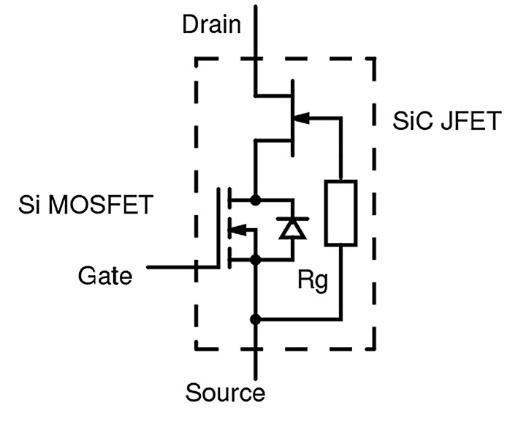
SiC cascode JFETs offer the advantages of SiC, such as ultrafast switching, high thermal conductivity, and high temperature operation, but with the ease of gate drive of low-voltage Si-MOSFETs. The device capacitance and stored charge are all low, it has a body diode effect, is fast, and has a low forward voltage drop of about 1.5 V at 25°C. Also, unlike GaN devices, it does not avalanche and is current limited under short circuit conditions.
new solution
Nowadays, the advantages of SiC cascode JFETs are being recognized in high-efficiency DC-DC converter applications using LLC and PSFB topologies. Leveraging these low losses, the converter size, especially the height, is reduced, allowing for tighter module packing and higher system power density. In these applications, surface mount packages are the only option for SiC cascode JFET power switches, and so far D2PAK-3L and D2PAK-7L have been used. These devices support higher current ratings, especially the -7L package, which is rated to 1700V, and use Kelvin source connections to combat the effects of lead inductance. However, the height is still close to 0.19in (5mm).
ON Semiconductor's new solution is a family of SiC cascode JFETs in a DFN 8x8-4L package measuring 8mm x 0.043 inches (1.1mm) maximum height. The devices are rated at 650V with on-resistance of 34 or 45mΩ at 25°C. Like other SiC cascode JFET devices, they offer easy gate drive from 0 to 10V, ultrafast switching, low QRR, and robust body diode effect in the event of loss of zero voltage switching. The RDS*EOSS and RDS*QRR figures of merit are the best in their class compared to 650V silicon superjunction MOSFETs and GaN HEMT cells (Table 1). The sintered silver die attach provides the lowest case thermal resistance, which, combined with SiC's inherent high temperature performance, ESD protection, and superior avalanche and short circuit behavior, make for a robust product.
| Technology |
|
Si-SJ |
Si-SJ |
GaN |
UF3SC065030D8S |
UF3SC065040D8S |
| Identity |
A |
20 |
22 |
16 |
18 |
18 |
| Vdsmax |
V |
650 |
650 |
650 |
650 |
650 |
| RthJC |
C/W |
0.74 |
0.66 |
1.3 |
0.47 |
0.64 |
| Eas |
mJ |
171 |
960 |
NAMore |
120 |
76 |
| Rds (25C) |
mΩ |
62 |
61 |
72 |
34 |
45 |
| Rds (150) |
mΩ |
149 |
134 |
150 |
55 |
70 |
| Rg |
Ω |
0.85 |
1.4 |
|
4.5 |
4.5 |
| Ciss |
pF |
3020 |
4200 |
600 |
1500 |
1500 |
| Coss (er) (400V) |
pF |
100 |
97 |
131 |
230 |
146 |
| Coss (tr) (400V) |
pF |
1110 |
344 |
217 |
520 |
325 |
| Qrr (400V) |
nC |
10000 |
9500 |
89 |
229 |
169 |
| Rds (150) * Coss (er) |
mΩ.pF |
14900 |
12998 |
19650 |
12650 |
10220 |
| Rds (150) * Coss (tr) |
mΩ.pF |
165390 |
46096 |
32550 |
28600 |
22750 |
| Rds (150) * Qrr |
mΩ.nC |
1490000 |
1273000 |
13350 |
12595 |
11830 |
Table 1: Comparison of 650V class switches, Si-SJ MOSFETs, GaN and SiC cascode JFETs
Conclusion
Efficiency is the driving force behind all modern power converter designs, due to the energy and cost savings, and the miniaturization that can be achieved with fewer power losses. Modern circuit topologies using resonant switching routinely achieve efficiencies in the high 90s, with the remaining losses concentrated in residual conduction and switching effects. To further reduce losses, wide bandgap semiconductor switches such as SiC cascode JFETs have emerged, offering mΩ-scale on-resistance and near-ideal switching characteristics. The availability of parts in ultra-low profile packages such as ON Semiconductor's DFN 8x8, combined with ease of circuit implementation, make them a high-performance, robust solution for low-loss power switching.
Inquiry
If you have any questions regarding this article, please contact us below.
On Semiconductor Manufacturer Information Top Page
If you want to go back to ONSEMI maker information top page, please click below.