- Semiconductor BusinessHOME
- Products and Services of Macnica,Inc.
-
technical information

-
Events and Seminars
- Handling Manufacturer
- Support
- Inquiry
- Click here to purchase products
- Semiconductor business e-mail magazine registration


 Narrow down by specifying conditions
現在2240件がヒットしています。check

What engineers face in the real world
Automotive engineers are being forced to make a radical shift away from electro-mechanical engineering as the pace of automobile invention accelerates faster than Henry Ford could have imagined. With consumer demand and industry focus moving towards hybrid and fully electric vehicles, this shift will be felt more strongly, pushing engineers to go beyond "business as usual" to drive high-current, high-voltage electric vehicles. Innovative solutions will be required for problems such as power line disconnection.
Possibilities of SiC semiconductors in solid state breakers
Some vehicle designs remain from the 1980s, even for electric vehicles, and electromechanical switches and contactors are still used to interrupt high currents and disconnect power rails in the event of a fault. However, with thousands of amps of current and battery voltages of 800V and above, mechanical options become complex and difficult. Interrupting DC creates an arc with a length proportional to the voltage and strength proportional to the current, so wear is an issue. Contact material burns off and the heat of the arc degrades the entire part. Specialized methods can be used to extinguish the arc, such as injecting oil or blowing it away with compressed air, but the problem becomes worse as current and voltage levels increase. Also, because breakers and contactors are mechanical devices, they are subject to shock and vibration, which are particularly problematic in the automotive environment, and they operate relatively slowly, taking tens of milliseconds.
Solid-state breakers, including the GTO, IGBT, and more recently MOSFET options, have high insertion loss and can dissipate tens of watts of power in the device under normal operating conditions, subjecting components to thermal stress and reducing system efficiency.
However, the latest SiC (Silicon Carbide) switches are opening up new possibilities. Switches configured as breakers operate within 100ns to a few us, and arcing is avoided. New parts from ON Semiconductor, such as the UF3SC065007K4S (650V, 6.7mΩ) and UF3SC120009K4S (1200V, 8.6mΩ), have minimal conduction losses and can operate reliably at continuous junction temperatures of 175°C. They can have even higher peak ratings. SiC switches in TO-247 packages are cascaded with SiC JFETs and Si-MOSFETs with non-critical gate drive, making them easy to incorporate into new designs or to use as replacements for existing discrete solid-state breaker designs using MOSFETs or IGBTs.
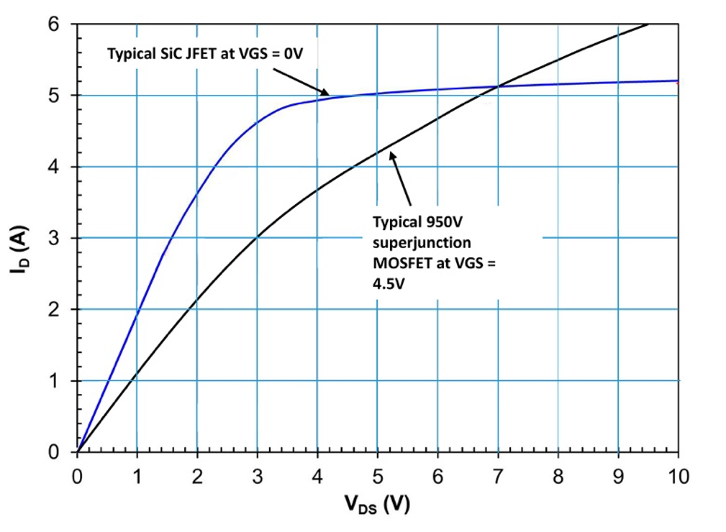
Compared to mechanical breakers, solid-state switches with SiC cathodes enable other functions, e.g., conduction can be controlled to limit inrush currents or to pre-charge capacitors. Short-circuit currents can be limited by the "pinch-off" effect of the JFET, and increased electron mobility allows for a well-controlled saturation current that decreases with increasing temperature (Figure 1).
Additionally, in the off-state, SiC semiconductors have high-energy avalanche ratings and are highly resistant to voltage transients.
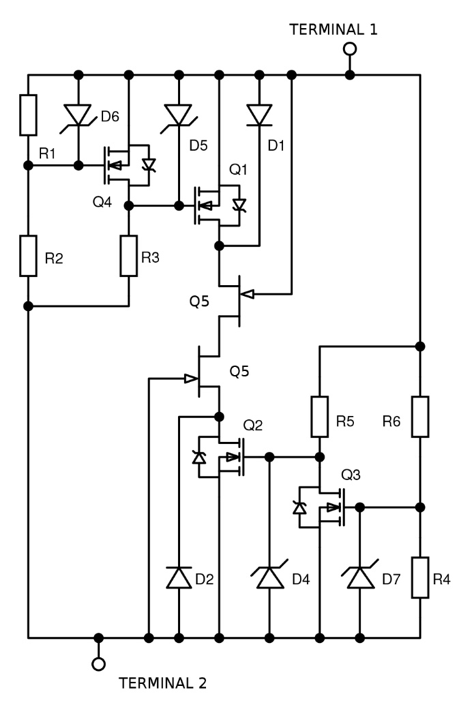
SiC cascodes are intended to be compatible with MOSFET and IGBT gate drives, and therefore require a positive Vg to saturate. ON Semiconductor also offers SiC JFETs that are normally on, i.e. conducting at Vg=0V. This opens up the possibility of true two-terminal circuit breaker modules without the need for an external auxiliary power rail or internal DC-DC converter (Figure 2).
In modern automotive design, where touchscreen displays and electronic switches are the norm and there is a growing trend to eliminate moving parts, ON Semiconductor's SiC cascode JFETs offer a highly efficient and robust solution for switching high voltages and currents in drive and battery systems.
The use of solid-state circuit breakers, switches and current limiters using SiC semiconductors is another opportunity for engineers to split the infinitive and "go bold" for the next generation of EV designs.
Inquiry
If you have any questions regarding this article, please contact us below.
On Semiconductor Manufacturer Information Top Page
If you would like to return to the ON Semiconductor manufacturer information top page, please click below.