- Semiconductor BusinessHOME
- Products and Services of Macnica,Inc.
-
technical information

-
Events and Seminars
- Handling Manufacturer
- Support
- Inquiry
- Click here to purchase products
- Semiconductor business e-mail magazine registration


 Narrow down by specifying conditions
現在2247件がヒットしています。check

Introduction
As the pace of innovation in areas such as EVs, renewable energy and 5G increases at a rate of knots, engineers are increasingly looking for new solutions, pushing technology further to meet consumer and industry demands. I am asking for a lot. SiC semiconductors are one of the answers and are on an exciting path of improvement, already delivering cost-competitive performance compared to older technologies.
Thinking about the price of innovation with SiC semiconductors
Irish poet, novelist and clergyman Oscar Wilde wrote in his play The Fan of Lady Windermere that the cynic is someone who "knows not the price of everything and the value of anything". . It was meant to be a putdown for those with a short-sighted view of the situation without looking at the wider picture. He contrasts the cynic with the "visionary" who focuses on benefits rather than costs.
Power engineers cannot ignore component prices, but there are complex, time-varying, and often difficult-to-quantify cost benefits. Power semiconductors are one example. The innovative and relatively recent disruptive technology of SiC semiconductors was very expensive when first commercialized, and most engineers are unaware of its potential advantages over silicon-based products such as IGBTs and Si-MOSFETs. I was aware of it, but put it far down on my "nice to have" list. However, as SiC semiconductor prices have fallen, performance has improved, and reliability has been demonstrated, it has moved up the list and can be seen as a replacement for existing older technology parts, and a starting point for new designs. . Their adoption is application dependent.
Solar and EV engineers were early adopters where efficiency improvements were a top priority, but the value of lower die costs, better performance, energy savings, and related component cost reductions are considered. With a much wider range of applications'' there is no reason not to switch.
ON Semiconductor's SiC cascode JFET devices, which use normally-off cascodes such as fast switching, have pushed the limits even further. The latest additions to the Company UF series have the lowest on-resistance in their class for 1200V and 650V devices, less than 9 milliohms and 7 milliohms respectively. These devices have a low-loss body diode effect, are inherently robust against overvoltage and short circuits, and are as easy to drive as Si-MOSFETs and IGBTs. In fact, the TO-247 package allows for a drop-in replacement for many of these parts, providing an immediate performance boost. For new designs, ON Semiconductor has also introduced a low-inductance, thermally enhanced DFN8x8 package that leverages the high frequency capabilities in the case of SiC cascode JFETs.

Gate drive for SiC cascode JFETs is compatible with existing technology with excellent gate protection
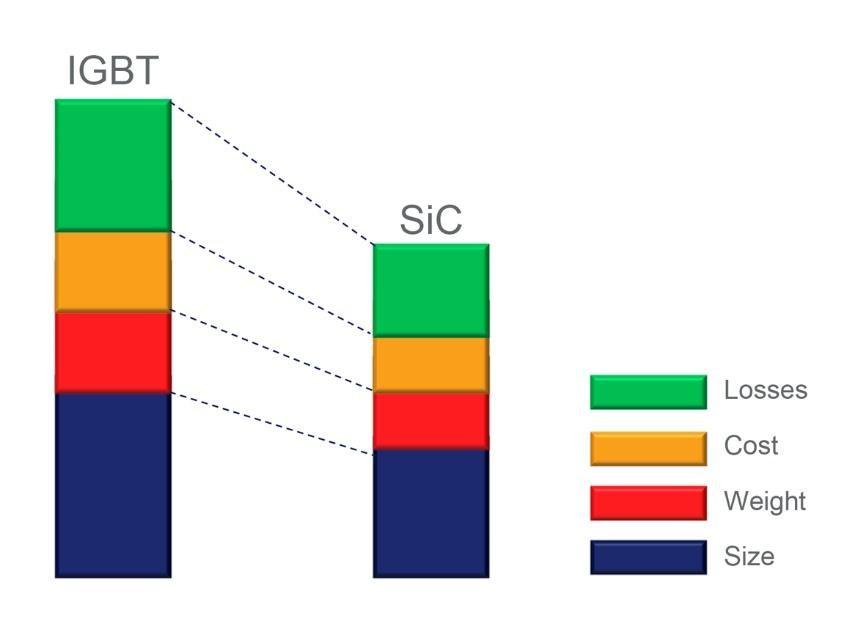
System energy efficiency savings are increasingly driving design decisions in favor of SiC cascode JFETs. When systems are designed around SiC cascode JFETs, switching frequencies can be increased without significant efficiency losses and components such as discrete rectifier diodes and snubber networks can also be eliminated.
This results in reduced size, weight and cost of other associated components such as heat sinks, inductors/transformers, capacitors etc. In extreme cases, entire cooling systems with their own inefficiencies can be made redundant, resulting in further savings. Especially in EV traction inverter applications, there is a virtuous cycle of increased efficiency, allowing the components in SiC-based inverters to be smaller and lighter.
SiC semiconductor technology continues to evolve with the promise of further performance improvements. In the next generation, on-resistance will further decrease along with switching losses, voltage ratings will increase, and the die will shrink further, improving yields and reducing costs. More variants will appear along with a wider choice of packages suitable for an expanding range of applications at higher voltages and power levels.
Inquiry
If you have any questions regarding this article, please contact us below.
On Semiconductor Manufacturer Information Top Page
If you would like to return to the ON Semiconductor manufacturer information top page, please click below.