- Semiconductor BusinessHOME
- Products and Services of Macnica,Inc.
-
technical information

-
Events and Seminars
- Handling Manufacturer
- Support
- Inquiry
- Click here to purchase products
- Semiconductor business e-mail magazine registration


 Narrow down by specifying conditions
現在2236件がヒットしています。check

Effectiveness of SiC semiconductors in rapid charging
The latest electric "hypercars" are now producing nearly 2,000bhp and are very fast on the road, but range and charging speed are still issues. It's nice to be able to zip from charging point A to charging point B at a brisk pace, but if you have to wait an hour to get there, the drive isn't as enjoyable.
Reducing charging times would ease driver anxiety if they didn't feel the need to squeeze that last mile out of their battery to avoid frequent, long stops. Ultra-fast 350kW chargers can help, but they are scarce, and there is a huge need to roll out or upgrade existing charging stations.
Fast and rapid chargers convert the AC line voltage to DC, typically around 400V for most EVs, but up to 800V for high-performance cars like the Porsche Taycan. The heart of these chargers is an AC-DC converter that uses IGBT or silicon MOSFET switch technology depending on the power level. IGBTs can only switch relatively slowly due to dynamic losses, and they also force the use of large, costly, and lossy magnetic filters, making this a difficult choice. MOSFETs can switch much faster with acceptable dynamic losses and small magnetics, but high-voltage types have high conduction losses. These losses waste energy and cost, and force larger components to keep temperatures within limits, so better switches are desperately needed.
Wide band gap (WBG) semiconductors, in the form of SiC and GaN switches and diodes, are available for many applications requiring higher efficiency. But they are not for beginners. It is important to layout and drive them correctly, and to avoid voltage stress and high EMI levels. In fact, converter designs using WBG technology should be designed from the ground up to get the maximum benefit. However, there are exceptions. That is, parts that combine Si-MOSFETs and SiC JFETs in a cascode configuration have special advantages. ON Semiconductor's SiC cascode JFETs are cascode-connected SiC-JFETs and Si-MOSFETs, and from the user's perspective they appear to be driving Si-MOSFETs, making them easy to drive, highly compatible with existing Si-MOSFETs and IGBTs, and have lower on-resistance than SiC MOSFETs and GaN, and are highly resistant to avalanche effects caused by overvoltage.
They are also highly tolerant to short circuits due to their self-limiting operation. Switching losses are generally lower than other WBG semiconductors due to the low device capacitance, and the general advantages of SiC semiconductors - high critical breakdown voltage, high temperature operation, and high thermal conductivity - are all maintained. QON Semiconductor's lowest on-resistance devices achieve on-resistance of less than 7 milliohms at 650V, with 1200V types achieving on-resistance of less than 10 milliohms, which may be used in 480VAC line systems for the highest power chargers.
Comparison of SiC cascode JFET and IGBT
So far, we have spoken in general terms, but we will now use some figures to explain the differences between IGBTs and SiC cascode JFETs available in the same package in the 600/650V class, as shown in Table 1. SiC semiconductors are superior in all parameters, meaning that existing devices can be easily converted to ON Semiconductor's SiC cascode JFETs, resulting in reduced component losses.
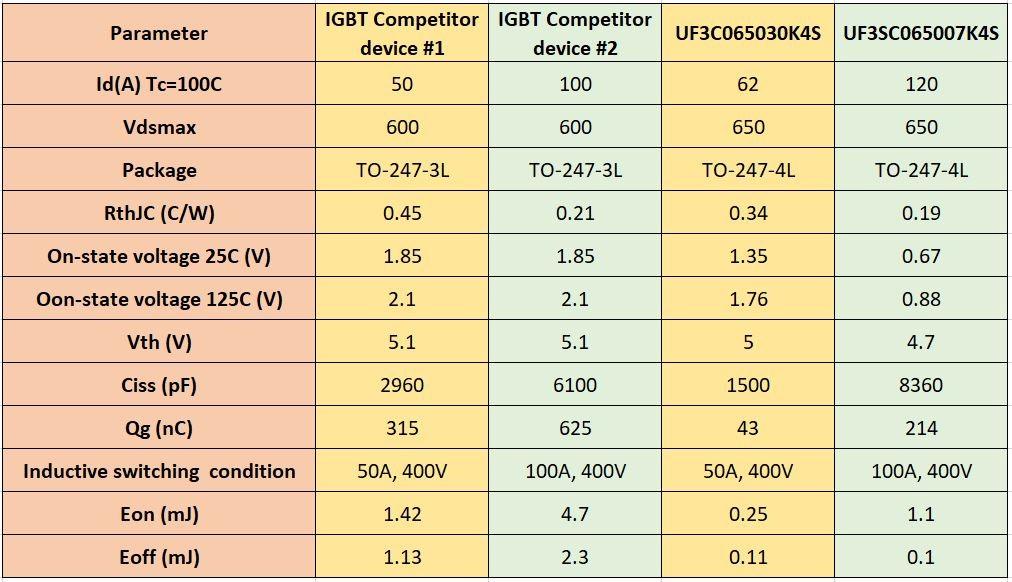
SiC cascode JFETs are also used in the power factor correction stages required for chargers, as synchronous rectifiers replacing diodes. For example, a 350kW fast charger for a 400V battery must deliver 875A in a diode bridge arrangement. The rectifier can be built from paralleled SiC JBS diodes or SiC cascode JFETs configured as synchronous rectifiers. Assuming a 50% duty cycle and 100A each, at 125°C the diodes would have a voltage drop of 2V and a loss of 100W, while the SiC cascode JFET would drop only 0.9V and a loss of 45W, less than half the value of the SiC diodes.
Summary
SiC cascode JFETs are available in TO-247-4L packages, allowing them to directly replace IGBTs and Si-MOSFETs in many cases, instantly boosting the efficiency of the circuit. An even bigger benefit is that new designs can now push frequencies higher without sacrificing efficiency, allowing associated passive components (especially magnetics) to be miniaturized.
This has made wide bandgap semiconductors such as SiC cascode JFETs the "Rolls Royce" of switches.
Inquiry
If you have any questions regarding this article, please contact us below.
On Semiconductor Manufacturer Information Top Page
If you would like to return to the ON Semiconductor manufacturer information top page, please click below.