- Semiconductor BusinessHOME
- Products and Services of Macnica,Inc.
-
technical information

-
Events and Seminars
- Handling Manufacturer
- Support
- Inquiry
- Click here to purchase products
- Semiconductor business e-mail magazine registration


 Narrow down by specifying conditions
現在2240件がヒットしています。check
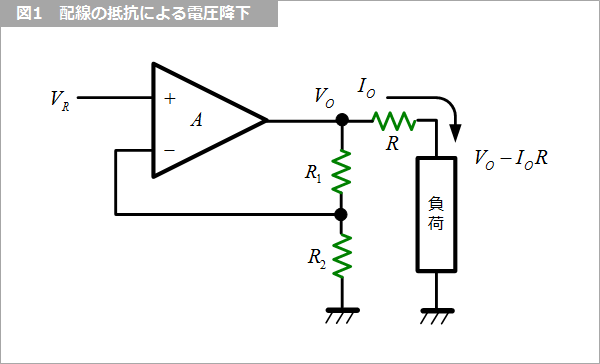
Figure 1 is a very simple series-drop regulator circuit. Output voltage VO is divided by resistors R1 and R2 and compared with reference voltage VR. A minute wiring resistance exists from the regulator to the load. If the output current IO is small, there is no problem with this circuit, but if the current becomes large, the voltage drop due to the current IO and the wiring resistance R cannot be ignored.
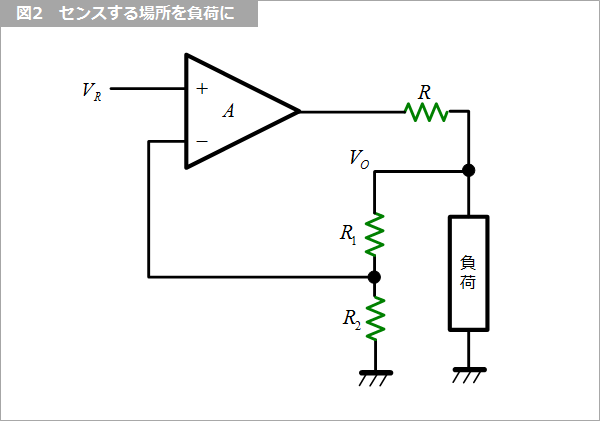
To ignore the voltage drop due to this wiring resistance, place the voltage detection point at the load end as shown in Fig.2. If the voltage drop on the GND side cannot be ignored, move the GND side detection point to the load end as well.
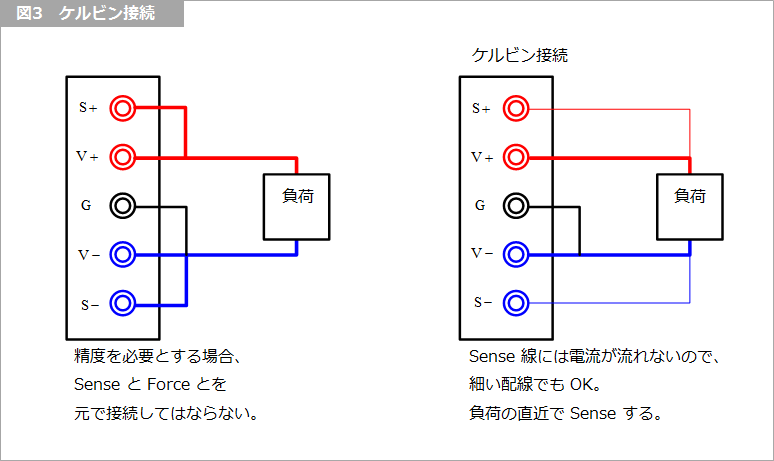
This connection method is called Kelvin Connection. Wires that carry current are called Force lines, and wires that detect voltage are called Sense lines. The series drop type is used as an example, but this connection method is the same for other regulators. Especially in recent years, there is a strong trend toward low voltage and high current, so it can be said that this is an essential method in power supply design.
Figure 3 shows how to connect the power supply used in the experiment. For simple experiments and small currents, connect the force line and sense line at the base of the power supply as shown on the left side of the figure. Must be routed separately from force and sense wires.
The Kelvin connection (more precisely, the Kelvin double bridge) is named after its inventor, Lord Kelvin, William Thomson. Kelvin is also named for absolute temperature (Kelvin temperature).
======================================
What is Yuzo Usui's Specialist Column?
It is a series of columns that start from the basics of the basics, and include themes that you can't hear anymore, themes for beginners, and even a slightly advanced level, and describe them in as easy-to-understand terms as possible.
Maybe there are other themes that interest you!
Check out our other themed columns here.