- Semiconductor BusinessHOME
- Products and Services of Macnica,Inc.
-
technical information

-
Events and Seminars
- Handling Manufacturer
- Support
- Inquiry
- Click here to purchase products
- Semiconductor business e-mail magazine registration


 Narrow down by specifying conditions
現在2237件がヒットしています。check


Hello, this is Taro.
This time, I will write about the frequency accuracy of the clock generator.
The clock generator datasheet does not mention frequency accuracy.
However, crystal oscillators and crystal oscillators generally have their frequency accuracy listed in PPM.
It should be important for replacing clock generators and oscillators, so why isn't it?
The frequency accuracy of the clock generator depends on the frequency accuracy of the reference
Many clock generators use the reference input as the source for adjustment such as division/multiplication.
Since synchronization is performed once by the PLL inside the clock generator, the frequency accuracy output from the PLL depends on the frequency accuracy of the reference clock signal.
Jitter specs depend on each clock generator, but the frequency accuracy can be considered equal to the source oscillation.
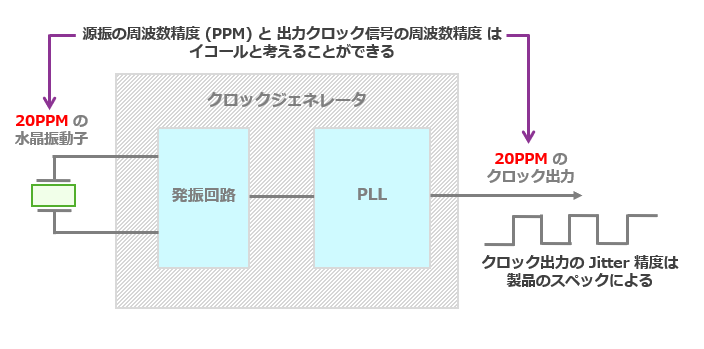
This is the reason why there is no mention of frequency accuracy in clock generator data sheets.
Crystal oscillator frequency accuracy
The frequency accuracy listed in the datasheet for a crystal oscillator is for a matched crystal.
Therefore, unmatched crystal units may not meet the frequency accuracy stated in the datasheet.
Also, the description of frequency accuracy in the data sheet of the crystal unit is divided into Initial / Temp / Aging.
Initial describes the frequency characteristics of the crystal unit itself. This depends on the purity of the crystal and the processing of the cutting.
The output frequency of a crystal oscillator also changes with changes in temperature.
Temp represents how much the frequency accuracy changes with respect to the operating temperature guaranteed by the crystal oscillator.
It means that the frequency accuracy of the data sheet is satisfied for the indicated temperature, so if the temperature changes, the frequency accuracy will also change.
Aging physically vibrates the crystal blank to create the clock signal. As a result, the crystal piece wears out and deteriorates over time.
Aging describes changes in frequency accuracy due to aging.
Come to think of it, Hachi, who joined the company at the same time as me, bought an RTC crystal oscillator and lamented that the clock didn't come out (laughs).
Please take a look at my previous article about RTC.