- Semiconductor BusinessHOME
- Products and Services of Macnica,Inc.
-
technical information

-
Events and Seminars
- Handling Manufacturer
- Support
- Inquiry
- Click here to purchase products
- Semiconductor business e-mail magazine registration


 Narrow down by specifying conditions
現在2240件がヒットしています。check


This time I will write about the types of Jitter.
I was unfamiliar with the word Jitter itself. But I like the song JitterBug Love by T.Rex (British band). As an aside... (laughs)
Jitter is an English word that means to be irritated.
So, I thought JitterBug Love means to like annoying insects, but it was a dance called Jitterbug... Take care.
In a nutshell, Jitter is the deviation in the timing (or period) of a clock signal.
The unit is time, which is generally expressed in [ps] order in clock product datasheets.
Why does Jitter occur?
The cause is
・ Reflected wave
・ Ground bounce
・ Mixing of different frequencies within the same IC and between peripheral devices
・ Fluctuations in power supply voltage
・ Thermal noise
And so on.
There are various types of Jitter depending on the measurement method.
This time, we would like to introduce Jitter, which customers must pay attention to when selecting clock products.
Period Jitter:
It represents the difference between the reference period and the actual clock waveform period.
Measurements of 10000 cycles or more are typically required.
Cycle-to-Cycle Jitter:
Represents the period difference when comparing adjacent clock waveforms.
Measurements of 1000 cycles or more are typically required.
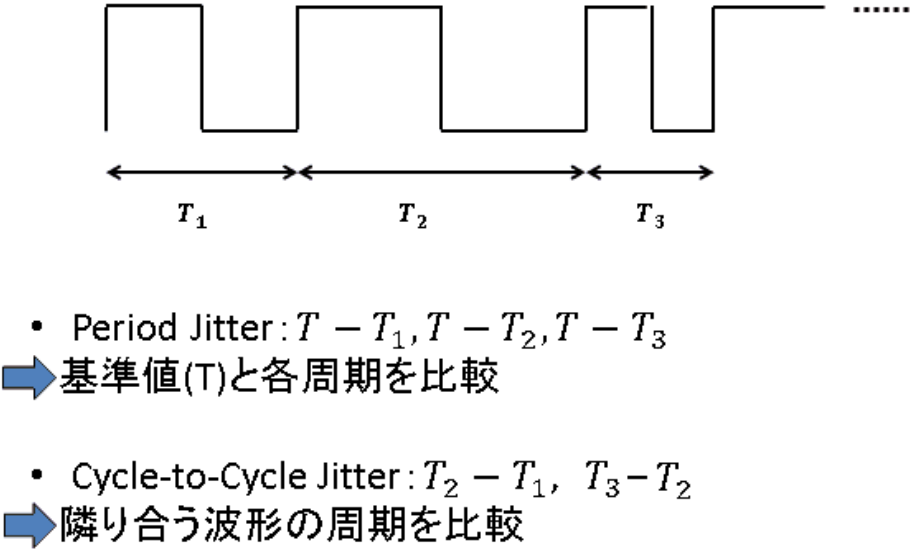
The two Jitter introduced here are called Timing Jitter, which is observed in the time domain.
There are also Jitters that are observed in the frequency domain, such as phase noise.
So why should we care about Jitter in the first place? ?
I will write about why next time.