- Semiconductor BusinessHOME
- Products and Services of Macnica,Inc.
-
technical information

-
Events and Seminars
- Handling Manufacturer
- Support
- Inquiry
- Click here to purchase products
- Semiconductor business e-mail magazine registration


 Narrow down by specifying conditions
現在2263件がヒットしています。check

In this seventh installment, we will discuss important points to consider when selecting a power supply for an FPGA, from the perspective of power supply specifications.
This time, we will again use the selection of a power supply for the Cyclone® V (5CSXFC5D) as an example.
Check whether the selected power supply device is compatible with the following four items.
1. Output voltage accuracy
It is necessary to select a power supply device that meets the voltage accuracy introduced in the previous column.
For Cyclone® V SX, the required voltage at VCC is 1.1V with a range of ±30mV.
- The voltage range of VCC is 1.07V-1.13V, with a variation range of ±2.72% centered at 1.1V.
- The voltage range of VCCA_FPLL is 2.375V-2.625V, with a variation range of ±5% centered at 2.5V.
- The voltage range of IO is 1.71V-1.89V, with a variation range of ±5% when 1.8V is the center.
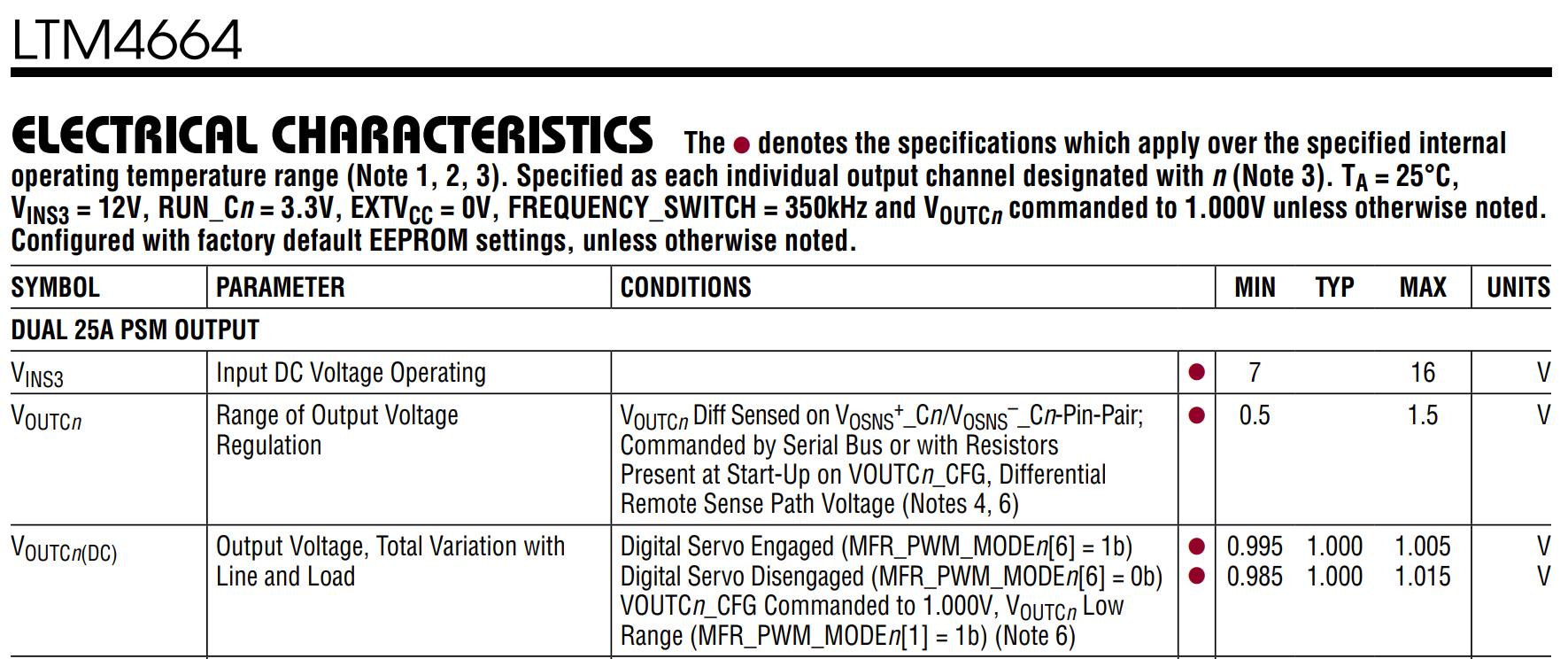
Altera® Agilex® 7 FPGA seriesSmart VIDCorresponding Figure 1 shows an excerpt from the datasheet of the LTM4664 product, which has a PMBus interface, illustrating the output voltage accuracy. There is a servo mode that improves the output voltage accuracy compared to a normal DC/DC converter. Under the condition of a 1.0V output, the accuracy is within ±1.5% when servo mode is off, and within ±0.5% when servo mode is on.
Therefore, the Cyclone® V SX's VCC voltage of 1.1V ± 30mV is a power supply device that can handle it without any problems.
2. Output voltage ripple
You need to select a power supply product that meets the FPGA's Allowable Ripple specifications.
As mentioned in my previous column, the Allowable Ripple (5% in this case) for each device is listed in the Introduction sheet of the PDN tool.
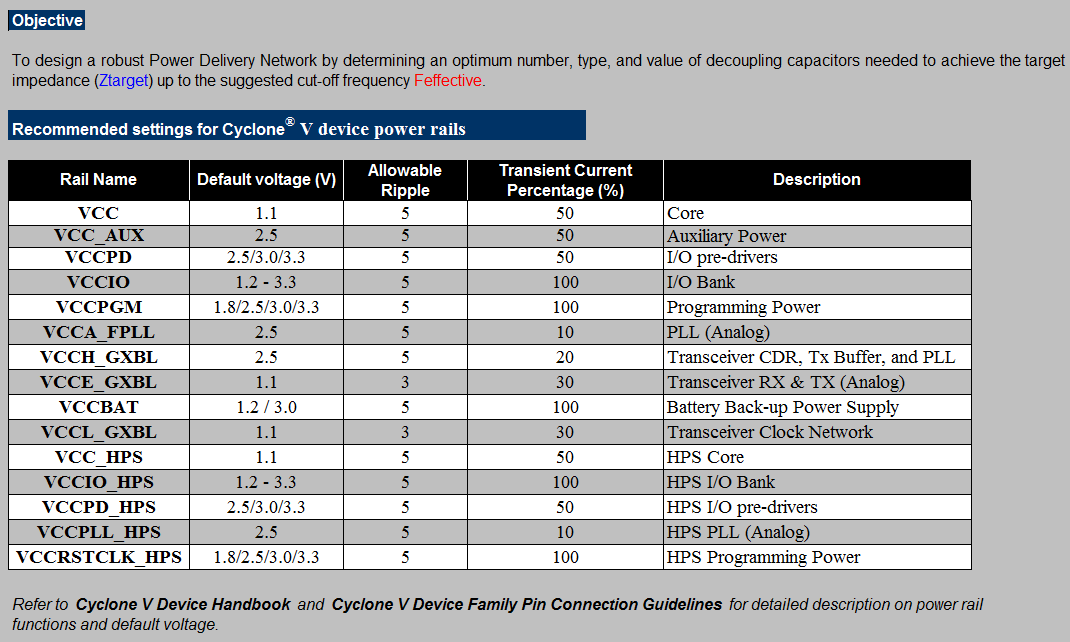
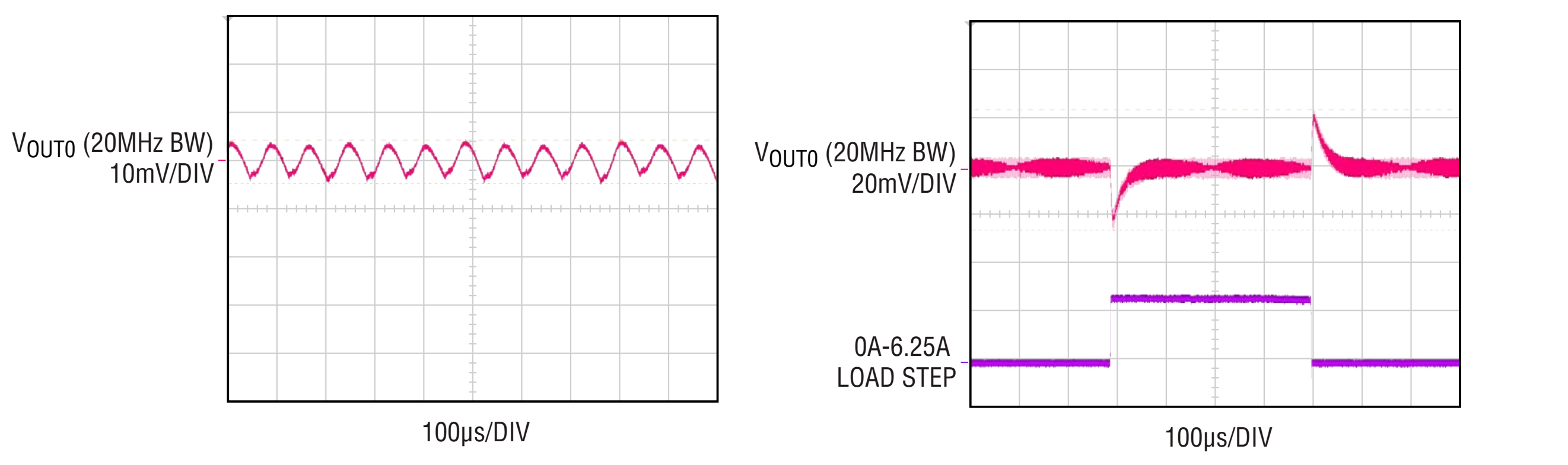
The FPGA's required voltage accuracy is specified as an Allowable Ripple of 5%, so it is necessary to check whether the DC/DC converter's ripple voltage and load response characteristics satisfy this requirement. The waveforms in Figure 3 show the ripple voltage and load response characteristics at a 1V output. Both are within 5%, so there is no problem.
3. Checking the FPGA startup sequence
We will configure the power supply so that VCC and VCCA_PLL start up in sequence (see the device handbook in the previous column).
For typical DC/DC converters, you would either select a power supply IC or module with PowerGood and Enable functions, or use an external sequencer to design a power supply that meets the sequencing requirements of the FPGA.
The LTM4683 allows you to set the sequence timing using the module's internal registers. Furthermore, it has PowerGood and Enable (RUN Pin) functions, thus meeting the necessary requirements.
4. Presence or absence of soft start
FPGA startup specifications include a tRamp specification (a specification for startup time), and you need to select a power supply with specifications that fall within that range.
Some DC/DC converters have a fixed startup time on the device side, while others allow adjustment using an external capacitor (CSS). Therefore, we recommend selecting a DC/DC converter that allows adjustment of the startup time using an external capacitor.
For the LTM4683, the rise time can be set using registers within the module.
This concludes our explanation of how to select a power supply product that meets the power requirements of an FPGA.
By reviewing this in conjunction with the previous column, you will be able to select a more appropriate power supply product for your FPGA.