- Semiconductor BusinessHOME
- Products and Services of Macnica,Inc.
-
technical information

-
Events and Seminars
- Handling Manufacturer
- Support
- Inquiry
- Click here to purchase products
- Semiconductor business e-mail magazine registration


 Narrow down by specifying conditions
現在2247件がヒットしています。check

Introduction

Hello, I'm Taro Washimiya, a technical support specialist for Altera® FPGA products.
When selecting a device, you may need to specify its temperature characteristics. In particular, when it comes to Altera® FPGAs, you need to know the "junction temperature," but do you understand what temperature it refers to?
This time, we will briefly explain the relationship between the ambient temperature and junction temperature of a semiconductor.
Are ambient temperature and junction temperature the same?
Junction temperature and ambient temperature are completely different things. If you think that the temperature characteristic is the ambient temperature, it will be a strange story.
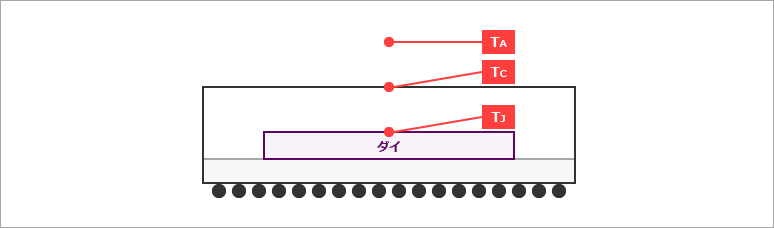
- Ambient Temperature (TA)
It usually refers to the static ambient air temperature. (Sometimes referred to as "the temperature of the local ambient air around the device.")
- Case temperature (TC)
Refers to the package temperature on the device surface.
- Junction temperature (TJ)
Refers to the temperature of the die surface inside the package of the device. Junction temperatures specified based on the device's recommended operating conditions, including commercial, industrial, and automotive.- Commercial temperature range (Commercial): 0 to 85°C
- Industrial temperature range (Industrial): -40 to 100°C
- Automotive temperature range (Automotive): -40 to 125°C
What is the thermal resistance needed to calculate the junction temperature?
The next keyword to keep in mind is "thermal resistance."
When the device operates, the heat generated on the die is transferred to the surroundings through the case (package). However, this heat cannot be completely transmitted and part of it stays inside the device. Then the temperature of the case will rise.
"Thermal resistance" is a number that expresses the difficulty of heat transfer. The smaller the value, the better the heat transfer.
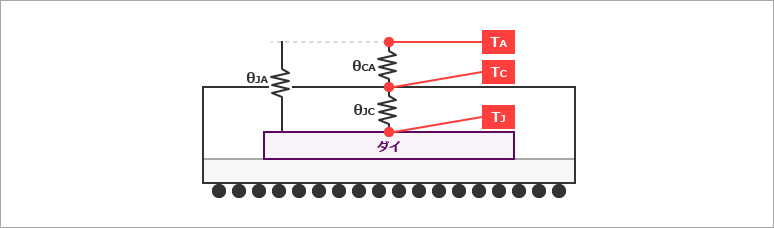
Devices have three types of thermal resistance: The unit is °C/W. (θ: lowercase Greek letter theta)
- θJC: Thermal resistance when transmitted from the die to the case
- θCA: Thermal resistance when transmitted from the case to the surroundings of the device
- θJA: Thermal resistance when transmitted from the die to the surroundings of the device
The relational expressions for these three thermal resistances are:
θJA = θJC + θCA
Get Thermal Resistance Information
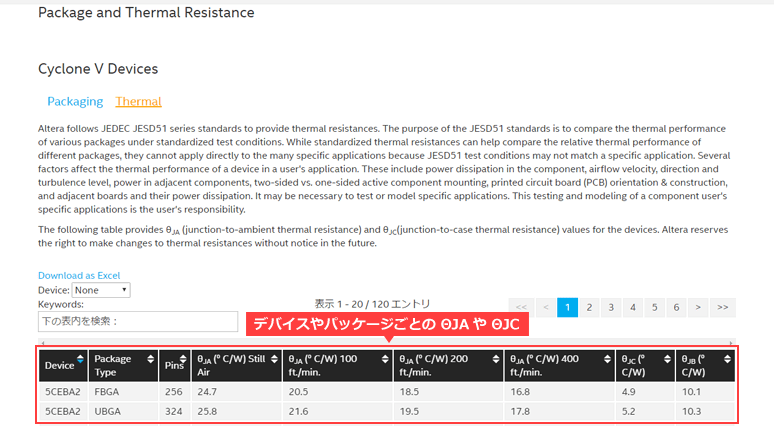
Device manufacturers usually provide θJA and θJC figures, which can be found in the device documentation. Altera® FPGA thermal resistance information is available here.
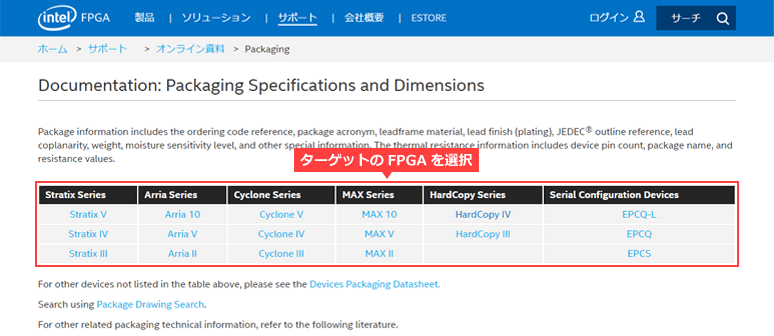
Packaging Specifications and Dimensions for Altera® FPGAs
Step 1. Select the target FPGA
Step 2. Click Thermal
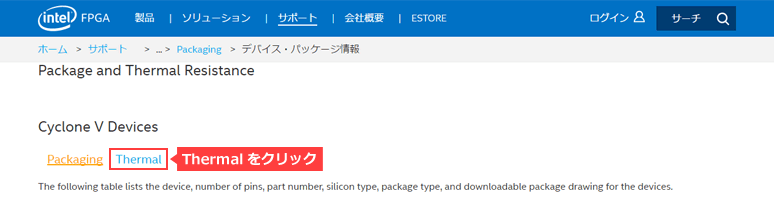
Step 3. Check the thermal resistance value from the device and package
What is the temperature difference required to calculate the junction temperature?
Next, let's talk about temperature difference. The temperature difference that occurs when heat is transferred through thermal resistance depends on the power consumption. The relationship is as follows:
Temperature difference [℃] = Thermal resistance [℃/W] × Power consumption [W]
This is where power consumption comes into play. Before checking the actual device, you can use estimated values for power consumption. The PowerPlay Early Power Estimator (EPE), a power consumption estimation tool for Altera® FPGAs, not only estimates power consumption from FPGA resource information, but also calculates junction temperature and allowable ambient temperature. This calculation also includes the information discussed here.
Temperature difference example
Let's understand it better with a simple example.
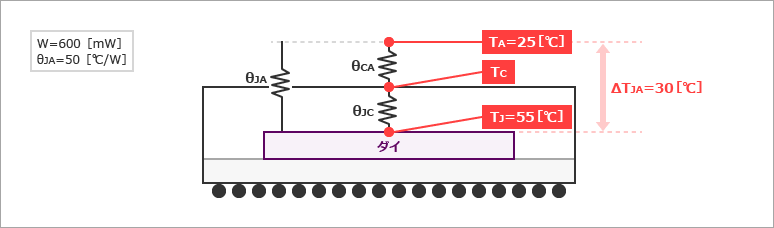
For a device with a θJA of 50 °C/W and a power dissipation of 600 mW, the temperature difference between the die surface and the device surroundings, ΔTJA, is
ΔTJA = 50 × 0.6 = 30°C
If the ambient temperature at this time is 25°C, the junction temperature TJ is
TJ = TA + ΔTJA = 25 + 30 = 55 [°C]
becomes. Did you understand?
lastly
Can you imagine the relationship between ambient temperature and junction temperature?
I'm sure many of you weren't comfortable with the heat of your device, but I think you'll find that it's not that difficult.
We also have an article on FPGA power consumption and an article on how to estimate FPGA power consumption, so please take a look.
Click here for recommended articles/materials
FPGA Power Consumption Types and Calculation Methods
How to estimate FPGA power consumption