Just "Speak → Click → Done!" 3"Summary Ninja".Generate AI Its unique feature is that it automatically transcribes and summarizes what you say on the spot, thanks to its advanced processing, and its simple screen and functions make it extremely easy to use. O (O) Product Manager (hereinafter, O We asked Mr.
The "Omatome Ninja" had an ancestor (?)
--What made you decide to create "Omatome Ninja" in the first place?
Mr. O: First, there were several predecessor tools, which evolved into the current "Omatome Ninja". The first thing we developed was a document classification app for quality control departments called "DochAIser". This was designed to make it easier to find analysis logs when a defect occurs in a product handled by our company.
We wondered if we could offer this as a product, and introduced it to a certain customer. Unfortunately, we received the response, "We don't use it much at our company...", but as we talked to them, we learned that they had an issue where it was taking a huge amount of time to create weekly reports to use in their business reports.
The person in charge seemed to write it down in about 10 minutes at the end of the day while recalling the work of the day, but over the five days from Monday to Friday, it would take at least 50 minutes. If it takes a little time to organize, it could take an hour, or even more than two hours in some cases.
In the midst of all this, the client wondered, "Do we really need to go to such lengths to report? Surely there's an easier way?" and came to us for advice on how to make weekly reports easier. This is where it all began.
Weekly reports are basically created in the following order: "Remember what you did" → "Write it down" → "Organize it." We wondered if we could use generative AI to do the "organizing" part of this process. At the time, it was just 2 to 3 months after the release of ChatGPT3.5, and generative AI was all the rage. The next tool we developed was a tool called "Nippon-kun (※)."
*This is the name used during development and is not the official name (product name, etc.).
--That's another very straightforward name (laughs).
O-san: (laughs) The first "Nippo-kun" only had a document sorting function using generative AI, and it didn't have voice input. However, the accuracy of the final product was not very good, so we made it possible to input by voice, added a dictionary function to input important keywords accurately, and so on.
Eventually, "Nippo-kun" gradually began to be used, and because it is a tool that allows you to organize data after voice input, we began receiving more and more requests from customers to use it in meetings.
--It's a so-called minutes app, isn't it? There are many services available now, but I guess people are having trouble with it and there is a high demand for it.
Mr. O: In market research reports related to generative AI, "minutes creation" is treated as one category of AI application field, so it is a "common case." After all, it takes time to create them and it is troublesome.
Various things during the development of "Omatome Ninja"
--How long did it take you to go from "Nippo-kun" to "Omatome Ninja"?
Mr. O: It was about 2 to 3 months.
--That was pretty fast!
Mr. O: At that time, we were the "have-nots," so for example, with "Nippon-kun," we would quickly create a prototype within about two weeks of deciding on the concept, and quickly get customers to use it and listen to their feedback. Another big factor was that Director M (Director of the Digital Business Development Department) made a big deal about the slogan "Create first."
How did you proceed from there?
Mr. O: First of all, I came up with the name with the following concept in mind.
・Friendly and easy to understand, even if it's a little uncool
- A supportive atmosphere, transcribing and summarizing information on behalf of the user
・You can set a character that you want to use in the product and reflect it in the tool.
Looking back, the name "DochAIser" was pretty edgy (laughs). We wanted to keep it as "Nippo-kun" to keep it easy to understand, but when we looked into it, we found that a service with the same name already existed, so we had to change the name.
The names that were proposed were as follows. There was also a version where the "ninja" part was changed to "samurai" and a version where the dog was changed to a cat. The reason we tried to use animals was because we wanted to make the character stand out.
[Initial name proposal for Omatome Ninja]
・Omatome Hanzo (first choice)
・Omatome Kotaro
・Summary Ninja
・Voice Report Ninja
・Voice Report Dog
・Raku Report Ninja ・Raku Report Dog
They also focused on creating something that was "familiar enough for people to use it every day." As a precursor to this, one of the development codes was "Taisoradi," an anagram of "Radiotaiso," a Japanese word for "radio calisthenics."
We decided to create characters at the strong request of the lead engineer. After all, AI has a very strong impression of being "difficult and professional", so we thought it would be better to have characters. We used ninjas and samurai because we wanted them to have a "feeling of closeness, summarizing and transcribing as a backstage player," and because we wanted them to have a Japanese feel.
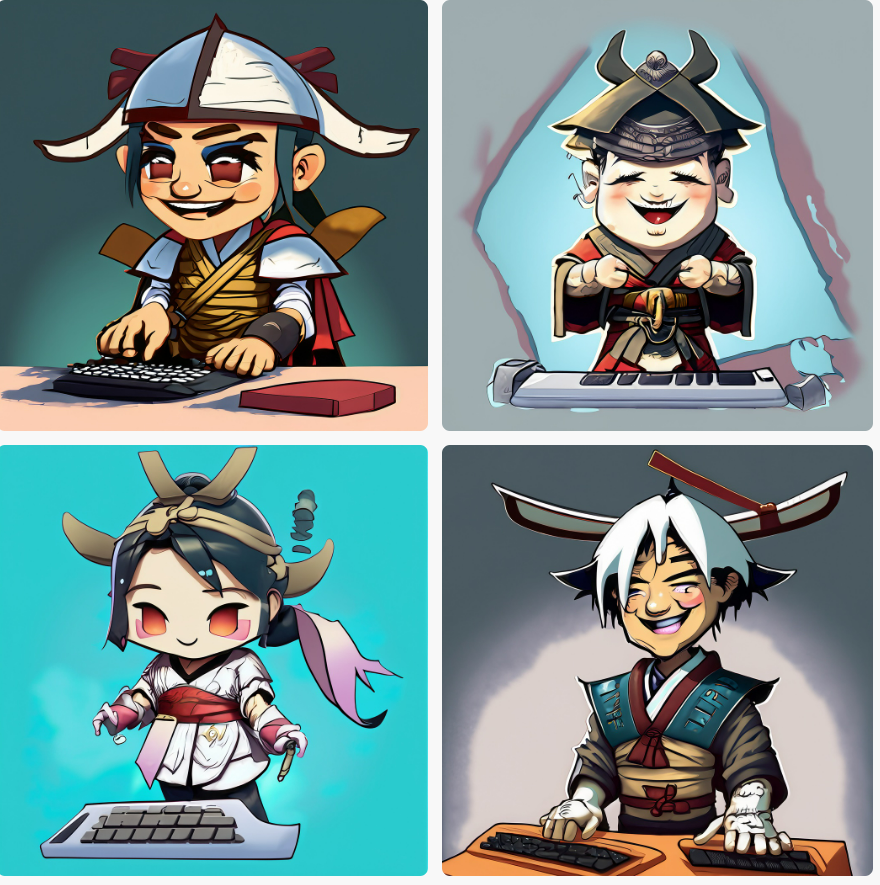
▲An early character design. This was also generated by a generative AI.
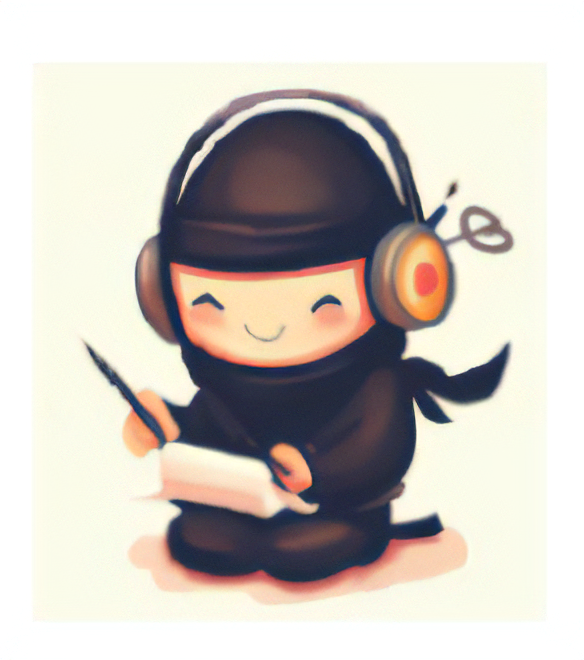
▲Then, the lead engineer submitted a more cute draft. This gives the impression of being closer to the current "Omatome Ninja".
--What about the functionality?
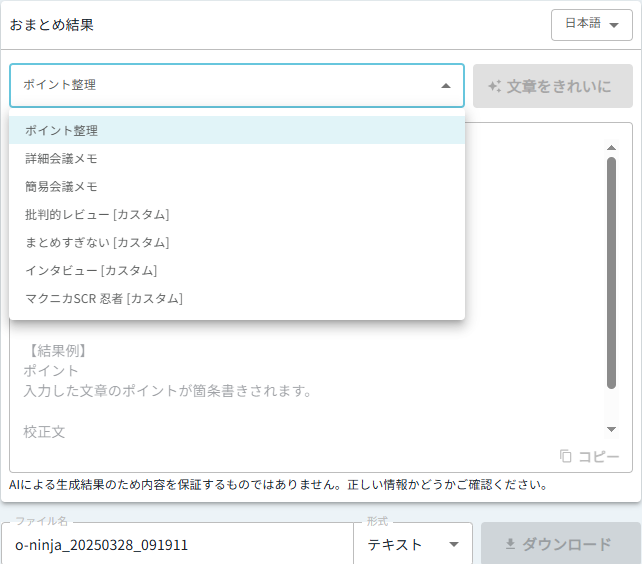
Mr. O: At first, it was just a "point summary" function that outputs the main points of the content entered by voice or text in bullet points. For example, in the case of a weekly report, it is difficult for the recipient to read a long text. There is also a mode that summarizes the main points in 30 characters or less.
Since then, we have continued to respond to customer requests with a "create first" mentality, gradually adding various modes such as "Meeting Notes." However, there is also the problem that adding too many modes can confuse users, which is something we are currently worried about (laughs).
-- It's like when you work at a restaurant accepting customer requests and before you know it, the number of menu items has grown to an enormous number...
O-san: That's right (laughs). After all, the basic concept is to make it easy for anyone to use. However, when we develop an upgrade for a certain mode, some people say that the previous version was better, so there are situations where V1 and V2 exist separately. This is a dilemma that arises because our customers are with us.
--But there are times when you have to make decisions, like cutting something out. What do you do in those situations?
Mr. O: To be honest, I think, "What should I do?" But in the end, I have no choice but to make a decision. However, we do of course analyze customer usage data to back up our decisions. There are times when the requests we receive differ from the actual usage, and I feel like it's difficult, but sometimes I decide, "This mode isn't used much, so let's delete it."
Why I'm glad I became a "Consolidation Ninja"
Mr. O: There were a lot of things that happened, but looking back, I think it was good that I became "Omatome Ninja."
--Why is that?
Mr. O: In the end, I feel that the function came with the character. For example, "Omatome Ninja" is designed not to save data, but the fact that it leaves no traces makes it seem like a "secret operation." The image of listening to conversations in the attic of a conference room and later transcribing and organizing them is also very ninja-like.
Some customers are concerned that generative AI will learn data, but with Omatome Ninja, there is no need to worry. In fact, some customers say that it was easy to understand and quickly implemented because it does not require strict security measures compared to other tools.
And then, of course, there's the characters. I'm really glad that I made them. It's easy to say, "Omatome Ninja is not a difficult tool!", but it's hard to get people to understand. However, the mascot characters of "Omatome Ninja" don't show how difficult it is at all. At exhibitions, people would say, "The characters are so cute!" and even people who had never heard of "Omatome Ninja" would take pictures with the panels.

--So communication begins through the characters.
Mr. O: That's right. You could say it's a character that personifies a tool. When you enter text into the tool and clean it up, at first it was just a spinning circle (loading cycle), but one day we added an animation of a dancing ninja. Then the impression changed completely, and I felt like the stress while waiting was relieved. It was like, "They're working hard for me" (laughs).
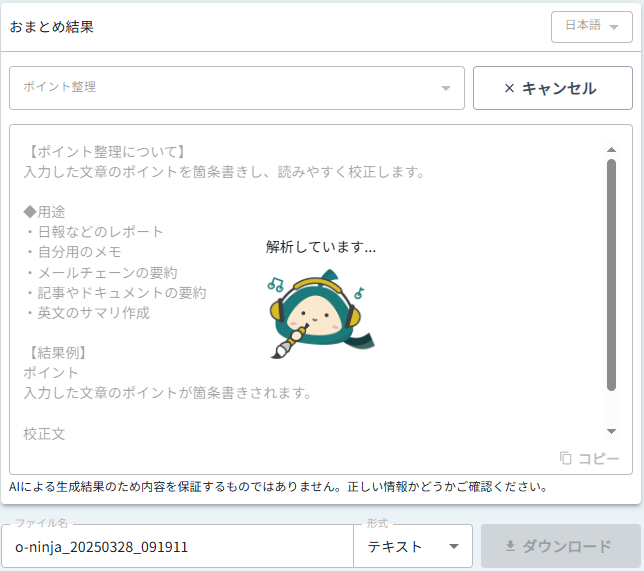
▲While you wait, an animation of a ninja holding a brush will play.
Generative AI is constantly evolving, and the same is true for humans. In the case of "Omatome Ninja," having someone give a voice output may improve their speech, and reading sentences organized by AI may help people learn how to organize sentences neatly. This hope has been with us since we were developing the tool that would become the precursor to "Omatome Ninja."
I hope everyone will try out Omatome Ninja and experience how convenient it is.
 Latest Information
 Case Study
 Blog
Blog Document List