Those considering introducing AI into their monitoring systems ・Those considering using AI in the transportation industry ・Those who want to learn about the latest examples and technologies of automated monitoring AI
Time needed to finish reading this article
5 minutes
Introduction
The 2021 Tokyo Olympic and Paralympic Games concluded to great success. Although the Olympics were held without spectators due to the pandemic, the changes in the market and working styles brought about by the Olympics will likely continue to have a significant impact in the future. In addition to the impact of COVID-19, there are signs of population decentralization within Japan, and it is said that after the Olympic and Paralympic Games, industrial and technological systems in various sectors will undergo a transformation. Therefore, in this article, I would like to introduce the latest examples and technologies in the transportation industry regarding automated monitoring, which has grown significantly since the Olympics.
Challenges of manual monitoring
The acceleration of the movement towards automating monitoring operations was largely influenced by the Tokyo Olympic and Paralympic Games. With a significant increase in monitoring tasks anticipated, it became necessary to reduce the workload of those performing manual monitoring and to conserve resources.
Furthermore, the significant growth in the image analysis market in recent years, along with the advancements in image recognition technology, also provided a favorable environment. Human error is a problem that can occur in any task, and if human error can be reduced through automation, it can also serve as a form of risk hedging.
Automatic monitoring AI example
Now, let's take a look at some examples of automated monitoring using AI.
Accident detection and prediction
Many system proposals and case studies have been published that detect vehicles that have stalled or stopped due to car accidents or vehicle malfunctions. AI models capable of detecting such traffic anomalies in near real-time have existed for some time, and now we are seeing newer methods addressing newer needs and approaches that differ from previous ones.
Furthermore, in recent years, we've seen many papers that utilize edge devices and the cloud as practical examples (or simulations toward implementation) to propose ways to create more efficient systems.
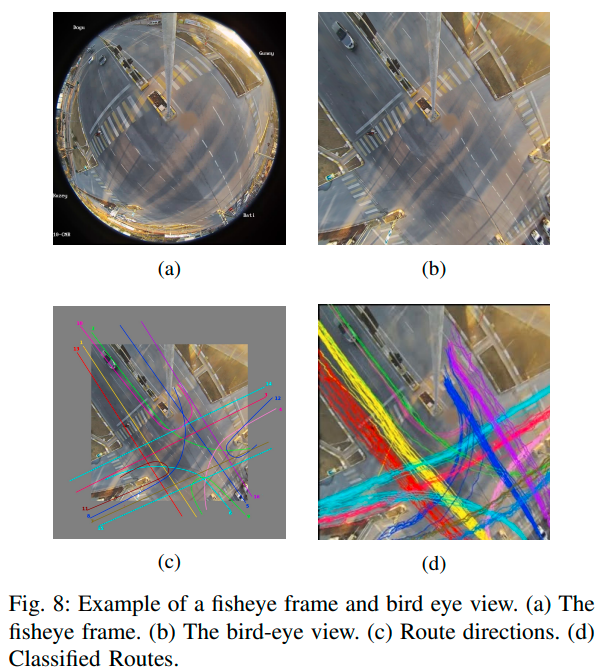
Here, I would like to introduce a recently submitted study aimed at realizing this. This framework, proposed in a paper submitted in 2021, does not use an AI model to determine vehicle collisions, but rather uses a 360-degree camera with a fisheye lens to analyze the vehicle trajectories and determine incidents at intersections. This framework detects vehicles involved in traffic incidents by comparing them with past vehicle trajectories. By using a 360-degree camera like the one shown in the diagram below, it is possible to capture and monitor the entire intersection with just one camera.
Source: Incident Detection on Junctions Using Image Processing Caption: Fig. 8. Example of a fisheye frame and bird's eye view. https://arxiv.org/pdf/2104.13437.pdf
Accidents are not limited to vehicles. In Japan, as part of smart city initiatives, cameras and systems are being introduced to monitor people who are ill, traffic accidents, and other incidents, so instances of surveillance are increasing in our daily lives.
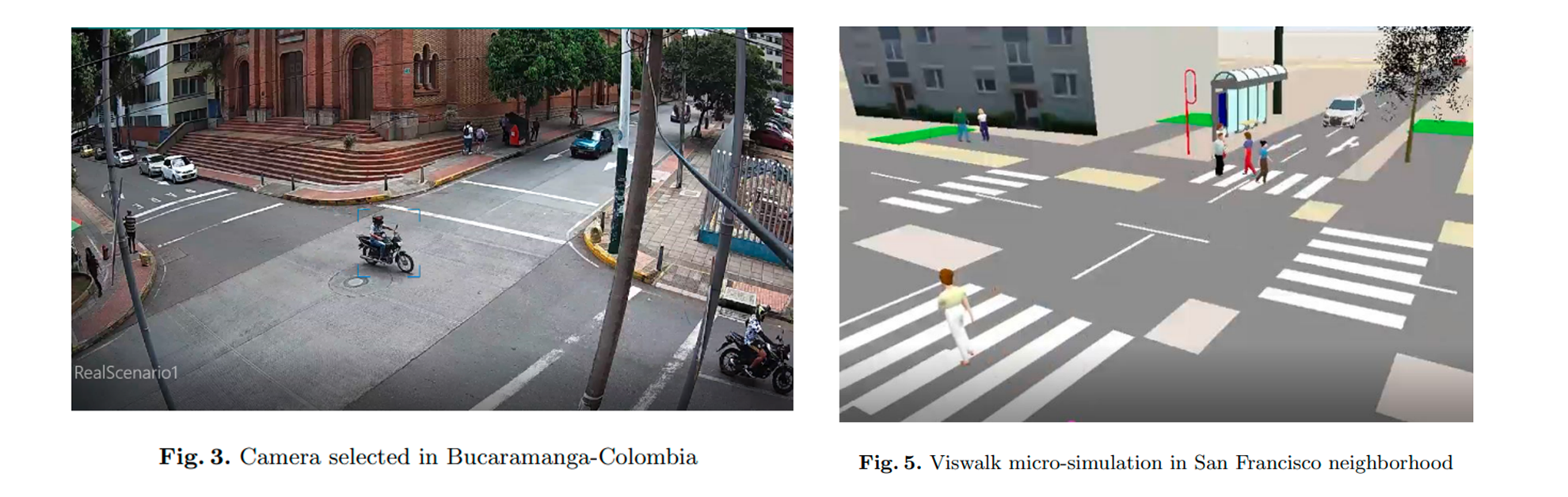
As an example, the diagram below shows a real-world example from Colombia where video data from the city is used to create simulations that take into account citizens' behavior in order to reduce pedestrian accidents. These simulations are then compared with reality to identify the causes of accidents. This is an initiative to improve accident-prone areas as the first step in building a smart city.
Source: Datacentric analysis to reduce pedestrians accidents: A case study in Colombia Caption: Fig 3. Camera selected in Bucaramanga-Colombia. Fig 5. Viswalk micro-simulation in San Francisco neighborhood. https://arxiv.org/pdf/2104.00912.pdf
Traffic density forecast
One of the contributing factors to traffic accidents is the increase in vehicle traffic volume. Increased traffic volume also leads to environmental pollution, health problems, traffic violations, and obstruction of emergency vehicle passage.
To prevent such traffic increases that reduce the productivity of transportation, automation such as traffic signal control is being implemented worldwide to achieve optimal traffic levels.
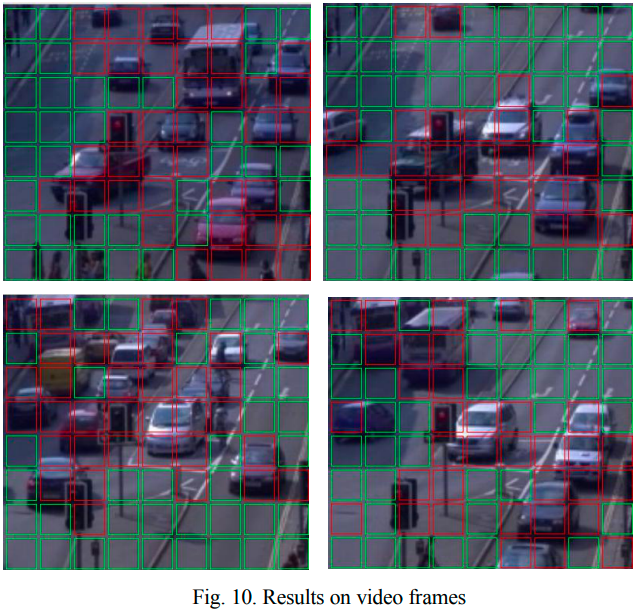
The figure below is taken from a paper that proposes a more computationally efficient method for estimating vehicle traffic density. This is a highly efficient strategy that allows image processing and machine learning technologies to run on a Raspberry Pi (a small computer with the bare minimum of core components on a single board). From images showing traffic conditions, we extract image features called HOG (Histogram of Oriented Gradients) and LBP (Local Binary Patterns), and calculate traffic density from the number of cells containing traffic information (red-bordered cells in the figure below).
The examples I've presented so far are all initiatives that utilize data obtained from object detection models. Our articles on object detection have also been very well received, so please be sure to check them out!
Object detection x Traffic (vehicle detection) demo video
The above demo is a vehicle detection demonstration using YOLOv5, which was also used in the AI City Challenge, a transportation-related competition. Just as competitions have been gaining momentum in recent years, the use of AI in the transportation industry, and the development of effective and efficient AI systems that go beyond mere use, are becoming major needs around the world.
Based on AI technology for object detection, as demonstrated in the demo, various applications are being implemented in the transportation industry through the utilization of the obtained data. Although there are still few examples, this experience has reinforced the understanding that there are as many different approaches as there are ideas when it comes to building a better society using AI.
■ Sources of the content and papers presented on this page / References
Murat Tulgac, Enes Yuncu, Mohamad-Alhaddad, Ceylan Yozgatl?gil,“Incident Detection on Junctions Using Image Processing”,Fig. 8. Example of a fisheye frame and bird eye view., https://arxiv.org/pdf/2104.13437.pdf
Michael Puentes, Diana Novoa, John M. Delgado Nivia, Carlos J. Barrios Hernandez, Oscar Carrillo, Frederic Le Mouel, “Datacentric analysis to reduce pedestrians accidents: A case study in Colombia ”, Fig 3. Camera selected in Bucaramanga-Colombia.,Fig 5. Viswalk micro-simulation in San Francisco neighborhood., https://arxiv.org/pdf/2104.00912.pdf
Devashish Prasad, Kshitij Kapadni, Ayan Gadpal, Manish Visave, Kavita Sultanpure Pune Institute of Computer Technology,“HOG, LBP and SVM based Traf ic Density Estimation at Intersection ”,Fig 10. Results on video frames., https://arxiv.org/ftp/arxiv/papers/2005/2005.01770.pdf
Click here for examples of papers
Case of SPACE Co., Ltd.
AI utilization case of Aisin AW Co., Ltd.
Case of Aisin AW Industries Co., Ltd.
Related article
* Tech Blog AI Women's Club * JSAI2020 Pick up from about 900 papers! -Explanability and systemization of AI-
* Tech Blog AI Women's Club * Posture estimation model and application examples that can be understood in 5 minutes



 Latest Information
 Case Study
 Blog
Blog Document List