- Semiconductor BusinessHOME
- Products and Services of Macnica,Inc.
-
technical information

-
Events and Seminars
- Handling Manufacturer
- Support
- Inquiry
- Click here to purchase products
- Semiconductor business e-mail magazine registration

Sensors for temperature detection include a thermostat that works to maintain a set temperature, a board-mounted semiconductor temperature sensor that monitors the temperature of the electronic system and protects the system from overheating, and a low temperature range. There are industrial temperature sensors such as thermocouples and resistance temperature detectors (RTDs) that can measure from to high temperature range.
This time, we will introduce thermocouples, resistance temperature detectors (RTDs), thermistors, and semiconductor temperature sensors, which are common and easy to handle for temperature measurement and control, and introduce the features of each temperature sensor.
Main features of each temperature sensor
The table below compares the features of each temperature sensor.
Thermocouples and resistance temperature detectors (RTDs) can measure from low to high temperatures and have good accuracy.
|
|
thermocouple |
Resistance temperature detector (RTD) |
thermistor |
semiconductor temperature sensor |
|
temperature range |
-200 ~ +1700℃ |
-240 ~ +700℃ |
-100 ~ +500℃ |
-55 ~ +150℃ |
|
accuracy |
〇 |
◎ |
Depends on calibration |
〇 |
|
price |
high |
high |
During ~ |
low |
Main features of the temperature sensor (according to our research)
Next, I will explain each temperature sensor in a little more detail.
thermocouple
A thermocouple is a device that measures the temperature of the contact area by contacting one side of two dissimilar metals and measuring the potential difference that appears on the other side. The measurable temperature range varies depending on the type of metal that is in contact. Thermocouples have Japanese Industrial Standards, and there are nine types of types B, R, S, N, K, E, J, T, and C.
temperature characteristics
The thermocouple introduced earlier can be seen to have the characteristics shown in the figure below, based on the temperature that can be measured and the "electromotive force," which is the driving force that causes the current to flow through the circuit.
*Type C is omitted from the graph because it cannot be used in air.
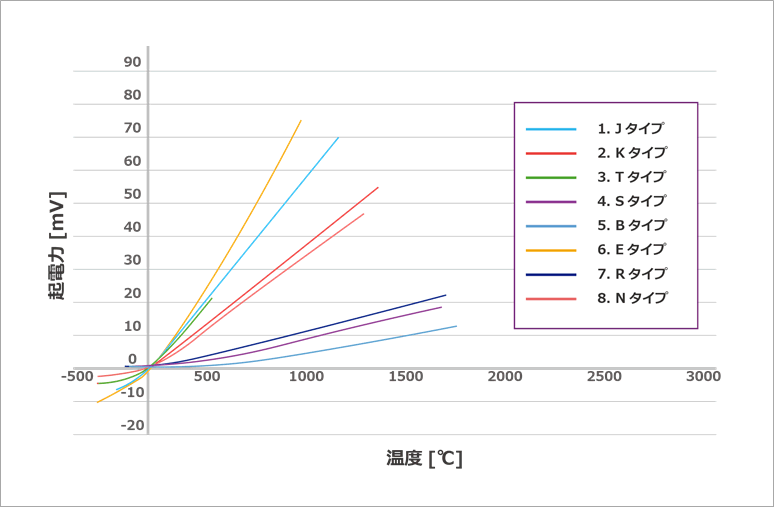
Some are slightly curved, while others are perfectly straight, but the measurable temperature range also varies. What they have in common is that the electromotive force is 0 mV at a temperature of 0°C. This is due to the addition of a correction called "cold junction compensation".
Correction method for "cold junction compensation"
A thermocouple is a device that measures the temperature of the contact area by contacting one side of two dissimilar metals and measuring the potential difference that appears on the other side. The part where two dissimilar metals come into contact is called the "temperature measuring junction," and the point of contact between the metal and the measuring instrument is called the "reference junction (cold junction)."
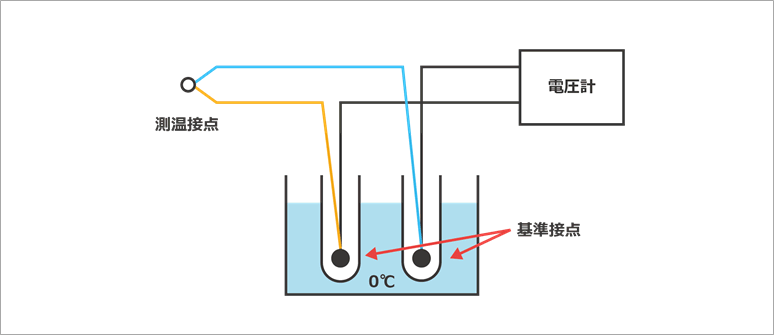
Thermocouple measurement basically converts the temperature of the measuring junction by measuring the voltage between the reference junctions when the reference junction is at 0°C. This is called "cold junction compensation".
Real problem, "cold junction compensation" is difficult
However, for "cold junction compensation", for example, it is not realistic to install a Peltier element or the like inside to keep the reference junction at 0°C all the time. For this reason, actual products are corrected using a method called "reference junction compensation." Reference junction compensation measures the temperature of the thermocouple connection part (terminal block, etc.) on the circuit board and corrects it by adding the thermoelectromotive force with 0°C as the reference.
Since a Pt100 platinum resistance temperature detector is often used for reference junction compensation, let us first explain the resistance temperature detector (RTD).
RTD: Resistance Temperature Detector
A resistance thermometer uses the phenomenon of changing its resistance value according to its own temperature.
Metal type ones are generally called RTDs, and those that use ceramic semiconductors are called thermistors.
RTDs are made of platinum, nickel, copper, etc. Among them, the Pt100 platinum resistance thermometer, which uses platinum, is widely used for industrial measurement due to its high accuracy.
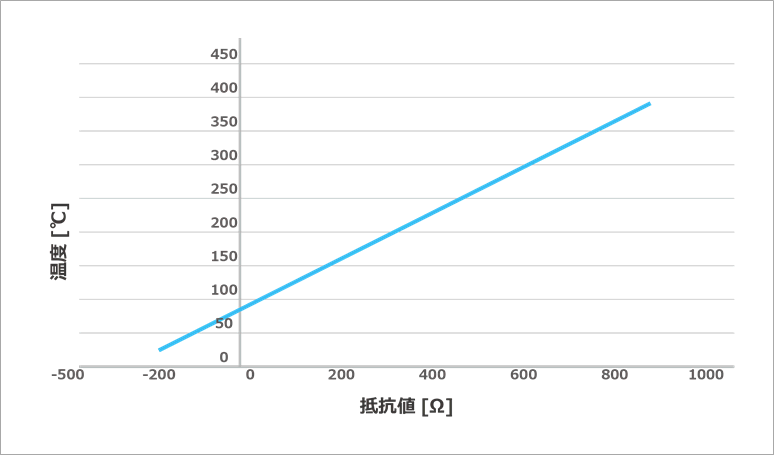
Temperature characteristics of Pt100 platinum resistance thermometer
Pt100 has very good linearity and is widely used for accurate temperature measurement. By the way, the name "Pt100" comes from "100Ω at 0℃".
Example of a thermocouple circuit using a platinum resistor
Regarding the "reference junction compensation" of thermocouples, which I explained earlier, since RTDs have extremely high accuracy, they are used for reference junction compensation of thermocouples. This can be achieved by using a high-precision resistor, a reference voltage (Vref), and a platinum resistor (Pt100) to configure the circuit as shown below.
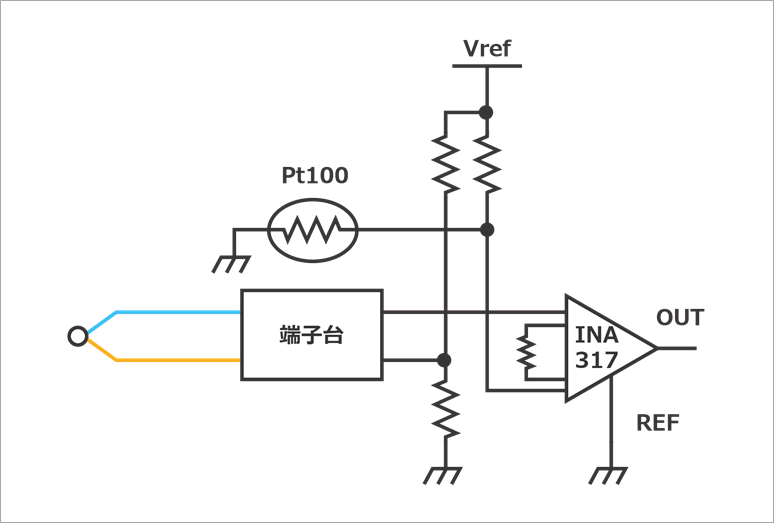
However, Pt100 is quite expensive because the material is platinum. Therefore, thermistors are often used in inexpensive temperature measurement circuits.
thermistor
A thermistor changes its resistance value due to heat, and there are two ways to change it.
・When the temperature rises, the resistance value decreases → NTC (Negative Temperature Coefficient)
・When the temperature rises, the resistance value rises → PTC (Positive Temperature Coefficient)
temperature characteristics
The thermistor temperature characteristics are shown below.
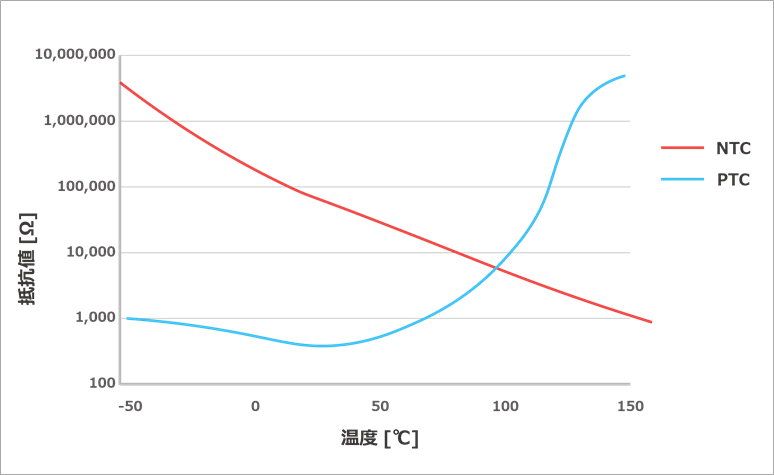
The temperature characteristic of the thermistor is that the resistance value changes significantly in the range of 0°C to 100°C, making it easier to clearly detect temperature changes than other temperature sensors.
NTC is commonly used for temperature measurement
There is a difference in the characteristic curve between NTC and PTC. The NTC changes slowly, while the PTC changes sharply after reaching a certain temperature. NTC is commonly used for temperature measurement.
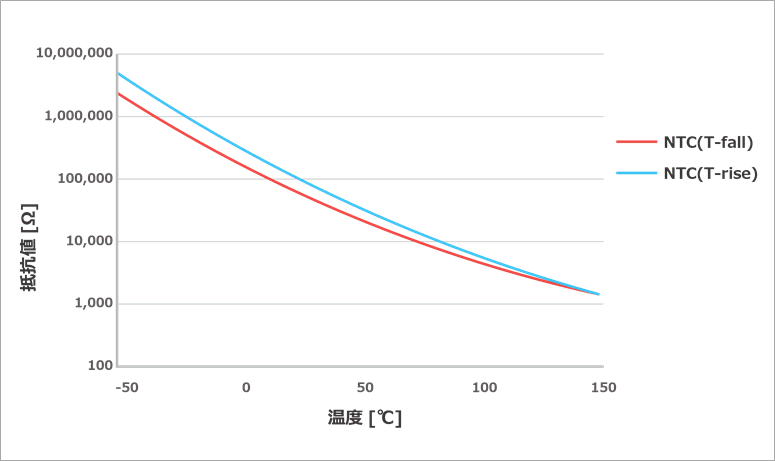
However, if you look closely, its characteristics are not linear, unlike platinum resistors. Furthermore, since it is basically a resistor, self-heating cannot be avoided, and hysteresis appears in the resistance value, which causes errors.
semiconductor temperature sensor
A typical semiconductor temperature sensor is a "Si diode". Si diode Vf (forward voltage) has a temperature coefficient of -2mV/°C, and Vf decreases as the temperature rises. The temperature can be measured by measuring the voltage across the diode.
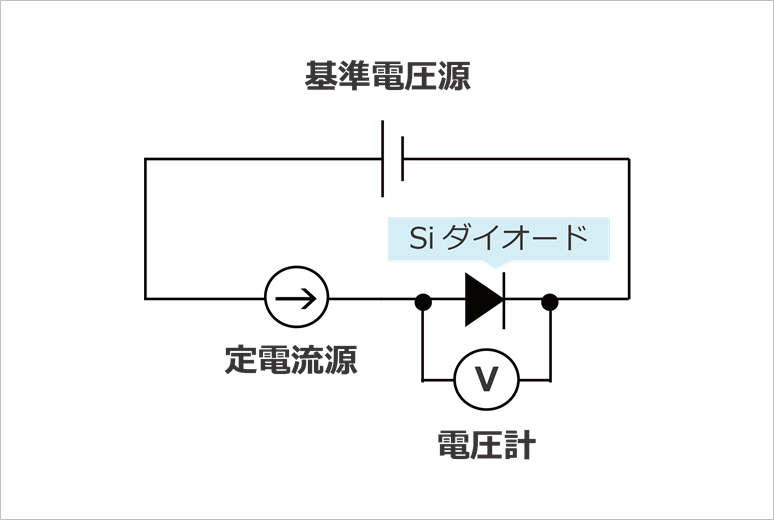
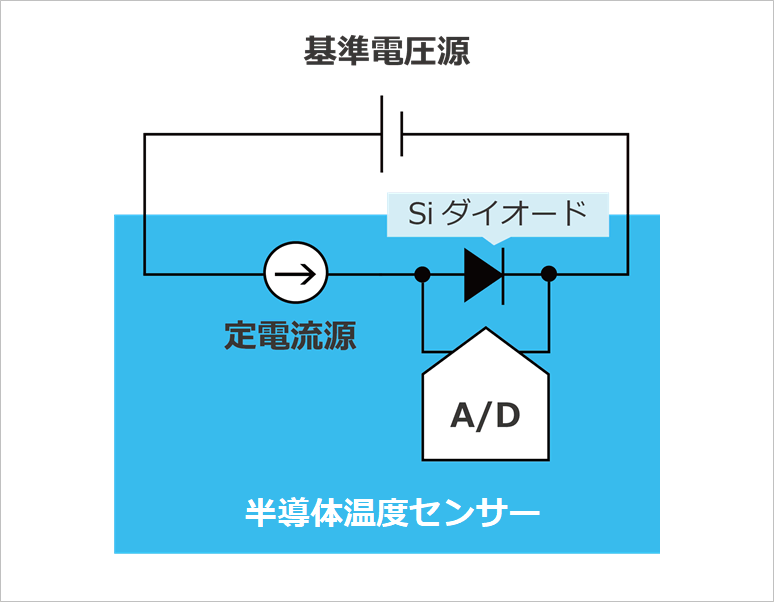
A PNP transistor can also be substituted for the Si diode. If so, measure the voltage between emitter and base. Since the Vf of the diode depends on the current value, a highly accurate constant current source is required. This measurement method is often used for temperature measurement inside ICs such as processors and ASICs.
Comparison of temperature sensors
Finally, let's compare platinum resistors (Pt100), thermistors, and semiconductor temperature sensors, excluding thermocouples.
|
|
Pt100 |
thermistor |
semiconductor temperature sensor |
|
temperature range |
-240 ~ +700℃ |
-100 ~ +500℃ |
-55 ~ +150℃ |
|
accuracy |
high |
low |
high |
|
linearity |
During ~ |
low |
high |
|
Peripheral circuit |
Many |
Many |
Not required/less |
|
price |
high |
During ~ |
low |
Temperature sensor comparison (according to our research)
Semiconductor temperature sensors are not as accurate as Pt100, but they are much better than thermistors. Since high-precision reference voltage sources and AFEs (operational amplifiers and A/D converters) can be omitted, the cost of the entire circuit is the lowest for semiconductor temperature sensors, even considering the peripheral circuits and price. It is also widely used in IoT devices such as continuous temperature measurement and abnormal operation detection.
Inquiry
For companies that are considering digitizing their products and services and IoT in order to develop new markets and develop new products, we will provide easy-to-understand explanations from optimal product selection to introduction methods. I'll enjoy having this. Please feel free to contact us.