- Semiconductor BusinessHOME
- Products and Services of Macnica,Inc.
-
technical information

-
Events and Seminars
- Handling Manufacturer
- Support
- Inquiry
- Click here to purchase products
- Semiconductor business e-mail magazine registration

I want to add wireless communication to IoT devices! But how do you start? where should i look for it?
Haven't you heard these comments when using wireless modules in IoT device development?
“I am making an IoT device, but which wireless communication should I adopt?”
"I want to use wireless, but I want to make the battery last longer!"
"Occasionally communicating is fine, but which one should I choose?"
“Can I only choose Wi-Fi or Bluetooth® to communicate with my smartphone?”
"Is it useless if I don't have technical aptitude?"
"What is technical suitability?"
"How do you use the wireless module?"
This time, while listening to the voice of such a user,
- Wireless knowledge you should know
- Suitable wireless method
- Wi-Fi
- Bluetooth
- Zigbee
- Thread
- Sub-GHz
Focusing on these two points, we will explain the characteristics and usage of each wireless method.
Wireless knowledge you should know
What is wireless?
Remember that there are laws when it comes to using wireless technology.
If you use radio waves without knowing that it is illegal, or even if you use it for a short time, you will be punished by law, so it is a good idea to have a minimum of knowledge.
About the Radio Law and Technical Conformity (Technical Conformity)
"Technical compatibility" should be taken into consideration when considering the introduction of wireless technology.
Technical conformance is a certification given only to products that have cleared the conditions stipulated in the Radio Law. In addition to complying with the Radio Law, certification by a third-party organization is also required. If the product is not certified by the certification body, it is necessary to take sufficient measures such as staggering the sales period before releasing the product.
However, many of the modules that can be purchased have cleared these points, so you can use them with confidence.
So, if you are going to try using a wireless module from now on, let's start by using the wireless module and evaluation kit that we will introduce. We introduce various modules such as Wi-Fi/Bluetooth/Zigbee. Also, if you have no choice but to use a wireless module that has not been certified for technical suitability, you need to operate it in an environment such as an anechoic chamber where radio waves do not leak outside. This is also very important.
Radio law and wireless output
The usable output power [W] of the wireless module is determined regardless of the frequency band used. In the Radio Law, it is written as "antenna power". This antenna power is the so-called "antenna output", which is the power at the time of radio wave transmission.
Each product is different, but is listed in a table like this.
|
Wireless standard
|
Notation
|
|
Bluetooth module output power
|
+3 dBm
|
|
Wi-Fi module output power
|
IEEE802.11b: 15dBm ±2dBm
|
|
Sub-G module output power
|
Active Mode TX +10dBm
|
The reason why "dBm" is used instead of W is the dB value based on 1mW.
- 1uW = -30dBm
- 1mW = 0dBm
- 1W = 30dBm
About technical suitability
Secondly, each country has its own wireless technology. A radio module that complies with this must be used. This is the so-called “Technical Conformity”. "Technical Conformity" is an abbreviation of "Technical Standards Conformity", but let's remember that there are two types: "Technical Standards Conformity Certification" and "Technical Standards Conformity Certification".
"Technical Standards Conformity Certification" is generally called "Technical Conformity Certification". A mark like this (⚡︎〒) is always attached to the wireless module.
Q&A about the Technical Conformity Mark (Ministry of Internal Affairs and Communications Radio Use Website)
When making a wireless module by yourself, you need to apply and register the circuit diagram, system configuration, etc. to the local radio control station.
Radio waves in Japan are supervised by the Ministry of Internal Affairs and Communications. (Ministry of Internal Affairs and Communications Radio Use Website)
When using wireless technology, following the rules is the minimum etiquette. When developing an IoT device, never choose a wireless module that does not have the Technical Conformity Mark, no matter how attractive the specs are.
Suitable wireless method
I think that the number one key for IoT devices is the wireless communication method, along with sensors.
Wireless can be used in a variety of ways because it can communicate without connecting wires. Even at the site of IoT device development, which radio to use is an important deciding factor, including the operation method.
Here, I would like to briefly review "wireless" and "band".
What is radio
What is wireless in the first place? I will explain briefly.
Radio uses electromagnetic waves to radiate energy into the air using "modulation", the product of a carrier wave and a signal wave. This is called a "transmitter".
For the transmitter there is a "receiver" that receives the energy in the air. There is a mechanism called "demodulation" that returns the modulated data.
Television and radio also transmit audio and video signals on (modulated) signals called carrier waves. Video and audio are extracted from the data "demodulated" by the receiver.
What they have in common is that they use electromagnetic waves. There are various radio frequencies, ranging from a few MHz to 3 THz, and there are various bands from licensed ones to unlicensed ones.
For details, please refer to the Radio Control Bureau of the Ministry of Internal Affairs and Communications.
Main uses and characteristics of radio waves for each frequency band (Ministry of Internal Affairs and Communications Radio Use website)
What is Bandwidth
When dealing with radio, the word "bandwidth" comes up. In English, "BandWidth" is synonymous.
This is an indicator of how much width is effective around one specific frequency. Consider that this wide width allows you to send and receive a lot of data. In return, the number of usable channels is reduced. Conversely, if this width is very narrow, it is not suitable for sending and receiving a lot of data, but it can be said that there are a lot of channels.
It may be a little old material, but in the case of Wi-Fi IEEE802.11b, a bandwidth of about 22MHz is used. Compared to 2.4GHz, 22MHz has a very narrow width (about 0.8% in terms of ratio). The bandwidth of 14ch is used with a width of 2401MHz to 2499MHz, shifting the center frequency little by little.
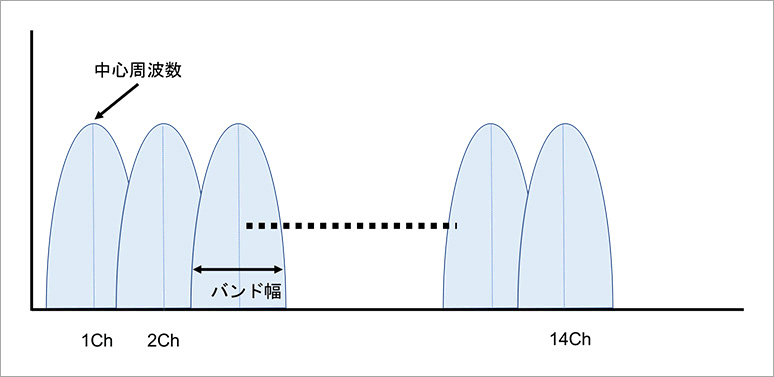
Not only Wi-Fi, but also other wireless systems have almost the same configuration, with specifications such as a large number of channels instead of a small and fragmented bandwidth. And since 2.4GHz is available all over the world, there are many protocols such as Bluetooth, Zigbee, Thread and SmartMesh.
Have you ever heard of LPWA or narrowband in recent IoT devices? This band is narrow! that is how it is. Because it is narrow, it requires less power to be transmitted, and is said to be suitable for sending small pieces of data. There are standards such as LoRa, SigFox, and NW-IoT.
Wireless technology used in IoT devices
When I thought about what would be a typical example of wireless technology for IoT devices, I think it would be the "smartphone" that is familiar to us. Products incorporating the latest standards such as LTE and 3G/4G lines for telephone functions, Wi-Fi, and Bluetooth are being introduced one after another.
Of course, the use of LTE lines for IoT devices has increased considerably, but communication charges and power consumption are a concern. As an IoT device, I think there are many usage scenes when you want to send data to a smartphone.
In that case, standards such as Wi-Fi and Bluetooth will be influential. It's become so common that it's hard to find a smartphone that doesn't have both. So, here, I will briefly explain the 2.4 GHz band wireless technology that does not require a license, such as W-Fi and Bluetooth.
Wifi
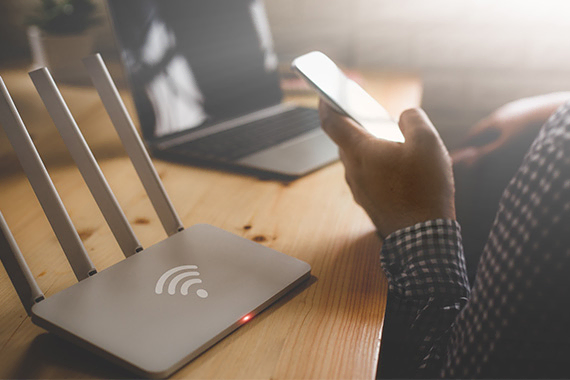
Wi-Fi is a representative method of wireless communication technology centered on 2.4GHz. As I explained in the band section, 5GHz is included in addition to 2.4GHz. It has also been standardized by IEEE and has many genealogies as IEEE802.11.x. The evolution of devices is remarkable, and efforts are being made to reduce power consumption without compromising transmission capacity, and there are many lineups from various companies.
Currently, it supports IEEE802.11b/g/n, and in terms of connectivity, it supports the most popular standard, making it very easy to use. The communication speed used to be 11 Mbps, but the latest standard is IEEE802.11ax, which exceeds 6 Gbps. Wi-Fi has become common to be installed in PCs and smartphones, and has already established itself as a complete infrastructure.
Bluetooth
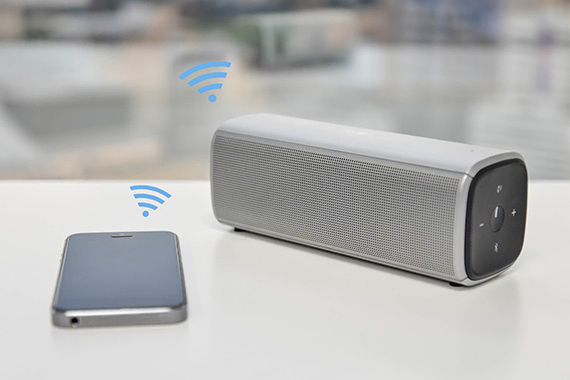
Bluetooth, like Wi-Fi, is a representative method of wireless communication technology centered on 2.4GHz.
As the version goes up, the usability has also improved. Bluetooth Low Energy (BLE) has appeared as a standard similar to Bluetooth 4.0, and the number of compatible smartphones has increased at a stretch. Wireless communication for IoT devices has become so common that it can be called BLE.
Bluetooth is also used in various computer peripherals, and while there are many more examples of adoption, there are also compatibility issues such as poor connection.
In addition, it is known that BLE is slightly different between Android system support and iOS system support.
Bluetooth is simple and easy to use, so I have the impression that you have to make a smartphone application well. Bluetooth modules and evaluation kits are also available. Starting with an evaluation kit, you can explore various protocols and Bluetooth.
Zigbee
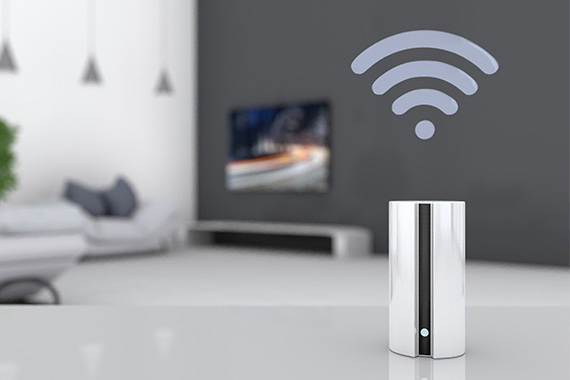
Zigbee is a wireless communication method centered on 2.4GHz, similar to Wi-Fi/Bluetooth. Appeared around 2003-4. Even now, it is used in many situations, and is a powerful communication method for systems that do not send or receive data to smartphones.
It is a wireless standard that is very compatible with home automation lighting control and smart locks, and the market has been very active, such as the appearance of AI speakers equipped with Zigbee hubs as standard last year.
Compared to Bluetooth and Wi-Fi, the transfer speed is lower, but the lightweight data communication method is very popular. Recently, there are some that can configure mesh shapes.
Zigbee is widely used as a wireless network system for commercial equipment. It is common to use a dedicated module with a PC, and it is not installed in smartphones. In general, by using Wi-Fi and Ethernet together with gateway equipment, a method is adopted in which Zigbee network information is linked to external services.
Sub-GHz
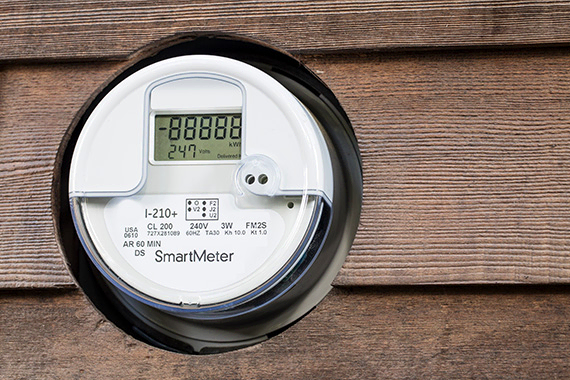
Sub-G, as the name suggests, is a communication method that performs wireless communication in the 1 GHz or lower band, and is mainly used for power meters and industrial equipment, mainly in the 920 MHz band.
Wi-SUN, which uses broadband, a group of specified low-power radios called narrowband (426/429MHz), and bands such as EnOcean (315/868/905MHz) are also included.
In Japan, it has been standardized as ARIB STD-T108 and is used as the standard for electric power meters and ECHONET lite. Although the communication speed is inferior to 2.4 GHz, it has a long range of radio waves, is resistant to reflection and diffraction phenomena, has many channels, and has gained support from business users who require a stable usage environment.
Inquiry
For companies that are considering digitizing their products and services and IoT in order to develop new markets and develop new products, we will provide easy-to-understand explanations from optimal product selection to introduction methods. I'll enjoy having this. Please feel free to contact us.