- Semiconductor BusinessHOME
- Products and Services of Macnica,Inc.
-
technical information

-
Events and Seminars
- Handling Manufacturer
- Support
- Inquiry
- Click here to purchase products
- Semiconductor business e-mail magazine registration

There are various types of sensors that can perform non-contact detection, such as infrared, magnetic, and optical sensors. It is difficult to introduce all of them, so this time, we will focus on three sensors: ultrasonic sensors, capacitive sensors, and inductive sensors, and introduce the sensor detection principles and what each sensor can detect.
ultrasonic sensor
Ultrasonic sensors measure using a technology called TOF. TOF (Time of Flight) is a method of measuring the time it takes for an emitted object to be reflected by an object and returned to the object, thereby measuring the distance. Light and ultrasonic waves are typical examples of emitted light.
Advantages of ultrasonic sensors
- Not affected by color
- Able to detect a wide range of objects
- Insensitive to dust and dirt

capacitance sensor
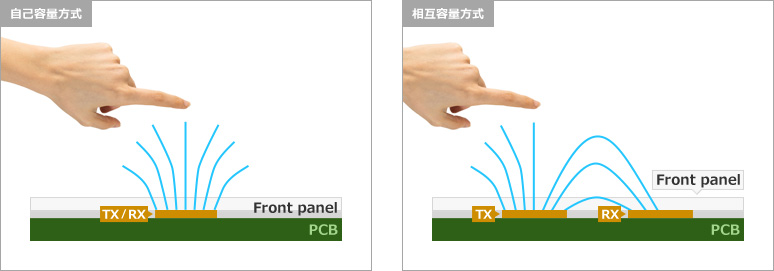
A capacitance sensor measures the change in dielectric constant caused by the approach of another substance (object) to the capacitance formed between a conductive substance (metal, etc.) and the ground as a change in capacitance. A sensor that captures
Capacitance sensors have two types of detection methods: the self-capacitance method and the mutual capacitance method.
Advantages of capacitive sensors
- Capable of detecting all types of materials, including conductors and insulators
- Not only PCB but also conductor can be used as a sensor depending on the mechanism design method.
inductive sensor
An inductive sensor (inductive proximity sensor) is a proximity sensor that uses the principle of mutual induction.
When a high-frequency signal is supplied to the sensor coil, an electromagnetic field is generated around the coil. When a metal/conductor approaches there, eddy currents flow on the surface of the detection target, and the inductance of the coil changes due to the principle of mutual induction. This change is read by an inductive sensor.
Advantages of inductive sensors
- Only reacts to metals/conductors
- Insensitive to dust and dirt

What can be detected by ultrasonic sensors, capacitive sensors, and inductive sensors
The table below shows what can be detected by inductive sensors, capacitive sensors, and ultrasonic sensors.
|
what can be detected |
ultrasonic sensor |
capacitance sensor |
inductive sensor |
|
angle |
- |
- |
○ |
|
Presence or absence of objects (collision avoidance, gesture recognition, position detection, etc.) |
○ |
○ |
○ |
|
Distance |
○ |
○ |
○ |
|
Flow rate |
○ |
- |
○ |
|
Liquid surface |
○ |
○ |
- |
|
touch |
- |
○ |
○ |
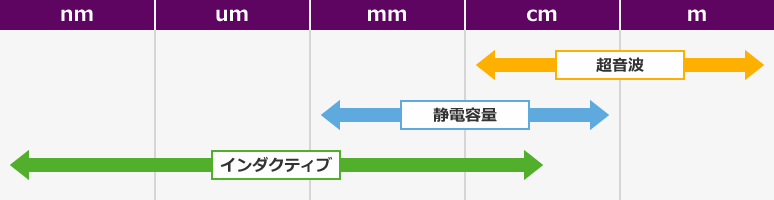
Regarding the distance, it is generally said that it is good to select the distance from the target.
Since the distance that can be measured varies for each of the three types of sensors, it is necessary to select one according to the application to be developed.
In addition, it is necessary to select which sensor to use after determining the specifications of the application.
For example, here are just a few of the items:
- Range of detection
- Accuracy of measurement
- size
- How to install the sensor
- Environment where the sensor is installed
From this information, the strengths and weaknesses of each sensor become clear, so we will narrow it down.
For representative applications of each sensor, please see the video released by the semiconductor manufacturer.
Demonstration video of object detection using capacitive sensors
The first half of this video introduces the advantages of capacitive sensors. In the second half, we will use the evaluation board of the capacitive sensor to demonstrate how to bring your hand closer to the sensor and how to detect people. The demo starts at 2:13.
Demonstration video of liquid level/liquid detection using ultrasonic sensor
This video explains how to measure time of flight (TOF) using ultrasound before introducing the demo. The actual demonstration will perform liquid level measurement and liquid identification of water and water with alcohol added.
Demonstration video of touch detection using inductive sensor
First, we will introduce the features of the inductive sensor and the device used in this demonstration.
The demo is a demonstration of pressing a metal button using a board with a touch coil. The demo starts at 1:08.
Inquiry
For companies that are considering digitizing their products and services and IoT in order to develop new markets and develop new products, we will provide easy-to-understand explanations from optimal product selection to introduction methods. I'll enjoy having this. Please feel free to contact us.