- Semiconductor BusinessHOME
- Products and Services of Macnica,Inc.
-
technical information

-
Events and Seminars
- Handling Manufacturer
- Support
- Inquiry
- Click here to purchase products
- Semiconductor business e-mail magazine registration


 Narrow down by specifying conditions
現在2237件がヒットしています。check
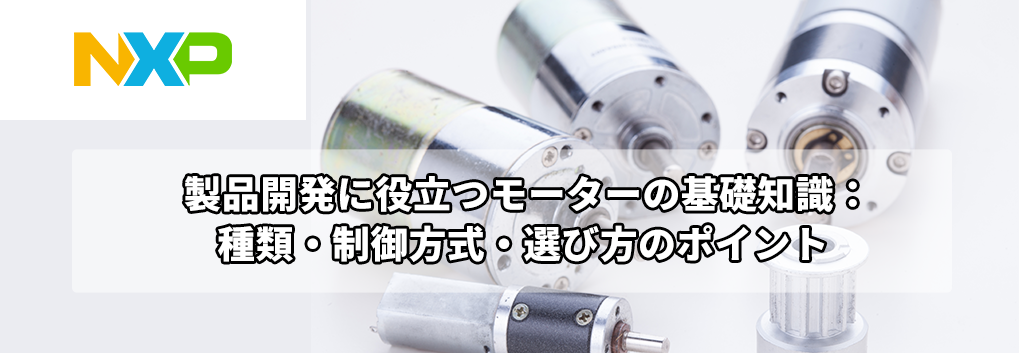
Introduction: Why is understanding motors necessary for product development?
Many motors are working invisibly around us. Motors are the core element that generates "motion" in all kinds of products, including home appliances, industrial equipment, medical devices, automobiles, and robots. When selecting a motor during product development, you often come across questions such as:
What types of motors are there?
How does each motor work?
"Which motor is suitable for our product?"
What kind of control is needed to operate the motor?
To answer these questions, a basic understanding of motor types, structures, and control methods is essential. In particular, in recent years, there has been an increase in situations where high motor efficiency and high-precision control are required, and there are many cases where simply "it just works" is not enough.
This article provides an easy-to-understand explanation of the following points, with the aim of enabling beginners to motor control to determine which motor to use and what type of control is required in the product development field.
・ Basic structure and operating principle of a motor
・ Main motor types and their features
・ Differences in motor control methods
・ Motor selection in product development
Let's start by deepening our understanding of the basics: "What is a motor?"
What is a motor? Basic structure and operating principle
A motor is a device that converts electrical energy into rotational motion. It is a core component that gives motion to products, and is responsible for a variety of operations such as turning fans, moving arms, and rotating wheels.
Basic structure of a motor
Although the detailed structure varies depending on the type of motor, the basic components are the same.
| Components | role |
| Stator | Located on the outside of the motor, it contains electromagnets and coils that generate a magnetic field. |
| Rotor | The rotating part at the center of the motor, containing permanent magnets and conductors. |
| shaft | The shaft rotates together with the rotor and transmits power to the outside. |
| bearing | Smoother shaft rotation and reduced friction. |
*Motors generate rotational force (torque) through the interaction of a magnetic field and electric current.
Mechanism of rotation: movement by electromagnetic force
Motor rotation is generated by electromagnetic force (Lorentz force*). Simply put, when current flows through a coil, a magnetic field is generated, and this magnetic field acts on the rotor, causing it to rotate.
*Lorentz force: A phenomenon in which a force acts on a conductor when a magnetic field is applied to the conductor through which current flows. This force is one of the principles that generates motor rotation.
Example: Basic operation of a DC motor
1. A magnet fixed to the stator creates a magnetic field.
2. When current flows through the rotor coil, a force is generated by interaction with the magnetic field.
3. This force causes the rotor to rotate.
4. Continuous rotation is possible by switching the direction of the current according to the rotation.
Elements necessary for motor operation
To run a motor, three elements are required:
1. Power supply: Direct current (DC) or Alternating current (AC)
2. Control circuit: Controls the flow of current and adjusts the speed and direction of rotation
3. Load: The object that the motor drives (fan, wheel, arm, etc.)
Main types and characteristics of motors
There are many different types of motors, each with different structures, operating principles, control methods, and suitable applications. When developing a product, it is important to select the optimal motor for the purpose. Here, we will clearly explain the differences in characteristics and applications for five common types of motors.
DC brushed motor
■ Features
・Simple structure that rotates just by connecting the power
・Rotation speed can be controlled by voltage
・The direction of the current is changed using brushes* and a commutator
*Brushes: Contact parts that allow current to flow through the rotating part (rotor) inside the motor. They wear out and need to be replaced periodically.
■ Benefits
- Easy to control and inexpensive
・Suitable for small devices
■ Disadvantages
・Limited lifespan due to brush wear
- Noise and sparks are likely to occur
■ Main uses
- Toys, power tools, small fans, simple drive devices
Brushless DC motor (BLDC)
■ Features
・Current is switched using an electronic circuit, without using brushes.
-High efficiency -Long life -Low noise
■ Benefits
・Maintenance-free
・Supports high speed rotation and high precision control
■ Disadvantages
・Complicated control circuit (requires sensors and microcomputers)
■ Main uses
・Drones, home appliances (air conditioners, refrigerators), electric bicycles, EVs
Stepping motor
■ Features
・Rotates at a fixed angle in a "jerky" manner
・Position can be controlled with pulse signals
■ Benefits
・Open loop control is possible (no sensors required)
・Good at high-precision positioning
■ Disadvantages
- Torque is weak, and there is a risk of step-out*
・Not suitable for high speed rotation
*Step-out: A phenomenon in which a stepping motor does not move correctly to the specified position, resulting in a misalignment of its operation.
■ Main uses
・Printers, 3D printers, medical equipment, measuring equipment
AC induction motor
■ Features
- Robust motor that runs on commercial AC power
・Current is induced in the rotor* to rotate it
*Induction: A mechanism in which current flows naturally through the rotor due to the magnetic field of the stator. Current is generated without contact.
■ Benefits
- Simple structure and high reliability
-Suitable for high power and long-term operation
■ Disadvantages
・Starting torque and speed control require ingenuity
- Not suitable for high precision control
■ Main uses
・Pumps, fans, compressors, factory equipment
Servo motor
■ Features
・Position, speed, and torque can be controlled with high precision
- Built-in feedback mechanism (encoder*, etc.)
*Encoder: A sensor that detects the rotational position and speed of a motor. It provides feedback to the control circuit.
■ Benefits
・High speed and high precision operation possible
・Ideal for robots and automated equipment
■ Disadvantages
・Expensive and complex to control
・Special drivers and control circuits are required
■ Main uses
- Industrial robots, CNC machines, FA equipment, medical robots
Check out the motor types and features in a list
|
Motor Type |
Ease of control |
accuracy |
cost |
Main Applications |
|
DC motor |
◎ (Easy) |
△ |
◎ (cheap) |
Small equipment, toys |
|
BLDC motor |
○ (control circuit required) |
○ |
○ |
Home appliances, EVs, drones |
|
Stepping motor |
○ (simple control) |
◎ |
○ |
Positioning Devices |
|
AC induction motor |
△ (needs improvement) |
△ |
◎ |
Factory equipment, pumps |
|
Servo motor |
△ (complex) |
◎ |
△ (expensive) |
Robots, FA equipment |
Differences in motor control methods
Some motors will rotate simply by connecting them to a power source, but in product development, control is required according to the purpose. For example, it is important to select a control method that matches the product specifications, such as "adjusting the rotation speed," "stopping it at an accurate position," or "maintaining constant torque." Here, we will organize the most common control methods in an easy-to-understand manner for beginners.
Voltage control/PWM control
Voltage control is a method of adjusting the rotation speed by changing the voltage applied to the motor. With DC motors in particular, the higher the voltage, the faster the motor will rotate, and the lower the voltage, the slower it will rotate. PWM control (Pulse Width Modulation)* is a method of adjusting the average voltage by repeatedly turning the power on and off at high speed, rather than changing the voltage directly.
*PWM: A technology that adjusts the rotation speed of a motor by changing the ratio (duty ratio) of the power supply's ON time to its OFF time.
Its features include:
・Simple and inexpensive control method
- Widely used in small motors and fans
Open-loop control and closed-loop control
Open-loop control is a method of simply issuing commands to a motor to operate it without checking its actual movement. It is often used with stepping motors. Closed-loop control is a method of detecting motor movement with a sensor (encoder, etc.) and comparing the command with the actual movement to make corrections. It is used with servo motors and in situations where high-precision control is required.
Its features include:
・Closed loop is highly accurate and reliable
・Open loop is easy to configure and reduces costs
Field-Oriented Control (FOC)
This is an advanced control method that efficiently generates torque by controlling the direction (vector) of the magnetic field inside the motor in real time. It is mainly used in BLDC motors and AC motors.
*FOC: A control method that realizes efficient rotation by treating the direction of the motor's magnetic field as a vector and flowing current in the optimal direction.
The features include the following:
- Highly efficient and highly accurate torque control is possible
・Suitable for products that require high performance, such as EVs and industrial equipment
・High processing power is required for control circuits and microcomputers
The choice of control method depends on the application
|
Control Method |
Control Method |
cost |
Main Applications |
|
Voltage control/PWM |
△ (simple) |
◎ (cheap) |
Small equipment, fans |
|
Open Loop |
○ (medium accuracy) |
○ |
Positioning, simple control |
|
Closed Loop |
◎ (High precision) |
△ (expensive) |
Robots, FA equipment |
|
Field Oriented Control (FOC) |
◎ (high efficiency) |
△ (high functionality but development load required) |
EV, industrial equipment |
Motor selection in product development
Once you understand the types of motors and their control methods, the next step is to consider which motor is best suited to your product. Motor selection has a significant impact on product performance, cost, and reliability, so it is important to make this decision at the early design stage.
Selection points according to application
The required motor characteristics vary depending on the product's purpose and usage environment. Below are some typical selection criteria.
|
Use/purpose |
Suitable motor |
reason |
|
I want to control the position accurately. |
Stepping motors, servo motors |
Highly accurate positioning is possible |
|
I want to operate it for a long time and under high load. |
AC induction motor |
Robust and durable |
|
Emphasis on quietness and efficiency |
BLDC motor |
Low noise and high efficiency |
|
I want to keep costs down |
DC motor, AC induction motor |
Simple structure and low cost |
|
Need for compactness and space saving |
BLDC motor, DC motor |
Compact design possible |
Design checkpoints
When selecting a motor, the following design conditions must also be taken into consideration:
- Required torque and rotation speed
→ How much force and how fast does the product need to move?
・Control complexity
→ Is open loop sufficient, or is feedback control required?
・Power environment
→ DC or AC power supply, are there any restrictions on voltage and current?
- Tolerance of noise, heat and vibration
→ An important factor for medical equipment and products that require quiet operation
- Size and weight restrictions
→ Affects the installation space and overall product weight
Motor selection is a balance between specifications and control
A motor should not be selected on its own, but rather should be optimized in combination with the control method and peripheral circuits. For example, BLDC motors are high performance, but the control circuits are complex, so the selection of the microcontroller and driver must also be considered as a set.
The product's life cycle and maintainability also influence your selection. Consider factors such as "long life," "maintenance-free," and "ease of replacement" depending on how the product will be used. When selecting a motor, it is important to work backwards from the product's purpose, such as "what kind of movement is required," "in what environment will it be used," and "how much control do you want?" Understanding the motor type and control method, and then making a comprehensive judgment based on product specifications, control complexity, cost, reliability, and other factors, will lead to the optimal selection.
Summary: Understanding motors is the first step in design
Motor control design is not just about "moving" something, but about selecting technologies to achieve the movement, performance, and reliability that match the product's purpose. As a first step, understanding the types of motors and their control methods is a very important foundation.
In this article, we have outlined the basics of motors in the following order:
・Motor structure and operating principle
・Representative motor types and features
・Differences in control methods and how to choose
・Concepts for selecting motors in product development
Understanding these will equip you with the ability to select the best motor for your product and determine the necessary control method. Beginners in particular should now have a foundation to confidently answer the question, "What kind of motor should I use?"
Inquiry
If you have any questions regarding this article, please contact us below.
NXP Semiconductors Manufacturer Information Top
NXP Semiconductors Manufacturer Information If you would like to return to the top page, please click below.