- Semiconductor BusinessHOME
- Products and Services of Macnica,Inc.
-
technical information

-
Events and Seminars
- Handling Manufacturer
- Support
- Inquiry
- Click here to purchase products
- Semiconductor business e-mail magazine registration


 Narrow down by specifying conditions
現在2189件がヒットしています。check


Nice to meet you, I'm Duck, who is learning electronic circuits from scratch every day.
The other day, during a training session, a senior colleague told me:
Senpai: “You understand combinational and sequential circuits, don’t you?”
Duck: "Are there flip-flops?"
Senpai: “Well, I agree, but whether or not the data is retained is important.”
Duck "(Hold??)"
So, let's think about the difference between combinational and sequential circuits.
This time, we take a 2-bit addition circuit and a D-flip-flop as examples of each.
I checked the difference in behavior.
Examples of digital circuits
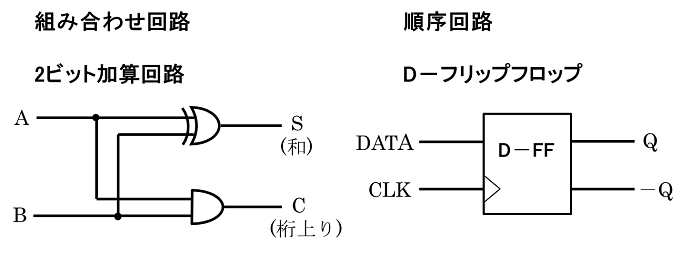
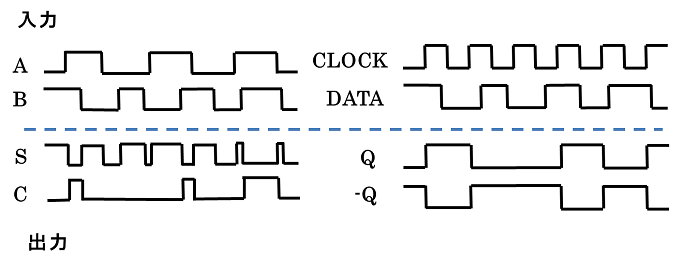
Check the output against the input in each circuit in the form of a timing chart.
Timing chart
|
For input data (A, B) |
The input data (DATA) is |
As mentioned above, the output of the D-flip-flop does not change except when the clock rises. After that, it continues to output past data at the rising edge of the clock.
Indeed, it is a holding circuit because it can reflect the past state in the current output.
Summary
Combinational circuit: The output changes as soon as the input data changes
→ output depends only on the current input
Sequential circuit: The output of input data does not change until the rising edge of the clock
→ past input can be reflected in output
as a side note
Sequential circuits can also contain combinational circuits, such as the circuit below.
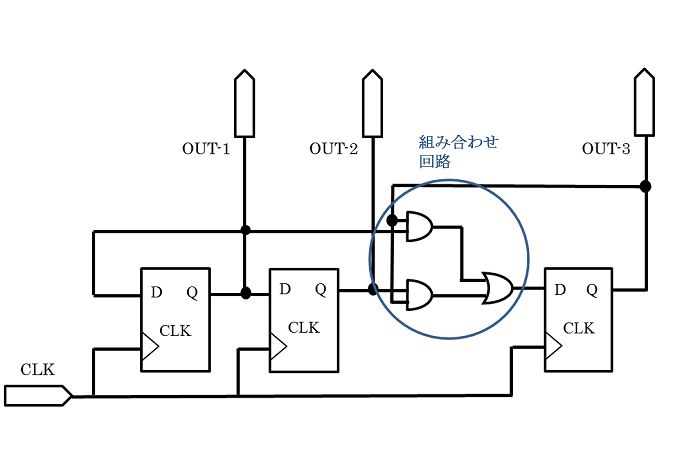
A synchronous circuit cannot be made without a sequential circuit. Since synchronous circuits are the basis for FPGA design, this sequential circuit is important.
Synchronous circuits and asynchronous circuits are explained in detail in related articles, so please refer to them.