- Semiconductor BusinessHOME
- Products and Services of Macnica,Inc.
-
technical information

-
Events and Seminars
- Handling Manufacturer
- Support
- Inquiry
- Click here to purchase products
- Semiconductor business e-mail magazine registration


 Narrow down by specifying conditions
現在2176件がヒットしています。check
![[Manufacturing DX] IoT visualizes the availability of inspectors, reducing minor stoppages and downtime!](/business/semiconductor/articles/145731-top_rewrite.png)
"We want to call an inspector, but we don't know who is available."
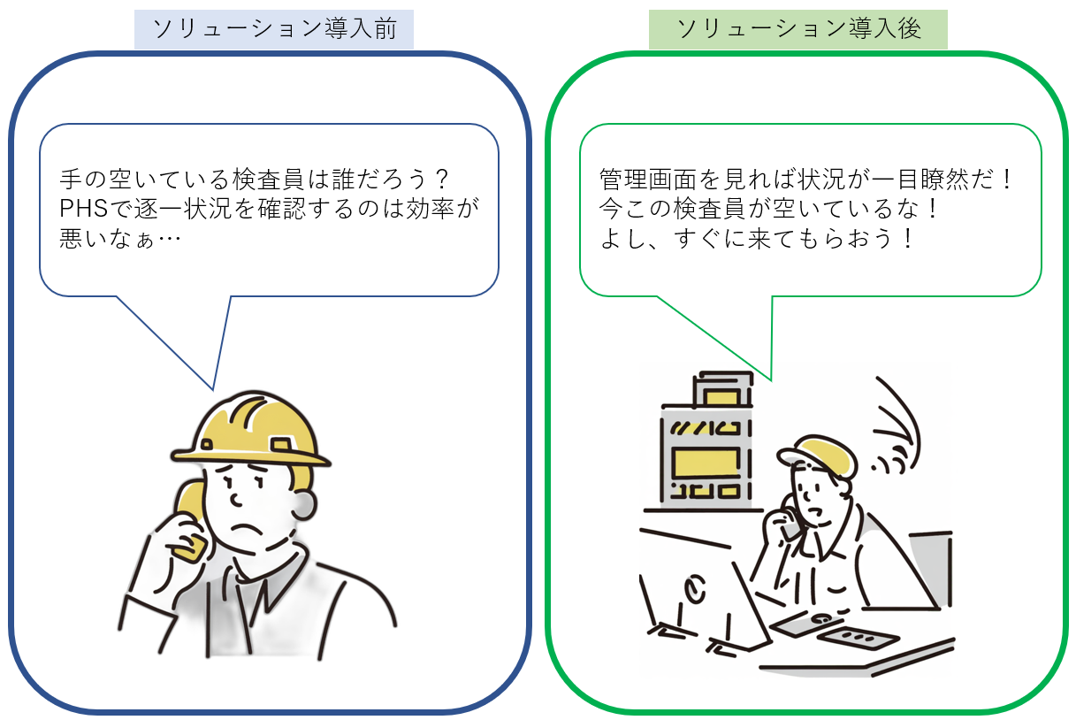
"If we had to check each person individually using their PHS (Personal Handy-phone System), it would take several minutes just for that."
The frequent occurrence of "time spent searching for and waiting for the person in charge" on-site is a major factor in reducing factory utilization rates. This article introduces a case study of how a major pharmaceutical company's factory implemented "visualization of availability using BLE beacons," which reduced the time required to dispatch inspectors from several minutes to just a few seconds. We will explain in detail everything from the background of the problem to the system configuration and the effects of implementation.

"Where is that inspector now?" The problem of finding people in manufacturing plants.
In manufacturing plants, there are many situations where "people with specific skills" are needed for quality control and equipment maintenance. However, it's often unclear whether those people are currently available. This is a common challenge faced by many factories.
Specifically, the following situations occur on a daily basis:
- The equipment briefly stopped (temporarily), but the maintenance staff are searching around because they don't know where it is.
I want to call an inspector, but I don't know who is available.
- When I called using my PHS phone, I got the message, "We are currently handling a LINE call." I tried contacting the next person in charge, but I couldn't get through either.
According to a survey by the Ministry of Economy, Trade and Industry, the number of people employed in the manufacturing sector has decreased by approximately 1.57 million over the past 20 years (2002-2021), making it an urgent issue for all manufacturing companies to efficiently operate factories with limited personnel.
Case study at pharmaceutical company K: Proof-of-concept system delivered within one month of initial consultation.
[Company Profiles]
| Industry | Consumer goods manufacturer (broadly developing cosmetics, daily necessities, food products, and pharmaceuticals) |
| Implementation locations | Packaging and inspection process in a pharmaceutical factory |
| Employee size | The group as a whole has approximately 2,000 employees. |
| Task | The availability of inspectors could not be determined in real time, which caused delays in scheduling. |


The challenge faced: Inefficient method of "finding inspectors one by one using PHS (Personal Handy-phone System)".
Company K is a major consumer goods manufacturer that handles cosmetics, daily necessities, food products, and pharmaceuticals. At their pharmaceutical factory, inspections by inspectors are required during the packaging process, but previously, the procedure involved "calling each person individually using a PHS (personal handy-phone system) to check their availability."
This method had the following structural problems:
- Often, there was no answer when I called, so I had to call the next inspector.
- It sometimes took several minutes to find an available inspector after multiple attempts.
- During that time, the manufacturing line process stopped, and productivity decreased.
- On the inspectors' side, it had become commonplace for important inspections to be delayed simply because they couldn't answer the phone.
The manufacturing department representative at Company K said, "Checking each person's status individually using PHS (Personal Handy-phone System) had its limitations. We wanted a system that would allow us to see everyone's status in real time."
IoT Solution: Visualizing Operation with BLE Beacons and Cloud
The mechanism is simple.
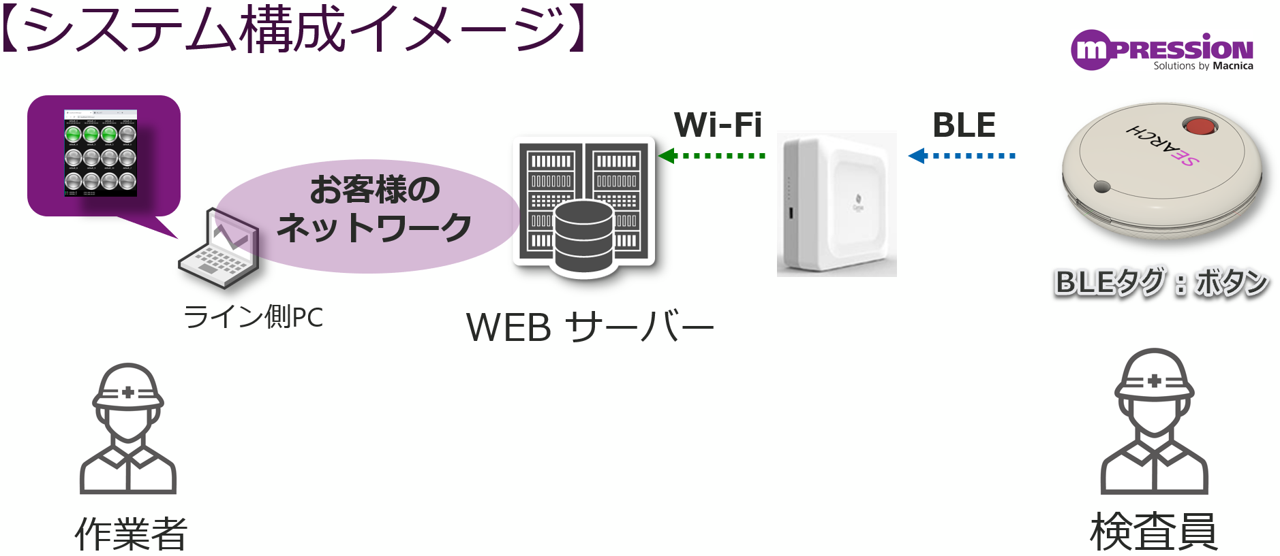
- Inspectors and maintenance staff carry small Bluetooth-enabled buttons (BLE tags).
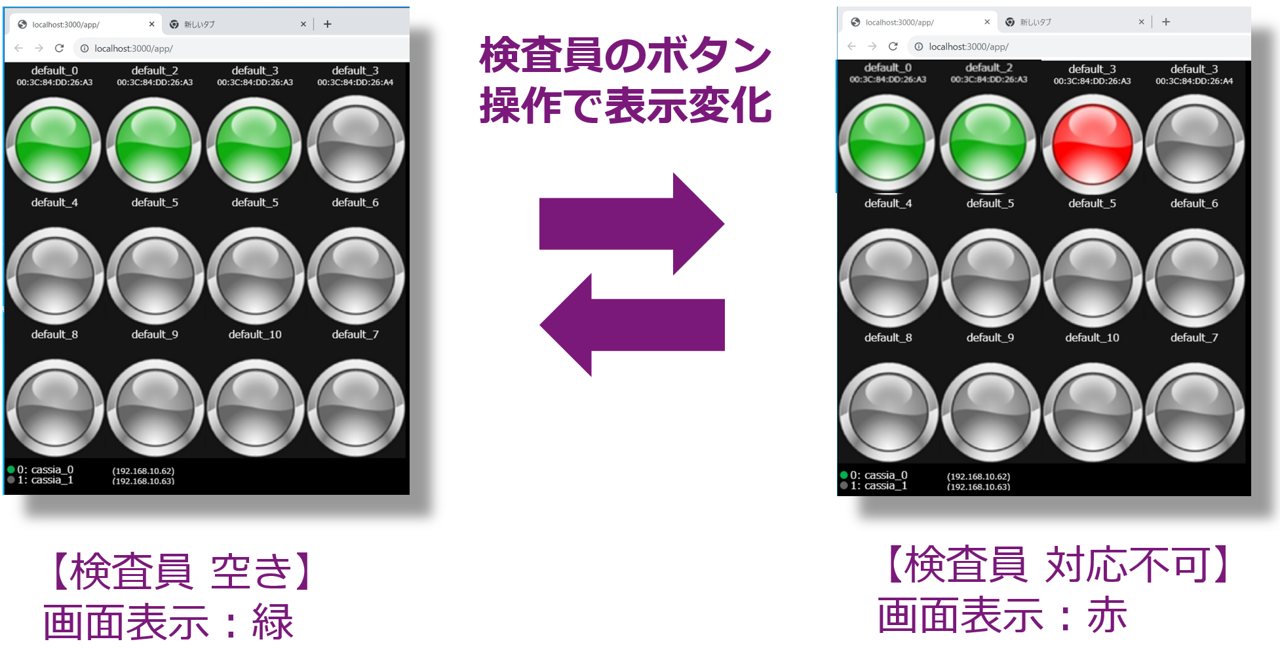
- Press the button to change the status when you have free time (Green = Available, Red = Unavailable).
- Gateways in each area collect signals and send them to the web server.
- The browser app on the LINE PC displays everyone's availability in real time.
The key feature is the creation of an independent network that does not rely on the internet. Because factory information is not shared externally, it offers peace of mind in terms of information security. Its design makes it easy to implement even in industries with strict information management requirements, such as pharmaceutical factories.
Key points and results of implementation
The following benefits were achieved by implementing this solution:
|
item |
Before implementation |
After implementation |
|
How to arrange for inspectors |
Each person makes a phone call using a PHS phone. |
Check everyone's availability on the screen. |
|
Time required for arrangements |
Several minutes (multiple attempts to call back) |
A few seconds (just look at the screen) |
|
Information Security |
PHS call (standard) |
An independent network not connected to the internet |
|
From consultation to delivery |
— |
Approximately one month (including hardware and cloud services) |
Reasons why delivery was possible in about one month from the initial consultation
This solution allowed us to deliver a proof-of-concept system, including both hardware and cloud services, in a remarkably short period of approximately one month from the initial consultation.
This was possible because Macnica, as "Manufacturing Consulting (MonoCon®)," has a system in place to provide hardware design, cloud development, and system integration—all services cultivated through semiconductor technology—in a one-stop manner. They can also flexibly respond to challenges such as "there are no suitable off-the-shelf products" or "there is no know-how to connect sensors and the cloud."
|
method |
Initial cost |
Real-time |
Security |
Implementation period |
|
PHS(current) |
low |
✖ |
standard |
― |
|
BLEbeacon(this solution) |
During ~ |
◎ |
◎ (Independent Network) |
Approximately one month |
|
Camera-type AI |
high |
◎ |
△ (Video data) |
3-6 months |
Potential applications in various fields, not just pharmaceutical factories.
This solution can be deployed in any industry where there is a need for other members to be able to see the availability of personnel with specific skills in real time.
▼Utilization scenarios by industry
|
Applicable industries and work sites |
Challenges and Needs |
Expected effects |
|
Various manufacturing factories/food factories |
Operational management in processes requiring human visual quality inspection. |
Real-time monitoring of inspector availability reduces call waiting times. |
|
Construction and civil engineering work sites |
Assignment management of workers with special qualifications and skills |
Immediately verify the presence of site supervisors and qualified personnel. |
|
Agricultural facilities and plant factories |
Wide-area management by a small staff |
Understanding staff locations and operational status within large facilities. |
|
Hospitals and nursing care facilities |
Management of the response status of doctors, nurses, and caregivers |
The status of attending to patients/on standby is centrally managed at the nurses' station. |
|
cram schools and educational facilities |
Sharing of instructors' teaching and consultation status |
Instructors can monitor students' comprehension status in real time and flexibly adjust lessons accordingly. |


Frequently Asked Questions (FAQ)
Q. What is the estimated cost of implementation?
A. While it varies depending on the scale and number of participants, it is possible to start with a proof-of-concept (PoC) experiment. In the case of Company K, we were able to implement a proof-of-concept system, including both hardware and cloud, at a low cost in about one month from the initial consultation. Please feel free to contact us for more information.
Q. Our factory has strict security regulations; can we still implement this system?
A. Yes. This solution is built on an independent network that does not use the internet, so factory information will not be leaked externally. It can be implemented with confidence even in environments with strict information management, such as pharmaceutical factories.
Q. Can it be used by on-site staff who are unfamiliar with IT?
A. Yes. Maintenance personnel and inspectors only need to "press a button." No dedicated app installation or smartphone operation is required. Field workers only need to view the dashboard in a web browser, so everyone can use it regardless of their IT literacy.
Q. How long does the implementation process take?
A. For small-scale proof-of-concept experiments, we have a track record of delivery in approximately one month. Macnica can handle everything from hardware design to cloud development in a one-stop service, enabling faster delivery than other companies.
Summary: The first step in solving factory labor shortages with IoT.
The labor shortage in factories cannot be solved simply by "increasing the number of employees." The key is how to efficiently utilize the personnel that are currently available. As in the case of Company K, simply making "who is available" visible can dramatically change the efficiency of the workplace.
Macnica 's "Manufacturing Consulting (MonoCon®)" provides end-to-end support, from proof-of-concept testing to full-scale implementation, with customized solutions tailored to our customers' challenges.
Please feel free to contact us even if your only question is, "Can this be used in our factory?"