- Semiconductor BusinessHOME
- Products and Services of Macnica,Inc.
-
technical information

-
Events and Seminars
- Handling Manufacturer
- Support
- Inquiry
- Click here to purchase products
- Semiconductor business e-mail magazine registration


 Narrow down by specifying conditions
現在2240件がヒットしています。check

Get notified when your drink runs out!
Previously, we introduced a solution for automatically managing inventory and remaining amount based on weight, but this time we used that technology to make coasters! When you are about to run out of beer or drinks at a drinking party, etc., it will shine brightly to let you know, so you don't miss the chance to get a refill!

When I'm entertaining guests, I tend to enjoy myself so much that I don't notice that the guests don't have drinks, but this gives me peace of mind! You can see it at a glance from a distance, so you don't miss the chance to suggest refills.
By the way, the refill coaster is equipped with Bluetooth, so you can instantly see which seat is about to run out of drinks from an app on your smartphone! Today we will show you how this solution was made possible.
What is restaurant DX? - Basic understanding of digital transformation
In recent years, competition has become more intense in the food and beverage industry, and various measures are required to increase sales. In particular, it is essential for restaurants such as izakayas to take steps to improve customer satisfaction.
The restaurant industry is riding a wave of major change due to digital transformation (DX). DX in the food and beverage industry is directly linked to strengthening competitiveness and improving customer satisfaction. For example, the introduction of a smart ordering system allows customers to order conveniently and stores to operate efficiently. Smart ordering systems typically use tablets or smartphones and have the advantage of allowing quick and easy ordering through an intuitive interface. This increases customer satisfaction and increases repeat business rates.
In this article, as an example of how weight sensors can be used, we will introduce a new item, the "Refill Coaster," to encourage people to order a second helping at a bar. It brings a new customer experience where you don't even need a tablet to order.
Refill coaster demo
We would like to introduce a demonstration of the prototype ``Refill Coaster,'' which clearly visualizes situations where refills are needed on the table, with the aim of increasing sales and reducing the burden on employees at restaurants such as izakaya bars.
"Okawari Coaster" is a coaster that uses LED illumination to notify staff when a drink is running low. Equipped with a weight sensor, it can measure the amount of drink. This allows us to provide smooth service without missing the timing when customers need a second drink.
Demo 1: Standby state

When on standby, the coaster glows light blue, and when you place a full glass on it, it changes to blue to indicate it's full.
Demo 2: Reducing the contents of the glass
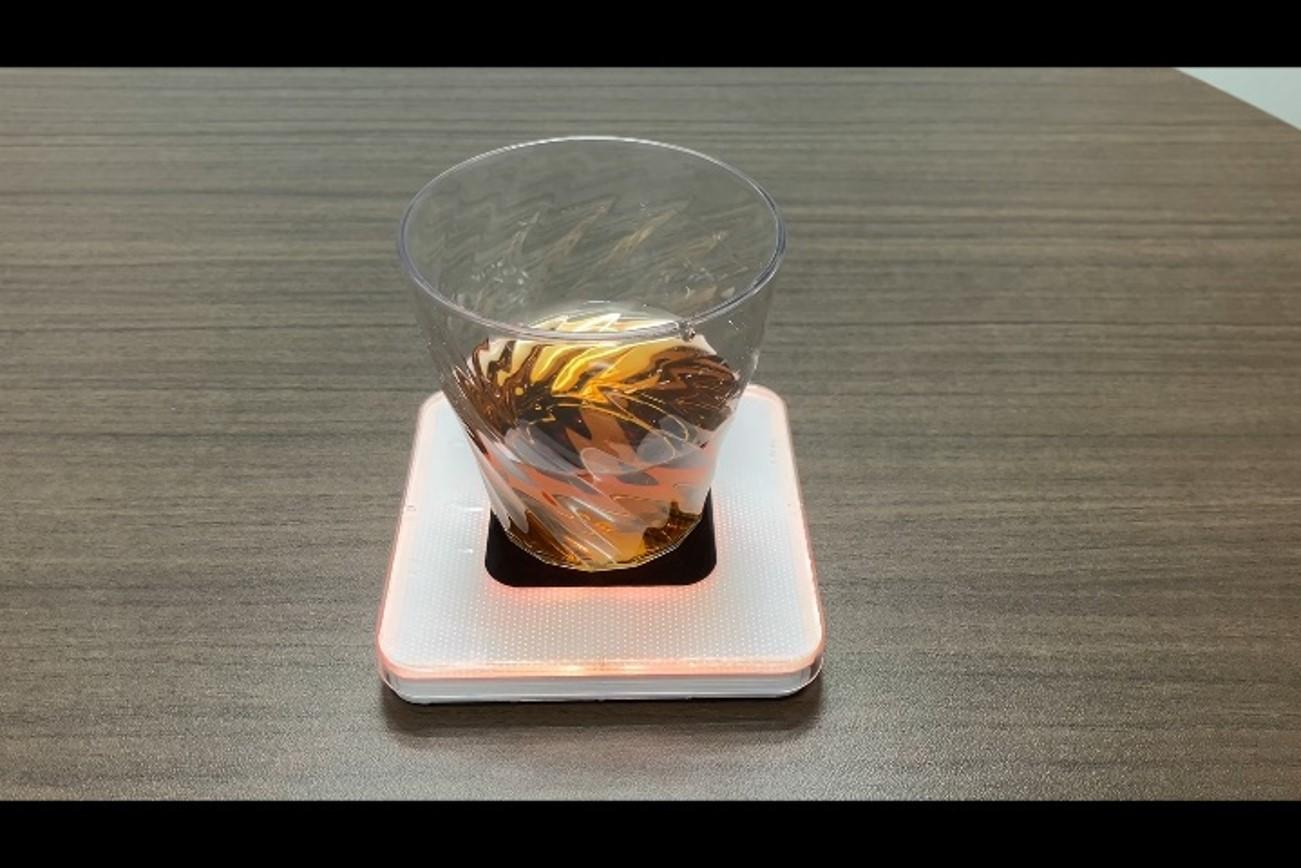
As the content of the glass decreases, it approaches the warning color. When reduced to about half, the color changed from blue to yellow.

When the contents decrease further, the light changes to red and gently flashes repeatedly to remind you to refill.
Demo 3: Changing the size of the glass
Even if you change the size of the glass, it will automatically recognize the glass and operate in the same way. Automatically identifies containers of different weights, from paper cups to beer mugs.

Demo summary
This coaster with a remaining volume detection function consists of components such as a weight sensor, a microcontroller, and LEDs. The weight sensor is placed under the coaster and detects the weight of the glass when a customer places it on it. The microcontroller analyzes the signal sent from the weight sensor and displays the remaining amount using LED illumination. Furthermore, this single device can automatically detect the remaining volume of a wide range of glass containers, from paper cups to beer mugs.
As a further possibility, this device utilizes a Bluetooth-enabled microcontroller, and with additional development, it will be possible to connect wirelessly with PCs and tablets. Further efficiency improvements can be expected by centrally managing the remaining drink levels at multiple tables using a single terminal.
Expanding applications: drinks, servers, soups, inventory
The remaining quantity detection of weight sensors isn't limited to drinks in izakayas (Japanese pubs). Based on actual inquiries received by Macnica, we'll introduce the expanding range of applications.
Drinks: Remote monitoring of remaining drinks in private rooms.
One restaurant requested a system to remotely monitor drink levels from a control room and replenish them before they run out. As they move towards automation and labor-saving measures, there is a need for a system that notifies the control room and staff terminals when the level gets low. While color detection is an option for things like coffee, transparent liquids are difficult to distinguish with color sensors, making weight-based detection a more practical solution in many cases.
Beer dispensers/drink dispensers: Never empty them.
In all-you-can-drink and self-service drink bars, when the dispenser runs out, service stops, leading to lost opportunities and customer complaints. By using a weight sensor to monitor the remaining amount and issuing a refill alert when it gets low, you can avoid having empty dispensers. For more details, please also see "Never Let Your Drink Dispenser Run Empty with a Level Sensor!"
Soups and liquids: Weight is better for ingredients and hygiene.
One facility requested remote monitoring of the remaining soup level. While there are methods to measure the liquid level using radar, in cases where ingredients are mixed, the liquid level is turbulent, or hygiene is a concern, a weight sensor (mat type) that is placed under the equipment and measures the change in weight is more straightforward. Advantages include not being affected by the shape of the liquid level and not having to touch the contents.
Inventory: Eliminate the need to "count" inventory in the back room.
Weight sensors can also be used for back-office inventory management. One business is using weight changes in mats placed on shelves to visualize inventory, track what has decreased and when in real time, and is considering threshold-based alerts, automatic ordering, and centralized management across multiple locations. Weight can reliably measure inventory even in places where cameras cannot reach or on shelves that are difficult to see into. Applications are not limited to retail; there are also requests for managing "inventory that must not run out," such as equipment for facilities.
DX strategy for restaurants with an eye on the future
By leveraging the latest technologies like AI and big data, restaurants can provide services that better meet customer needs. For example, AI can be used to analyze customer preferences and make personalized menu suggestions.
By incorporating AI into the refill coaster, it could be developed into even more unique systems, such as having people who drink at a fast pace suggest mugs or pitchers.
DX transformation is an inevitable trend for the food and beverage industry. By embracing and proactively embracing this transformation, you can expect to improve operational efficiency, increase customer satisfaction, and strengthen your long-term competitiveness. Restaurants of the future will continue to offer customers new dining experiences through a combination of technology and human touch.
Frequently Asked Questions (FAQ)
Q1. Do I need special glasses or containers?
No. The weight sensor system measures the remaining amount from the weight of the container, so a special glass is not required. The refill coaster automatically detects the remaining amount using a single unit, from paper cups to beer mugs. There is no need to prepare a special glass like with the LED light signal system.
Q2. How is this different from the camera method (AI imaging)?
The weight-based method measures the remaining amount by physical weight without using a camera. Therefore, it is less susceptible to blind spots, lighting interference, and privacy concerns, and can reliably measure even in back rooms or on shelves in hard-to-reach areas. The camera-based method is more suitable when you want to visualize the entire seating area with images; the choice of method depends on the application.
Q3. Can false detections occur when the glass is lifted be prevented?
Yes. We will handle weight changes during drinking (lifting) by distinguishing them in the design of the judgment logic. Since the threshold and filter design according to the application will affect the accuracy, we will adjust them to suit the actual situation during the PoC.
Q4. Can it be used for inventory management or beer dispensers?
Yes. It visualizes inventory based on changes in the weight of mats placed on shelves, enabling threshold-based alerts, automatic ordering, and centralized management across multiple locations. It is used in a wide range of applications, including monitoring the remaining amount of beer in beer dispensers and drink bars, in the backrooms of restaurants and other food service establishments, and for ensuring that retailers and facilities never run out of stock.
Q5. Can I try it on a small scale first? What is the cost?
Yes. We offer demo unit rentals/loans for weight sensors, allowing you to start with a proof-of-concept (PoC) on-site while keeping initial costs down. If an off-the-shelf product suffices, we can introduce it to you. If custom development is required, the cost will vary depending on your requirements, so please contact us first.
Summary
This time, I made a refill coaster for drinks as an easy-to-understand application, but there are also other uses.
- Management of remaining amount of medicine and whether or not it has been taken
- Alarm for remaining amount of liquid or powder detergent (bushes are a problem!)
- Subscription water and drink server alarm + automatic ordering by connecting to the internet
It seems like it could be used in a variety of situations.
Macnica 's Manufacturing Consulting (MonoCon®) leverages cutting-edge sensors and AI technologies to create solutions that address challenges across various industries. A refill coaster utilizing weight sensors can be an effective tool for increasing sales in restaurants. By monitoring the amount of drink remaining in customers in real time, it becomes possible to make appropriate orders and encourage refills.
If you are interested in this solution, which includes the use of weight sensors inspired by refillable coasters, please contact us.
Manufacturing consulting service
Please refer to the button below for details of our manufacturing consulting service.
Introducing other examples of DX for stores

Macnica has developed a prototype of an "AI smart shelf" that can check inventory and remaining stock using weight sensors. A video demonstrating it is available online, so please take a look.
Automatic inventory and remaining quantity management using weight sensors and IoT [For retail stores and restaurants]

We have developed a prototype of a "remaining drink amount sensor" that can efficiently replenish drinks by automatically managing them in the drink servers offamily restaurants and cafes. Functions such as low drink amount notifications can be verified in real stores.
Automatic management of remaining amount using remaining amount sensor and IoT The remaining amount sensor ensures that your drink server will never be empty!