- Semiconductor BusinessHOME
- Products and Services of Macnica,Inc.
-
technical information

-
Events and Seminars
- Handling Manufacturer
- Support
- Inquiry
- Click here to purchase products
- Semiconductor business e-mail magazine registration


 Narrow down by specifying conditions
現在2204件がヒットしています。check

Analog Devices' innovative portfolio provides digital isolation technology for data, high power isolated DC/DC converters, and communication protocols ranging from RS485, USB, and CAN to gigabit low voltage differential signaling and isolated gate drivers.
This article introduces the latest in Analog Devices' isolator products, the ADuM360N family, which has helped improve system reliability and offers improved timing performance and noise immunity.

ADuM360N Family: High-Speed, Low-Latency Digital Isolation with High Noise Immunity
The ADuM360N family of digital isolators combines high voltage resistance, high speed, low power consumption, and high reliability. In particular, its high CMTI, low latency, high data rate, and robust standard support enable it to meet the stringent requirements of industrial and automotive applications.
ADuM360N Family Features
The ADuM360N family of products offers significant improvements in timing and noise performance compared to previous products.
|
Item |
Features (benefits) |
|
High noise immunity |
- Very high common mode transient immunity (CMTI) of 180KV/μs - Resistant to radiated and conducted noise (compliant with CISPR32/EN55032 Class B) |
|
High data rates and low latency |
- Maximum data transfer speed of 150Mbps - Small propagation delay of 6.2ns (Typ.)/10ns (Max.) |
|
Low power consumption (1Mbps operation @5V) |
・1.65mA/ch |
Table 1: ADuM360N features (benefits)
Benefits of replacing conventional technologies and products
What are the advantages of using the ADuM360N family over circuits using conventional optocouplers, or over Analog Devices' second-generation isolator product, the ADuM414 family?
If your circuit uses optocouplers, a traditional isolation technology, you may not need the high speeds required by the ADuM360N isolator products. Also, if you are already using the ADuM141 family of second-generation isolators, you may already be satisfied with isolator technology.
However, I would like to check again to see if there is any benefit to replacing it with a new product.
(Advantage 1) Replacing photocouplers with isolators
The advantage of replacing photocouplers with the ADuM360N family is that it significantly reduces area (size) in addition to improving reliability and signal quality.
When comparing four channels, even when comparing only the main device size, using the ADuM360N makes it possible to reduce the size to one-fourth. When considering factors such as board size, mounting costs, and reliability (fit rate), the benefits of replacing photocouplers and using new technology are significant.
|
part size |
30mm2
|
120mm2
|
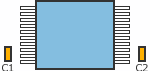
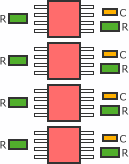
Figure 1: Solution size comparison between isolators and optocouplers
(Advantage 2) Replacement for second generation isolators
Some people may think that there are not many benefits to replacing a second-generation isolator with a third-generation isolator. Aside from the faster signal speeds and improved noise resistance, the third-generation isolator also has the advantage of supporting six channels.
As a result, in systems where two ICs were used to achieve a high channel count up until the second generation, it may be possible to get enough channels with just one IC. It may also be possible to further reduce the number of ICs used in systems that use multiple ICs.
|
Item |
ADuM360N (3rd generation) |
ADuM141E (2nd generation) |
|
number of channels |
6 |
4 |
|
package |
16-lead QSOP |
16-lead QSOP |
*In addition to the 6-channel products, the third generation also offers 4-channel products (ADUM34X series) and 2-channel products (ADUM32X series).
(Advantage 3) Improved CMTI characteristics
With each new generation, the performance of isolators improves. When comparing characteristics, the CMTI value is often used. CMTI is an index that indicates the strength of external interference (noise) that can maintain a normal state without causing the output to malfunction.
Figure 2 shows an example of operation when a very strong interference signal of 280 kV/μs is input. The output, which should normally remain high, mistakenly outputs low due to the interference signal, which is an "insufficient CMTI" condition. The CMTI value represents the maximum interference signal strength at which such malfunctions (errors) do not occur.
Therefore, the higher the CMTI of an isolator, the less likely it is to malfunction due to external noise, contributing to improved reliability of the entire system. For this reason, in designs where reliability is a priority, it is desirable to select a product with as large a CMTI as possible.

The table below compares the noise characteristics of each generation of Analog Devices isolators. It shows that characteristics improve with each generation. While some customers may think that existing devices are sufficient for their systems because they comply with standards and company regulations, it is important to consider upgrading to the latest devices to improve system reliability.
|
Item |
ADuM360N (3rd generation) |
ADuM141E (2nd generation) |
ADuM1401 (1st generation) |
|
CMTI IEC60747-17 |
180KV/μs |
75KV/μs |
25KV/μs |
|
Surge voltage IEC61000-4-5 |
16KV (peak) |
10KV (peak) |
8KV (peak) |
This article introduced the features and benefits of high-performance isolators that help improve system reliability. Analog Devices' ADuM360N isolator family products achieve high speed, compactness, and robustness on a single chip, helping customers reduce the number of components and improve system reliability.
We have evaluation boards available for each product, so please give them a try.

If you are interested, please feel free to contact us.
Click here to purchase products
Click here for manufacturer site/other related links
Inquiry
If you have any questions regarding this article, please contact us below.
Analog Devices Manufacturer Information Top
Analog Devices Manufacturer Information If you would like to return to the top page, please click below.