- Semiconductor BusinessHOME
- Products and Services of Macnica,Inc.
-
technical information

-
Events and Seminars
- Handling Manufacturer
- Support
- Inquiry
- Click here to purchase products
- Semiconductor business e-mail magazine registration


 Narrow down by specifying conditions
現在2227件がヒットしています。check

The characteristics of electronic components may change due to external force applied to them. Various electronic components are mounted on the boards of electronic devices. Normally, components are soldered and mounted on a board through a process such as reflow. The components mounted on the board are soldered, so there is no force applied to them. As the ambient temperature fluctuates, the materials used in each part have different coefficients of expansion, which slowly puts stress on the parts.
This article introduces an example of a voltage reference based on the contents of the Analog Devices application note (AN82).
About voltage references
A/D converter voltage reference
Voltage references are commonly used in A/D converters and D/A converters. When considering an A/D converter, the voltage reference value determines the reference voltage when converting the input signal to digital. Therefore, the accuracy of the voltage reference is very important because it greatly affects the accuracy of A/D conversion.
Figure 1 is a typical circuit example using the LTC1286 A/D converter. An LT1634 is used as an external voltage reference.

regulator voltage reference
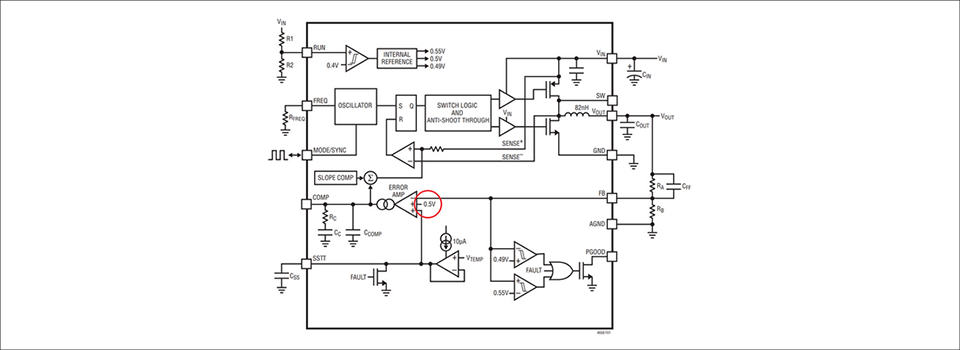
In addition to A/D converters, we will also introduce examples of products that use voltage references to configure circuits. Figure 2 is a block diagram of the LTM4658 step-down switching regulator.
The red circle of the built-in error amplifier says 0.5V, which is the internal reference voltage. The output of the regulator is stabilized by comparing this voltage with the output voltage. Therefore, the accuracy of the reference voltage is important for stabilizing the power supply voltage.
As I will discuss next, power supply products are not as affected by external stress as stand-alone reference voltage products, but I hope that you have understood that reference voltage circuits are used in a variety of circuits. Masu.
Effect of stress on electrical properties
About stress
Stress is a physical quantity that represents the amount of force that occurs inside an object. Stress occurs when temperature changes or external forces are applied. When the temperature rises, substances expand, and when the temperature falls, most substances shrink. However, because the coefficient of expansion differs depending on the material, stress is generated.
As an example, consider a temperature below 100 °C. Plastic and glass-based materials expand when the temperature rises to a high temperature of 80°C, but metals hardly expand. The parts mounted on the board have plastic parts and metal parts, so stress is generated due to the difference in expansion coefficient and affects the characteristics.
When there is a change in temperature, stress is generated not only due to the different expansion coefficients of the materials used in the board and device, but also due to the distortion of the board itself. In the next experiment, we will check the variation of the reference voltage due to substrate stress.
Effect of substrate stress
The effect of board stress can be observed by monitoring the reference output voltage while applying a bending force to the board. Mount the device (LT1460CS8-2.5) in the center of a 7" x 9" rectangular board as shown in Figure 3. Deflect the board by 18 mils per inch as shown in steps 1 through 4.
For the experiment, we prepared approximately 1/2 inch x 1/2 inch substrates with and without grooves.

Figure 4 shows the reference voltage results measured over eight cycles of flex. To measure the output voltage variation, a measuring device with ±1 count of 4ppm (10μV) peak-to-peak is used.
The measurements above are for the original circuit board without grooves and show a peak-to-peak shift of about 60ppm. The measurement results below are for a circuit board with grooves and are suppressed to approximately 4ppm. Output voltage shift is improved by a factor of 10, which reduces stress by putting grooves into the substrate.

Summary
I hope you understand that the stress on the board affects the output voltage of the reference product. From the phenomena described in this article, you can understand that electrical characteristics are affected by differences in packages, board size, temperature conditions, etc.
Please refer to this as reference products may be affected by stress in circuits that discuss minute voltages and currents, such as circuits that require high-precision output or circuits that are affected by leakage current. . For more information, please refer to Analog Devices' application note (AN82).
Click here for recommended seminars/workshops
Click here for recommended articles/materials
LTspice List of articles: Let's use LTspice series
FAQ regarding analog function IC: FAQ list
List of technical articles: technical articles
Manufacturer introduction page: Analog Devices, Inc.
Inquiry
If you have any questions regarding this product, please contact us using the form below.
Analog Devices Manufacturer Information Top
If you want to return to Analog Devices Manufacturer Information Top, please click the button below.